


Text this colour links to Pages. Text this colour links to Family Trees. Text this colour are links that are disabled for Guests.
Place the mouse over images to see a larger image. Click on paintings to see the painter's Biography Page. Mouse over links for a preview. Move the mouse off the painting or link to close the popup.
1100-1129 Henry I and the White Ship is in 12th Century Events.
On 5th August 1100 King Henry I "Beauclerc" England (age 32) was crowned I King of England by Bishop Maurice at Westminster Abbey [Map].
Anglo-Saxon Chronicle. 1100. And after this the Bishop of London, Maurice, consecrated him king (age 32); and all in this land submitted to him, and swore oaths, and became his men. And the king, soon after this, by the advice of those that were about him, allowed men to take the Bishop Ranulf of Durham (age 40), and bring him into the Tower of London [Map], and hold him there.
The Ecclesiastical History of England and Normandy by Orderic Vitalis. In the year of our Lord 1100, on Thursday, the fourth of the nones [ 20th ] of August, William Rufus was mortally wounded by an arrow in the New Forest, after having possessed the kingdom of England twelve years and nearly ten months. Thereupon Henry hastened to London with Robert earl of Mellent, and the following Sunday [5th August 1100] was placed on the throne in the church of St. Peter the apostle, at Westminster, being anointed by the venerable Maurice, bishop of London. Anselm, archbishop of Canterbury, was then an exile, as it has been already observed, and Thomas, archbishop of York, being lately dead1, that metropolitan see was still vacant. Henry was thirty years old when he ascended the throne, and his reign lasted thirty-five years and four months2. He ruled the dominions, divinely committed to him, with prudence and success in prosperity and adversity, and was distinguished among the princes of Christendom for his love of peace and justice. In his time the church of God was brilliantly endowed with wealth and honours, and all orders of the religious increased to the glory of the Creator. This is shown by the monks and clergy, who, during his reign, augmented their numbers and their dignity; this is proved in the case of anchorites, who, felling dense woods, and rearing among them the lofty spires of churches and abbeys, exult in their labours, and sing the praises of God with heart-felt peace, where once robbers and outlaws, abandoned to all wickedness, found their retreats.
Note 1. This is incorrect; the archbishop of York survived till the end of the following November. It is not even quite certain that he did not assist at the coronation of Henry I, placing the crown on his head, after the royal unction had been given by the bishop of London. At any rate the archbishop did not die till Sunday, November 28.
Note 2. In the MS. of St. Evroult the figures have been erased, and the six last words, "reigned five years and six months," interlined.
 Become a Member via our Buy Me a Coffee page to read complete text.
On 11th November 1100, three months after acceeding to the throne, King Henry I "Beauclerc" England (age 32) and Matilda of Scotland (age 20) were married. She was crowned Queen Consort England. Baptised Edith she took the regnal name Matilda. The marriage brought together the houses of Normandy and Wessex; she was a great granddaughter of King Edmund I of England. She the daughter of King Malcolm III of Scotland and Margaret Wessex Queen Consort Scotland. He the son of King William "Conqueror" I of England and Matilda Flanders Queen Consort England.
History of the Dukes of Normandy by William of Jumieges. Chapter 8.9. How Henry, his brother, succeeded him, and took Matilda, daughter of the King of Scotland, as his wife.
When King William was slain, as we have already said, his brother Henry immediately had his body carried to Winchester, and there he placed it in the church of Saint Peter, before the high altar, for burial. When he had been buried, Henry came to London, and at Westminster, with the agreement of all the Normans and the English, on the fourth day after his brother's death, he received the royal crown. Many rejoiced greatly that they now at last had a king born of a king and queen, and born and raised in England. And so that the king might live in lawful wedlock, he took that same year the venerable Matilda, daughter of Malcolm, King of Scotland, and of Margaret. What great holiness and learning, both secular and spiritual, was possessed by both queens, Margaret and Matilda, is clearly described in the book that has been written concerning their life. Nor must we omit that Matilda was betrothed to King Henry the most noble, by Anselm, Archbishop of Canterbury of holy memory, on the feast of Saint Martin [11th November 1100] at Westminster, and that on the same day she was crowned with the royal diadem. King Henry was a man endowed with many virtues: a lover of justice and peace, a friend of religion, a most zealous punisher of the wicked and of thieves, and a most fortunate conqueror not only of his enemies among powerful princes and counts, but even among renowned kings.
CAPUT X. Quod Henricus frater ipsius ei successit, qui Mathildem filiam regis Scotiæ duxit in uxorem.
Occiso itaque Willelmo rege, ut præmisimus, statim frater suus Henricus corpus ejus Wintomiam deferri fecit, ibique in ecclesia sancti Petri ante majus altare sepulturæ tradidit. Quo sepulto, Lundoniam venit, atque apud Westmonasterium, annuentibus cunctis Francis et Anglis, quarto die post mortem fratris regale diadema suscepit. Undo plurimi sunt lætati quod modo regem natum de rege et regina, natum et nutritum in Anglia habere meruissent. Ut autem idem rex legaliter viveret, duxit eodem anno venerabilem Mathildem filiam Malcomi regis Scotia et Margaretæ. Quantæ autem sanctitatis et scientiae tam sæcularis quam spiritualis utraque regina, Margareta scilicet et Mathildis, fuerint; liber qui de Vita ipsarum scriptus est, plano sermone describit. Nec illud prætermittendum quod a sanctæ recordationis Anselmo Cantuariensi archiepiscopo eadein Mathildis in festivitate sancti Martini apud Westmonasterium Henrico regi nobilissimo desponsata et eodem die regali diademate insignita est. Fuit autem rex Henricus vir pluribus virtutibus præditus, justitiæ ac pacis sectator, religionis amator, iniquorum et furum ferventissimus punitor, inimicorum suorum non solum excellentium principum et comitum, verum et nominatissimorum regum felicissimus triumphator.
Become a Member via our Buy Me a Coffee page to read complete text.
Anglo-Saxon Chronicle. [11th November 1100]. And soon hereafter the king (age 32) took him to wife Maud (age 20), daughter of Malcolm, King of Scotland, and of Margaret the good queen, the relative of King Edward, and of the right royal132 race of England. And on Martinmas day she was publicly given to him with much pomp at Westminster, and the Archbishop Anselm (age 67) wedded her to him, and afterwards consecrated her queen.
Note 132. This expression shows the adherence of the writer to the Saxon line of kings, and his consequent satisfaction in recording this alliance of Henry with the daughter of Margaret of Scotland.
In December 1101 King Henry I "Beauclerc" England (age 33) hosted his at Christmas Court at Westminster Palace [Map]. Gilbert de Clare (age 35) attended.
Anglo-Saxon Chronicle. 25th December 1100. In this year at Christmas held the King Henry (age 32) his court in Westminster, and at Easter in Winchester, Hampshire [Map]. And soon thereafter were the chief men in this land in a conspiracy against the king; partly from their own great infidelity, and also through the Earl Robert (age 49) of Normandy, who with hostility aspired to the invasion of this land.
After 25th July 1101 King Henry I "Beauclerc" England (age 33) and Robert Curthose III Duke Normandy (age 50), brothers, both sons of King William "Conqueror" I of England, signed the Treaty of Alton at Alton, Hampshire by which Robert Curthose III Duke Normandy agreed to renounce his claim to the English throne in exchange for a yearly stipend and other concessions.
Anglo-Saxon Chronicle. June 1101. Then at midsummer went the king (age 33) out to Pevensey [Map] with all his force against his brother (age 50), and there awaited him. But in the meantime came the Earl Robert up at Portsmouth, Hampshire [Map] twelve nights before Lammas; and the king with all his force came against him. But the chief men interceded between them, and settled the brothers on the condition, "that the king should forego all that he held by main strength in Normandy against the earl; and that all then in England should have their lands again, who had lost it before through the earl, and Earl Eustace also all his patrimony in this land; and that the Earl Robert every year should receive from England three thousand marks of silver; and particularly, that whichever of the brothers should survive the other, he should be heir of all England and also of Normandy, except the deceased left an heir by lawful wedlock." And this twelve men of the highest rank on either side then confirmed with an oath. And the earl afterwards remained in this land till after Michaelmas; and his men did much harm wherever they went, the while that the earl continued in this land.
On 8th January 1107 King Edgar I of Scotland (age 33) died. His brother Alexander (age 29) succeeded I King Scotland.
Anglo-Saxon Chronicle. 1107. This year died Maurice, Bishop of London, and Robert, Abbot of St. Edmund's bury, and Richard, Abbot of Ely. This year also died the King Edgar in Scotland (age 33), on the ides of January, and Alexander (age 29) his brother succeeded to the kingdom, as the King Henry (age 39) granted him.
On 30th July 1108 King Philip I of France (age 56) died. His son Louis (age 26) succeeded VI King France: Capet.
All About History Books
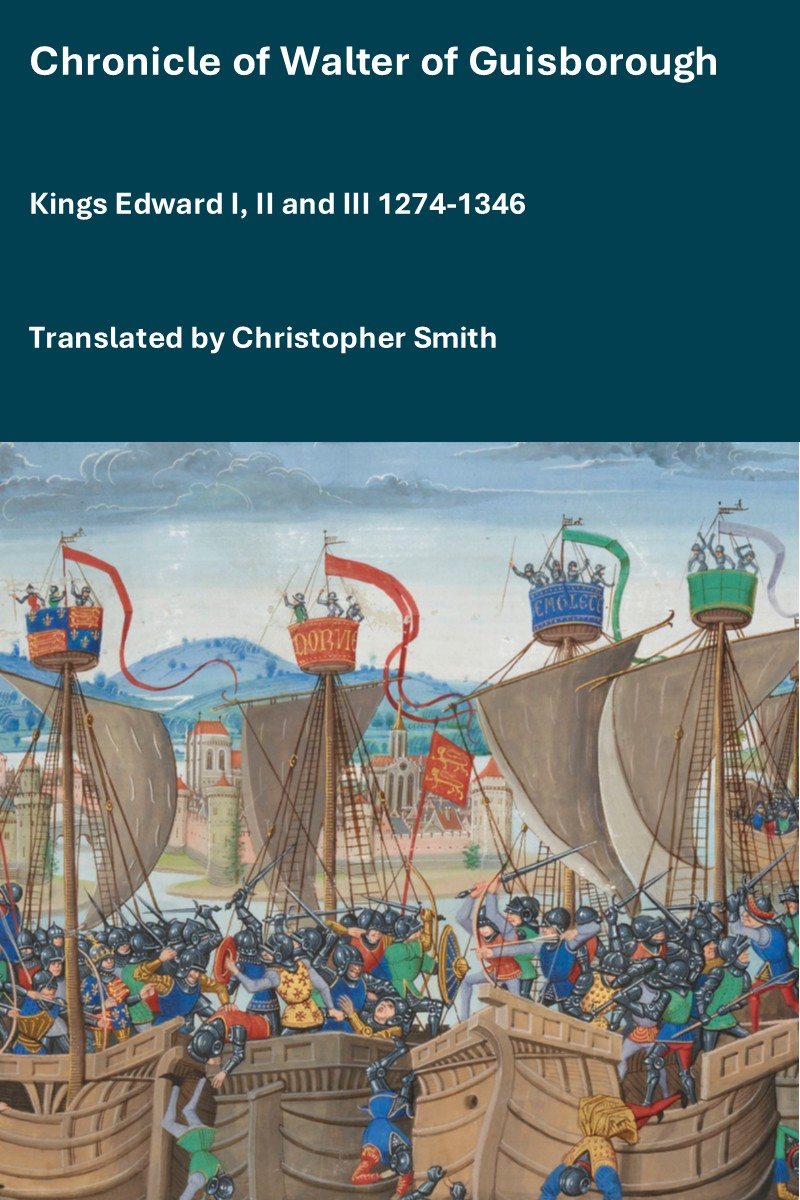
The Chronicle of Walter of Guisborough, a canon regular of the Augustinian Guisborough Priory, Yorkshire, formerly known as The Chronicle of Walter of Hemingburgh, describes the period from 1066 to 1346. Before 1274 the Chronicle is based on other works. Thereafter, the Chronicle is original, and a remarkable source for the events of the time. This book provides a translation of the Chronicle from that date. The Latin source for our translation is the 1849 work edited by Hans Claude Hamilton. Hamilton, in his preface, says: "In the present work we behold perhaps one of the finest samples of our early chronicles, both as regards the value of the events recorded, and the correctness with which they are detailed; Nor will the pleasing style of composition be lightly passed over by those capable of seeing reflected from it the tokens of a vigorous and cultivated mind, and a favourable specimen of the learning and taste of the age in which it was framed." Available at Amazon in eBook and Paperback.
Anglo-Saxon Chronicle. 1108. In this year was the King Henry (age 40) on the Nativity at Westminster, and at Easter at Winchester, and by Pentecost at Westminster again. After this, before August, he went into Normandy. And Philip, the King of France (age 55), died on the nones of August [30th July 1108], and his son Louis (age 26) succeeded to the kingdom. And there were afterwards many struggles between the King of France and the King of England, while the latter remained in Normandy.
Chronicum Anglicanum by Ralph Coggeshall. Philip, King of France, passed away, and his son Louis succeeded him. Louis had six sons and one daughter. Philip1, who was anointed as king, but suffered a tragic and unheard-of misfortune. One day, while riding through Paris, his horse was startled by a diabolical pig, causing it to fall. Philip was thrown against a stone and crushed, and he died the following night [30th July 1108]. Immediately afterward, his brother Louis was crowned by Pope Innocent at their father's request. The third son, Henry, became a monk at Clairvaux and later Archbishop of Reims. The fourth son, Robert, became Count of Dreux and father of Robert, Count of Perche, as well as the Bishop of Beauvais and the Bishop of Orléans. The fifth son, Philip, became a cleric. The sixth son, Peter, married the daughter of Reginald of Courtenay and inherited his lands.
Philippus, rex Francorum, obiit, cui successit Ludovicus filius ejus, qui genuit sex filios et unam filiam, Philippum, qui fuit inunctus in regem, de quo inauditum contigit infortunium. Cum enim quadam die per Parisius equitaret, obvio porco diabolico offensus equus cecidit, et sessorem suum ad silicem contrivit, et nocte sequenti spiritum exhalavit; et statim Ludovicus, frater ejus, ab Innocentio papa coronatur petitione patris. Tertius filius regis fuit Henricus, monachus Claravalensis, et postea Remensium archiepiscopus. Quartus Robertus comes Drocensium, pater Roberti, comitis de Perche, et episcopi Belvacensis, et episcopi Aurelianensis. Quintus filius fuit Philippus, clericus. Sextus Petrus, qui duxit filiam Reginaldi de Cortenai, cum terra ipsius. Soror istorum regis filia fuit Constantia, qure primo tradita est Eustachio comiti Boloniensi, filio regis Stephani, ac postmodum Raimundo, comiti Sancti Ægidii, quam postea repudiavit.
Note 1. Philip of France, 1116–1131, co-ruled with his father from 1129. Orderic Vitalis, Book 4, 105: "In the year of our Lord, 1129, the seventh indiction, the boy Philip was chosen by his father Philip, and crowned as king at Rheims by Reynold II, archbishop of that see on Easter day; but two years afterwards he was so severely fractured by his horse falling under him, that he died at Paris." Abbot Suger, Life of Louis the Fat, Chapter 31: "Meanwhile there occurred a singular and utterly unheard-of misfortune for the kingdom of France. For the son of King Louis, a blooming and gracious boy, Philip, the hope of the good and the terror of the wicked, one day while riding through a suburb of the city of Paris, his horse, struck by a devilish pig that crossed its path, fell heavily and crushed its rider, that most noble boy, who, thrown upon the pavement, was shattered beneath the weight of the animal. At this calamity the city and all who heard of it were stricken with consternation, for that very day he had summoned the army for an expedition, and they cried aloud, wept, and lamented. They gathered up the tender boy, nearly dead, and carried him to a nearby house; but when night came, alas, he breathed out his spirit. How great and how wondrous the grief and mourning that fell upon his father, his mother, and the nobles of the realm, even Homer himself would not have sufficed to express it. He was buried according to royal custom in the church of blessed Denis, in the royal sepulchre, to the left of the altar of the Holy Trinity, in the presence of many bishops and nobles of the realm. His wise father, after grievous lamentations and bitter complaints of a life left bereft, at last, by the counsel of religious men, allowed himself to be consoled."
On or before 17th July 1119 at the Battle of Bures-en-Bray King Henry I "Beauclerc" England (age 51) fought against the army of King Louis VI of France (age 37).
Baldwin VII Count Flanders (age 26) who was killed. His first cousin Charles (age 35) succeeded I Count Flanders. Marguerite Clermont Countess Flanders (age 14) by marriage Countess Flanders.
Anglo-Saxon Chronicle. 1119. In this same year died the Pope Gelasius, on this side of the Alps, and was buried at Clugny. And after him the Archbishop of Vienna was chosen pope, whose name was Calixtus. He afterwards, on the festival of St. Luke the Evangelist, came into France to Rheims, and there held a council. And the Archbishop Turstin of York went thither; and, because that he against right, and against the archiepiscopal stall in Canterbury, and against the king's (age 51) will, received his hood at the hands of the pope, the king interdicted him from all return to England. And thus he lost his archbishopric, and with the pope went towards Rome. In this year also died the Earl Baldwin of Flanders (age 26) of the wounds that he received in Normandy. And after him succeeded to the earldom Charles (age 35), the son of his uncle by the father's side, who was son of Cnute, the holy King of Denmark.
On 20th August 1119 at the Battle of Bremule at Gaillardbois Cressenville King Henry I "Beauclerc" England (age 51) and his son William Adelin Duke Normandy (age 16) defeated the army of King Louis VI of France (age 37) who had invaded Normandy in support of William Clito Normandy Count Flanders (age 16) who claimed the Duchy of Normandy.
Chronicon ex Chronicis by Florence and John of Worcester. 1119. Wars between Henry and Lewis
War having broke out between Henry, king of England, and Lewis, king of France1, with the count of Anjou and the count of Flanders, king Henry seized an opportunity of making a separate peace with the count of Anjou, receiving his daughter in marriage with his son William, whom he had already declared heir of all his kingdom. The count of Anjou went to Jerusalem. After this, king Henry, with the concurrence of his nobles, made peace with the king of France, on which occasion his son William was invested with Normandy, to be held of the king of France. The king also made peace with his nobles who had unjustly and treasonably revolted against him, and also with the count of Flanders. An earthquake was felt in several parts of England on Sunday, the fourth of the calends of October (28th September), about the third hour of the day.
Note 1. Our author treats very summarily of the wars between the kings Henry and Lewis, which ended in the decisive battle of Bremull or Noyon, fought on the 20th August, 1119. Ordericus gives considerable details of these hostilities in the early chapters of his twelfth book (vol. iii., pp. 446—492, of the edition in the Antiq, Lib.). See also Henry of Huntingdon's History, ibid, pp. 247, 248.
Chronicle of Henry of Huntingdon 1119. 1119. King Henry, in the fifty-second year after the Normans conquered England, and in the nineteenth year of his reign, fought a great battle with the King of France1. That king placed the first division of his army under the command of William, the son of Eobert, King Henry's brother, supporting him with the main body of his army* On the other side, King Henry posted his [Norman] vassals in the first line; the second, consisting of his household troops, he led himself on horseback; in the third, he placed his sons, with the main body of infantry. At the outset, the first line of the French unhorsed and quickly dispersed the Norman knights. It afterwards attacked the, division which Henry himself commanded, and was itself routed. The troops imder the command of the two kings now met, and the battle raged fiercely; the lances were shivered, and they fought with swords. At this time, William Crispin2 twice struck King Henry on the head, and though his helmet was sword-proof, the violence of the blow forced it a little into the king's fore-head, so that blood gushed forth. The king, however, returned the blow on his assailant with such force, that though his helmet was impenetrable, the horse and its rider were struck to the ground, and the knight was pre sently taken prisoner in the king's presence. Meanwhile, the infantiy, with whom the king's sons were posted, not being yet engaged, but waiting for the signal, levelled their spears, and charged the enemy. Upon which the French were suddenly daunted, and broke their ranks, and fled. King Henry, thus victorious, remained on the field until all file nobles of the defeated araiy were taken prisoners and brought before him. He then retiuned to Eouen, while the bells were ringing, and the clergy were chanting hymns of thanksgiving to the Lord God of hosts. This glorious victory has been thus celebrated in heroic verse:
Where Noyon's tow'rs rise o*er the plain.
And Oise flows onward to the Seine,
Two banner'd hosts in ranks advance:
Here, Lewis leads the powers of France;
Henry of England, there, commands His English and his Norman bands
See his arm the foremost crush.
The island spearmen onward rash;
While the bold chivalry of France
Recoils before the Norman lance;
And mattered oaths reveal their shame,
As they curse the conqueror's name.
So distant ages long shall tell
Of gallant Henry, first to quell
On his own soil the Frenchman's pride,
Where Noyon's field with blood was dyed;
And conq'ring England's mighty son
The spoils and laurell'd trophies won.
Note 1. Henry of Huntingdon omits mentioning in the text of his history where the battle was fought, but the verses which follow supply the name at the place, Noyon. We are indebted to Henry of Huntingdon for a full account of this very important and decisive action, of which the Saxon Gbreniele S'ves only a slight notice. Indeed, from this time, or shortly afterwards, enry of Huntingdon assumes the character of an original historian of events contemporary with the period in which he lived.
Note 2. Count of Evreux.
Become a Member via our Buy Me a Coffee page to read complete text.
Chronicon ex Chronicis by Florence and John of Worcester. Henry I marries Alice of Louvaine.
Henry, king of England (age 53), having been a widower for some time, that he might not in future lead a dissolute life, by the advice of Ralph, archbishop of Canterbury, and the barons of his realm, who assembled at London by his command on the feast of our Lord's Epiphany [6th January 1121], resolved to marry Alice (age 18), daughter of Godfrey, duke of Lorraine (age 61)1, a young maiden of great beauty and modesty. Envoys being sent over, they brought the future queen with signal honours from parts beyond the sea to Henry's court.
Note 1. Ducis Lotharingoe (or Lorraine), the reading in the text of all the printed editions of Florence. It is a mistake into which several of the English chroniclers have fallen, but Henry of Huntingdon and Roger of Wendover, as well as Ordericus Vitalis and William of Jumièges, describe Adelaide, or Alice, the second wife of Henry I., as daughter of Godfrey, duke of Lorraine.
Chronicon ex Chronicis by Florence and John of Worcester. 29th January 1121. On the fourth of the calends of February the maiden (age 18) already mentioned as selected for queen was married to the king (age 53) by William, bishop of Winchester, at the command of Ralph, archbishop of Canterbury; and on the following day, the third of the calends of February (30th January), she was consecrated and crowned as queen by the archbishop in person.
Note. Some sources say 24th January 1121.
Anglo-Saxon Chronicle. [29th January 1121] This year was the King Henry (age 53) at Christmas at Bramton, and afterwards, before Candlemas, at Windsor was given him to wife Athelis (age 18); soon afterwards consecrated queen, who was daughter of the Duke of Louvain (age 61).
Anglo-Saxon Chronicle. 8th March 1122. And in the Lent-tide before that, the town of Glocester [Map] was on fire: the while that the monks were singing their mass, and the deacon had begun the gospel, "Praeteriens Jesus", at that very moment came the fire from the upper part of the steeple, and burned all the minster, and all the treasures that were there within; except a few books, and three mass-hackles. That was on the eighth day before the ides of Marcia.
Anglo-Saxon Chronicle. 19th May 1123. This same year, ere the Bishop of Lincoln came to his bishopric, almost all the borough of Lincoln was burned, and numberless folks, men and women, were consumed: and so much harm was there done as no man could describe to another. That was on the fourteenth day before the calends of June.
Anglo-Saxon Chronicle. 26th March 1124. All this year was the King Henry (age 56) in Normandy. That was for the great hostility that he had with the King Louis of France (age 42), and with the Earl of Anjou (age 35), and most of all with his own men. Then it happened, on the day of the Annunciation of St. Mary, that the Earl Waleram of Mellent (age 20) went from one of his castles called Belmont to another called Watteville. With him went the steward of the King of France, Amalric, and Hugh (age 26) the son of Gervase (age 54), and Hugh of Montfort (age 49), and many other good knights. Then came against them the king's knights from all the castles that were thereabout, and fought with them, and put them to flight, and took the Earl Waleram, and Hugh, the son of Gervase, and Hugh of Montfort, and five and twenty other knights, and brought them to the king. And the king committed the Earl Waleram, and Hugh, the son of Gervase, to close custody in the castle at Rouen; but Hugh of Montfort he sent to England, and ordered him to be secured with strong bonds in the castle at Glocester [Map]. And of the others as many as he chose he sent north and south to his castles in captivity.
Chronicon ex Chronicis by Florence and John of Worcester. 1127. Fealty sworn to the empress Matilda. As soon as the feast days [of Christmas] were over, the king (age 59) went to London, attended by all the men of rank in the realm who had flocked to his court, and there, by the king's command, William (age 57), the archbishop and legate of the see of Rome, and all the other bishops of England, and the nobles of the land, swore fealty to the king's daughter (age 24); engaging to defend her right to the crown of England, if she should survive her father, against all opposers, unless he should yet before his death beget a son in lawful wedlock, to become his successor. On the death of the emperor Henry, who had lived in marriage with her many years, without leaving children, she had returned to her father's court, where she was surrounded with all the honours becoming her station. The king, therefore, having lost his son William in the manner already described, and there being as yet no other direct heir to the kingdom, for that reason made over the right to the crown to his daughter, under the provisoe just mentioned.
All About History Books
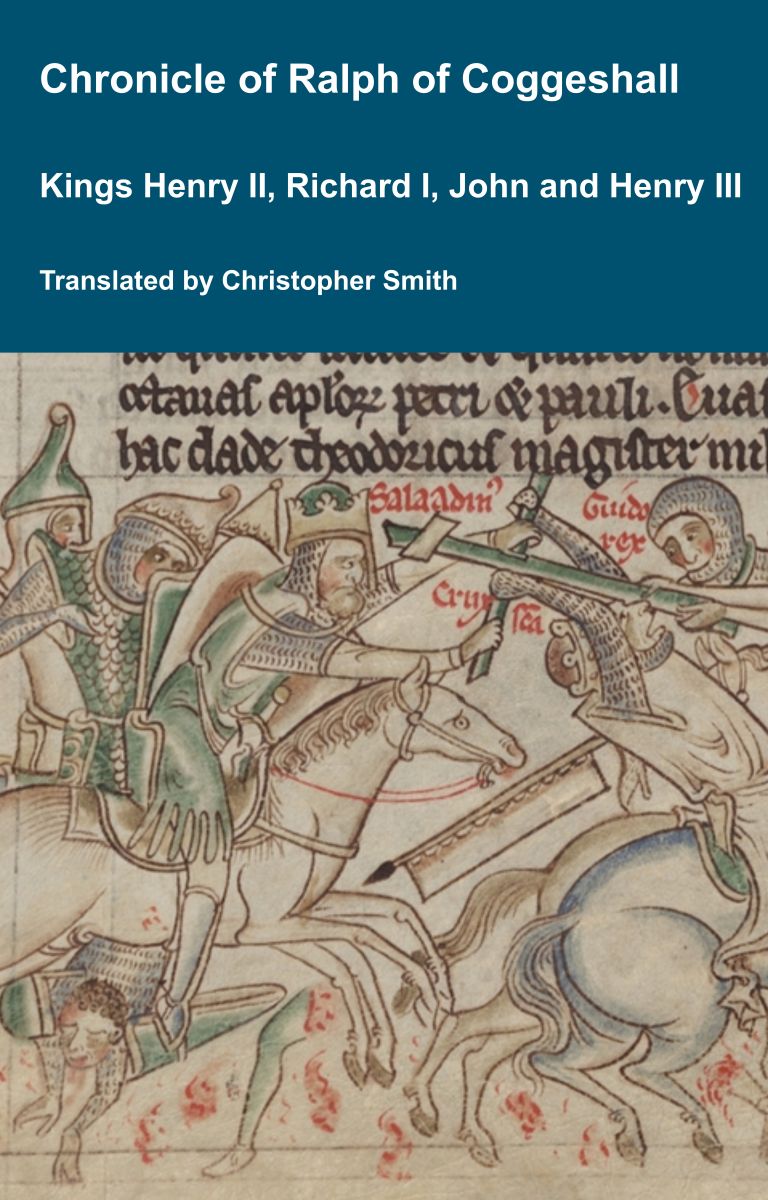
The Chronicle of Abbot Ralph of Coggeshall describes the reigns of Kings Henry II, Richard I, John and Henry III, providing a wealth of information about their lives and the events of the time. Ralph's work is detailed, comprehensive and objective. We have augmented Ralph's text with extracts from other contemporary chroniclers to enrich the reader's experience. Available at Amazon in eBook and Paperback.
Anglo-Saxon Chronicle. 1127. This year held the King Henry (age 59) his court at Christmas in Windsor. There was David the king of the Scots (age 43), and all the head men that were in England, learned and lewd. And there he engaged the archbishops, and bishops, and abbots, and earls, and all the thanes that were there, to swear England and Normandy [Map] after his day into the hands of his daughter Athelicia (age 24), who was formerly the wife of the Emperor of Saxony. Afterwards he sent her to Normandy; and with her went her brother Robert, Earl of Glocester (age 28), and Brian, son of the Earl Alan Fergan (age 27);154 and he let her wed the son (age 13) of the Earl of Anjou (age 38), whose name was Geoffry Martel. All the French and English, however, disapproved of this; but the king did it for to have the alliance of the Earl of Anjou, and for to have help against his nephew William (age 24).
Note 154. See an account of him in "Ord. Vit." 544. Conan, another son of this Alan, Earl of Brittany, married a daughter of Henry I.
Anglo-Saxon Chronicle. 2nd March 1127. In the Lent-tide of this same year was the Earl Charles of Flanders (age 43) slain in a church, as he lay there and prayed to God, before the altar, in the midst of the mass, by his own men.
Chronicon ex Chronicis by Florence and John of Worcester. 27th July 1128. William (age 25), count of Flanders, surnamed The Sad, falling into an ambush, was wounded by his enemies, and, his sufferings increasing, died, amidst universal lamentations, on the sixth of the calends of August [27th July], and was buried at St. Bertin.
Anglo-Saxon Chronicle. 27th July 1128. All this year was the King Henry (age 60) in Normandy, on account of the hostility that was between him and his nephew (age 25), the Earl of Flanders. But the earl was wounded in a fight by a swain; and so wounded he went to the monastery of St. Bertin; where he soon became a monk, lived five days afterwards, then died, and was there buried. God honour his soul. That was on the sixth day before the calends of August.
Anglo-Saxon Chronicle. 1129. This same year died Pope Honorius. Ere he was well dead, there were chosen two popes. The one was named Peter, who was monk of Clugny, and was born of the richest men of Rome; and with him held those of Rome, and the Duke of Sicily. The other was Gregory: he was a clerk, and was driven out of Rome by the other pope, and by his kinsmen. With him held the Emperor of Saxony, and the King of France (age 47), and the King Henry (age 61) of England, and all those on this side of the Alps. Now was there such division in Christendom as never was before. May Christ consult for his wretched folk.