

Chronicle of Walter of Guisborough
A canon regular of the Augustinian Guisborough Priory, Yorkshire, formerly known as The Chronicle of Walter of Hemingburgh, describes the period from 1066 to 1346. Before 1274 the Chronicle is based on other works. Thereafter, the Chronicle is original, and a remarkable source for the events of the time. This book provides a translation of the Chronicle from that date. The Latin source for our translation is the 1849 work edited by Hans Claude Hamilton. Hamilton, in his preface, says: 'In the present work we behold perhaps one of the finest samples of our early chronicles, both as regards the value of the events recorded, and the correctness with which they are detailed; Nor will the pleasing style of composition be lightly passed over by those capable of seeing reflected from it the tokens of a vigorous and cultivated mind, and a favourable specimen of the learning and taste of the age in which it was framed.'
Available at Amazon in eBook and Paperback format.
Caribbean is in Atlantic Islands.
In 1794 Captain Richard Newton Ogle [aged 25] died of the infectious fever on board HMS Boyne on its voyage from Guadaloupe.
On 16th April 1775 William Leybourne Leyboure [aged 40] died at Saint Vincent And The Grenadines. He was buried at Saint George Cathedral and Graveyard.
On 16th April 1775 William Leybourne Leyboure [aged 40] died at Saint Vincent And The Grenadines. He was buried at Saint George Cathedral and Graveyard.
On 29th August 1805 Brigadier-General Robert Bernard Sparrow [aged 32] died aboard ship whilst returning from Barbados. He was buried at Tortola.
Samuel Pepys' Diary. 23rd February 1663. This morning came my Lord Windsor [aged 36] to kiss the Duke's [aged 29] hand, being returned from Jamaica. He tells the Duke, that from such a degree of latitude going thither he begun to be sick, and was never well till his coming so far back again, and then presently begun to be well. He told the Duke of their taking the fort of St. Jago, upon Cuba, by his men; but, upon the whole, I believe that he did matters like a young lord, and was weary of being upon service out of his own country, where he might have pleasure. For methought it was a shame to see him this very afternoon, being the first day of his coming to town, to be at a playhouse.
Samuel Pepys' Diary. 3rd April 1663. I find at Court that there is some bad news from Ireland of an insurrection of the Catholiques there, which puts them into an alarm. I hear also in the City that for certain there is an embargo upon all our ships in Spayne, upon this action of my Lord Windsor's [aged 36] at Cuba, which signifies little or nothing, but only he hath a mind to say that he hath done something before he comes back again. Late tonight I sent to invite my uncle Wight and aunt with Mrs. Turner [aged 40] to-morrow.
Samuel Pepys' Diary. 13th February 1663. Took my wife home, and I to my office. Find myself pretty well but fearful of cold, and so to my office, where late upon business; Mr. Bland sitting with me, talking of my Lord Windsor's [aged 36] being come home from Jamaica, unlooked-for; which makes us think that these young Lords are not fit to do any service abroad, though it is said that he could not have his health there, but hath razed a fort of the King of Spain [aged 57] upon Cuba, which is considerable, or said to be so, for his honour.


In August 1762 George Keppel 3rd Earl Albermarle [aged 38] commanded during the Capture of Havana.
In 1762 William Keppel [aged 34] directed at Morro Castle Havana.
On 8th March 1748 William Cust [aged 28] was killed by a cannonball whilst leading the attack on Port Louis, Cuba on HMS Elizabeth.
In February 1748 Rear-Admiral Charles Knowles left Port Royal, Jamaica, with eight ships of the line to make an attack on Santiago de Cuba. Delayed by contrary winds, he diverted his expedition to Port Louis in the south east of Hispaniola, now known as Haiti. The town sat at the head of a large, deep bay, with two islands, on one of which was a French fort. Knowles sailed his ships up the channel and passed them to the west and north of the fort, which surrendered after a sharp bombardment. The town’s surrender followed soon afterwards and Knowles, having taken possession of a small merchant vessel called a snow and three privateer sloops, burnt the fort and departed for Santiago de Cuba.
The walls of the fort are shown in the centre of the picture with Knowles’s flagship, the ‘Canterbury’ placed slightly to the left, firing into it. Ahead of the French fireship which had been sent against the first in the line, the ‘Elizabeth’ is being towed by boats out of harms way. The ‘Elizabeth’ herself, which had had to evade it is on the extreme left, out of position of the firing. The ship ahead of the ‘Canterbury’, and firing into the north face of the port is believed to be the ‘Worcester’. To the right is a two decker, probably the ‘Stafford’, engaging the fort, while to the right of her, and not engaged because the inner ships mask her batteries, is a ship which is probably the ‘Plymouth’. The ‘Cornwall’ and the ‘Warwick’ are shown beyond engaging. In the extreme right of the picture in the foreground a two-decker, is half into the picture.
William Cust: In 1720 he was born to Richard Cust 2nd Baronet and Anne Brownlow Lady Cust.
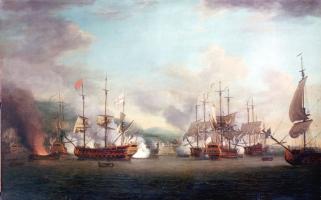

On 9th April 1748 the Battle of Santiago de Cuba was a failed attempt by the British to force the entrance of the port of Santiago de Cuba.
Samuel Pepys' Diary. 17th May 1669. Thence carried them and Mr. Gibson, who met me at my Lord Brouncker's [aged 49] with a fair copy of my petition, which I thought to shew the Duke of York [aged 35] this night, but could not, and therefore carried them to the Park, where they had never been, and so home to supper and to bed. Great the news now of the French taking St. Domingo, in Spaniola, from the Spaniards, which troubles us, that they should have it, and have the honour of taking it, when we could not.
This is a translation of the 'Memoires of Jacques du Clercq', published in 1823 in two volumes, edited by Frederic, Baron de Reissenberg. In his introduction Reissenberg writes: 'Jacques du Clercq tells us that he was born in 1424, and that he was a licentiate in law and a counsellor to Philip the Good, Duke of Burgundy, in the castellany of Douai, Lille, and Orchies. It appears that he established his residence at Arras. In 1446, he married the daughter of Baldwin de la Lacherie, a gentleman who lived in Lille. We read in the fifth book of his Memoirs that his father, also named Jacques du Clercq, had married a lady of the Le Camelin family, from Compiègne. His ancestors, always attached to the counts of Flanders, had constantly served them, whether in their councils or in their armies.' The Memoires cover a period of nineteen years beginning in in 1448, ending in in 1467. It appears that the author had intended to extend the Memoirs beyond that date; no doubt illness or death prevented him from carrying out this plan. As Reissenberg writes the 'merit of this work lies in the simplicity of its narrative, in its tone of good faith, and in a certain air of frankness which naturally wins the reader’s confidence.' Du Clercq ranges from events of national and international importance, including events of the Wars of the Roses in England, to simple, everyday local events such as marriages, robberies, murders, trials and deaths, including that of his own father in Book 5; one of his last entries.
Available at Amazon in eBook and Paperback format.
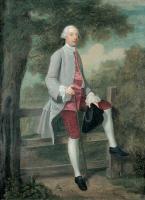
In 1776 Edward Payne Merchant puchased a coffee plantation at St Paul's.
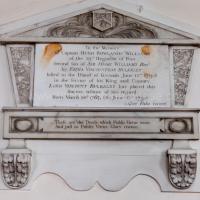
On 12th June 1795 Hugh Williams [aged 28] was killed at Grenada, Caribbean. Monument in St Marys and St Nicholas Church Beaumaris [Map].
Hugh Williams: On 20th March 1767 he was born to Hugh Williams 8th Baronet and Emma Bridget Rowlands Viscountess Bulkeley.
On 4th November 1803 Major-General William Douglas-Maclean-Clephane [aged 44] died at Grenada, Caribbean.
On 9th October 1838 Henry George Jarvis [aged 29] died in Grenada, Caribbean. Memorial at St Peter's Church, Doddington [Map].
Henry George Jarvis: On 18th February 1809 he was born to George Ralph Payne Jarvis and Sarah Delaval.
In 1780 Peter Simond of London [aged 88] and David Hankey are listed as owners of a number of Lots at St Andrew, Grenada and St David, Grenada.
In 1780 Peter Simond of London [aged 88] and David Hankey are listed as owners of a number of Lots at St Andrew, Grenada and St David, Grenada.
In 1595 Nicholas Clifford of Bobbing Kent died near Puerto Rico.
On 20th August 1780 Lucius Ferdinand Cary Master of Falkland [aged 45] died in Tobago.
In 1833 General Lionel Smith 1st Baronet [aged 54] was Governor of Tobago.

On 3rd February 1851 George Canning Harris 4th Baron Harris was born to George Harris 3rd Baron Harris [aged 40] at St Ann's, Trinidad. He married 8th July 1874 Lucy Ada Jervis Baroness Harris, daughter of Carnegie Jervis 3rd Viscount St Vincent, and had issue.
In September 1652 Peyton Carteret and Maurice Palatinate Simmern [aged 31] drowned in the Virgin Islands Caribbean when HMS Defiance sank.