

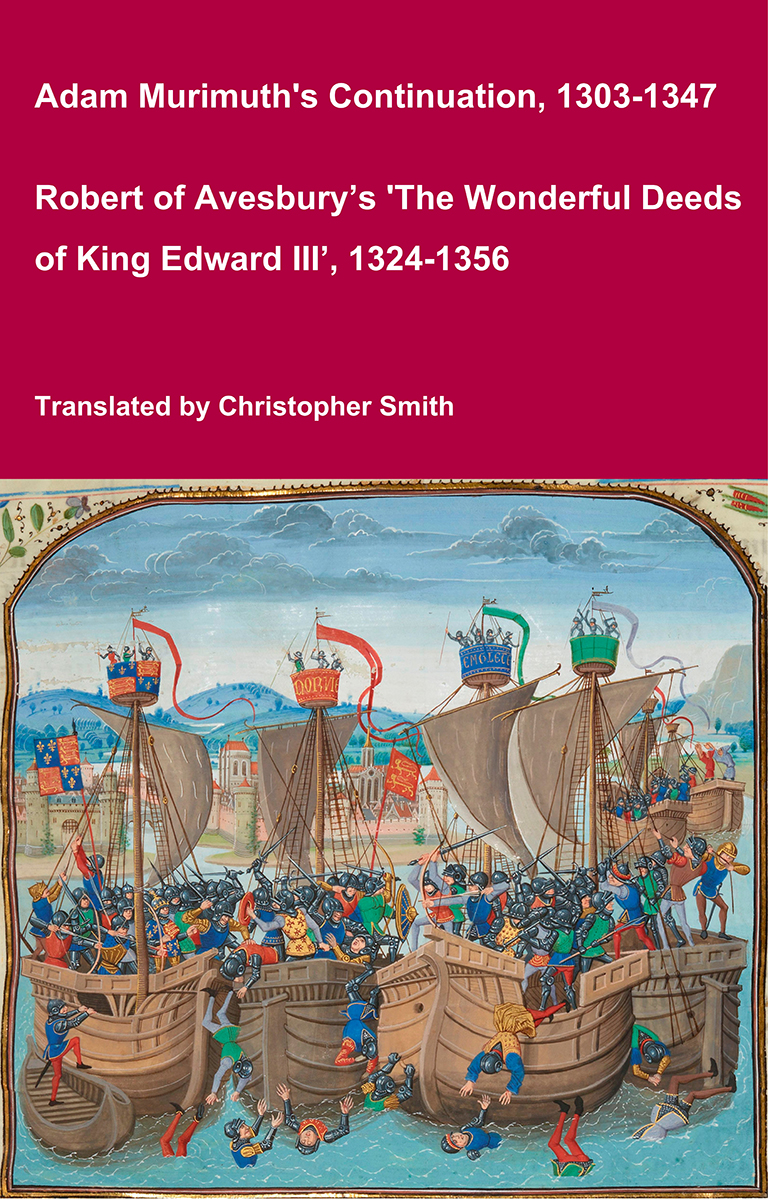
Adam Murimuth's Continuation and Robert of Avesbury’s 'The Wonderful Deeds of King Edward III'
This volume brings together two of the most important contemporary chronicles for the reign of Edward III and the opening phases of the Hundred Years’ War. Written in Latin by English clerical observers, these texts provide a vivid and authoritative window into the political, diplomatic, and military history of fourteenth-century England and its continental ambitions. Adam Murimuth Continuatio's Chronicarum continues an earlier chronicle into the mid-fourteenth century, offering concise but valuable notices on royal policy, foreign relations, and ecclesiastical affairs. Its annalistic structure makes it especially useful for establishing chronology and tracing the development of events year by year. Complementing it, Robert of Avesbury’s De gestis mirabilibus regis Edwardi tertii is a rich documentary chronicle preserving letters, treaties, and official records alongside narrative passages. It is an indispensable source for understanding Edward III’s claim to the French crown, the conduct of war, and the mechanisms of medieval diplomacy. Together, these works offer scholars, students, and enthusiasts a reliable and unembellished account of a transformative period in English and European history. Essential for anyone interested in medieval chronicles, the Hundred Years’ War, or the reign of Edward III.
Available at Amazon in eBook and Paperback format.
Paternal Family Tree: Wessex
Around 670 King Ine of Wessex was born to [his father] Cenred Wessex.
Bede. King Ceadwalla having slain Ethelwalch, King of the West Saxons, wasted that Province with tapine and slaughter.
685. In the meantime, Ceadwalla (age 26), a daring young man, of the royal race of the Gewisse, who had been banished his country, came with an army, slew Ethelwalch, and wasted that country with much slaughter and plundering; but he was soon expelled by Berthun and Andhun, the king's commanders, who afterwards held the government of that province. The first of them was afterwards killed by the same Ceadwalla, when he was king of the Gewisse, and the province was more entirely subdued: Ina (age 15), likewise, who reigned after Ceadwalla, kept that country under the like servitude for several years; for which reason, during all that time, they had no bishop of their own; but their first bishop, Wilfrid, having been recalled home, they were subject to the bishop of the Gewisse, i. e. the West Saxons, in the city of Winchester, Hampshire [Map].
In 688 King Cædwalla of Wessex (age 29) Abdicated as King Wessex. In 688 His second cousin once removed Ine (age 18) succeeded King Wessex.
Anglo-Saxon Chronicle. 688. This year Ceadwall (age 29) went to Rome, and received baptism at the hands of Sergius the pope, who gave him the name of Peter; but in the course of seven nights afterwards, on the twelfth day before the calends of May, he died in his crisom-cloths, and was buried in the church of St. Peter. To him succeeded Ina (age 18) in the kingdom of Wessex, and reigned thirty-seven winters. He founded the monastery of Glastonbury [Map]; after which he went to Rome, and continued there to the end of his life. Ina was the son of [his father] Cenred, Cenred of [his grandfather] Ceolwald; Ceolwald was the brother of Cynegils; and both were the sons of Cuthwin, who was the son of Ceawlin; Ceawlin was the son of Cynric, and Cynric of Cerdic.
Anglo-Saxon Chronicle. 694. This year the people of Kent covenanted with Ina (age 24), and gave him 30,000 pounds in friendship, because they had burned his brother Mull. Wihtred (age 24), who succeeded to the kingdom of Kent, and held it thirty-three winters, was the son of Egbert, Egbert of Erkenbert, Erkenbert of Eadbald, Eadbald of Ethelbert. And as soon as he was king, he ordained a great council to meet in the place that is called Bapchild; in which presided Wihtred, King of Kent, the Archbishop of Canterbury, Brihtwald, and Bishop Tobias of Rochester; and with him were collected abbots and abbesses, and many wise men, all to consult about the advantage of God's churches that are in Kent. Now began the king to speak, and said, "I will that all the minsters and the churches, that were given and bequeathed to the worship of God in the days of believing kings, my predecessors, and in the days of my relations of King Ethelbert and of those that followed him-shall so remain to the worship of God, and stand fast for evermore. For I Wihtred, earthly king, urged on by the heavenly king, and with the spirit of righteousness annealed, have of our progenitors learned this, that no layman should have any right to possess himself of any church or of any of the things that belong to the church. And, therefore, strongly and truly, we set and decree, and in the name of Almighty God, and of all saints, we forbid all our succeeding kings, and aldermen, and all lawmen, ever, any lordship over churches, and over all their appurtenances, which I or my elders in old days have given for a perpetual inheritance to the glory of Christ and our Lady St. Mary, and the holy apostles. And look! when it happeneth, that bishop, or abbot, or abbess, depart from this life, be it told the archbishop, and with his counsel and injunction be chosen such as be worthy. And the life of him, that shall be chosen to so holy a thing, let the archbishop examine, and his cleanness; and in no wise be chosen any one, or to so holy a thing consecrated, without the archbishop's counsel. Kings shall appoint earls, and aldermen, sheriffs, and judges; but the archbishop shall consult and provide for God's flock: bishops, and abbots, and abbesses, and priests, and deacons, he shall choose and appoint; and also sanctify and confirm with good precepts and example, lest that any of God's flock go astray and perish-"
 Become a Member via our Buy Me a Coffee page to read more.
Anglo-Saxon Chronicle. 710. This year Acca (age 50), priest of Wilferth, succeeded to the bishopric that Wilferth ere held; and Alderman Bertfrith fought with the Picts between Heugh and Carau. Ina (age 40) also, and Nun his relative, fought with Grant, king of the Welsh; and the same year Hibbald was slain.
In 715 Ceolred King Mercia and King Ine of Wessex (age 45) were defeated by an unknown army during the 715 Battle of Wanborough at Adam's Grave [Map].
Anglo-Saxon Chronicle. 715. This year Ina (age 45) and Ceolred fought at Wanborough;24 [possibly Wednesbury, Staffordshire [Map], Wanborough, Wiltshire [Map] or Woden's Barrow aka Adam's Grave [Map]] and King Dagobert (age 16) departed this life.
Note 24. Wothnesbeorhge, Ethelw.; Wonsdike, Malmsb.; Wonebirih, H. Hunt; Wodnesbeorh, Flor.; Wodnesbirch, M. West. There is no reason, therefore, to transfer the scene of action to Woodbridge, as some have supposed from an erroneous reading.
Anglo-Saxon Chronicle. 721. This year Bishop Daniel went to Rome; and the same year Ina (age 51) slew Cynewulf, the etheling. This year also died the holy Bishop John; who was bishop thirty-three years, and eight months, and thirteen days. His body now resteth at Beverley [Map].
Before 722 King Ine of Wessex (age 51) and Æthelburg Queen of Wessex (age 48) were married. She by marriage Queen Consort Wessex.
Anglo-Saxon Chronicle. 722. This year [his wife] Queen Ethelburga (age 49) destroyed Taunton [Map], which Ina (age 52) had formerly built; Ealdbert wandered a wretched exile in Surrey and Sussex; and Ina fought with the South-Saxons.
Anglo-Saxon Chronicle. 725. This year died Wihtred (age 55), King of Kent, on the ninth day before the calends of May, after a reign of thirty-two winters. His pedigree is above; and he was succeeded by Eadbert. Ina (age 55) this year also fought with the South-Saxons, and slew Ealdbert, the etheling, whom he had before driven into exile.
Jean de Waurin's Chronicle of England Volume 6 Books 3-6: The Wars of the Roses
Jean de Waurin was a French Chronicler, from the Artois region, who was born around 1400, and died around 1474. Waurin’s Chronicle of England, Volume 6, covering the period 1450 to 1471, from which we have selected and translated Chapters relating to the Wars of the Roses, provides a vivid, original, contemporary description of key events some of which he witnessed first-hand, some of which he was told by the key people involved with whom Waurin had a personal relationship.
Available at Amazon in eBook and Paperback format.
Anglo-Saxon Chronicle. 728. This year Ina (age 58)25 went to Rome, and there gave up the ghost. He was succeeded in the kingdom of Wessex by Ethelhard his relative, who held it fourteen years; but he fought this same year with Oswald the etheling. Oswald was the son of Ethelbald, Ethelbald of Cynebald, Cynebald of Cuthwin, Cuthwin of Ceawlin.
Note 25. The establishment of the "English school" at Rome is attributed to Ina; a full account of which, and of the origin of "Romescot" or "Peter-pence" for the support of it, may be seen in Matthew of Westminster.
In 728 King Ine of Wessex (age 58) died. Æthelheard King of Wessex succeeded King Wessex.
In 740 [his former wife] Æthelburg Queen of Wessex (age 67) died.
Bede. When Caedwalla went to Rome, Italy [Map], Ini succeeded to the kingdom, being of the blood royal; and having reigned thirty-seven years over that nation, he in like manner left his kingdom and committed it to younger men, and went away to the threshold of the blessed Apostles, at the time when Gregory was pope, being desirous to spend some part of his pilgrimage upon earth in the neighbourhood of the holy places, that he might obtain to be more readily received into the fellowship of the saints in heaven. This same thing, about that time, was wont to be done most zealously by many of the English nation, nobles and commons, laity and clergy, men and women.
Kings Wessex: Great x 3 Grand Son of Ceawlin King Wessex
Great x 4 Grandfather: Cynric King Wessex
Great x 3 Grandfather: Ceawlin King Wessex
Great x 2 Grandfather: Cuthwine
Great x 1 Grandfather: Cuthwulf Wessex
GrandFather: Ceolwald Wessex
Father: Cenred Wessex