

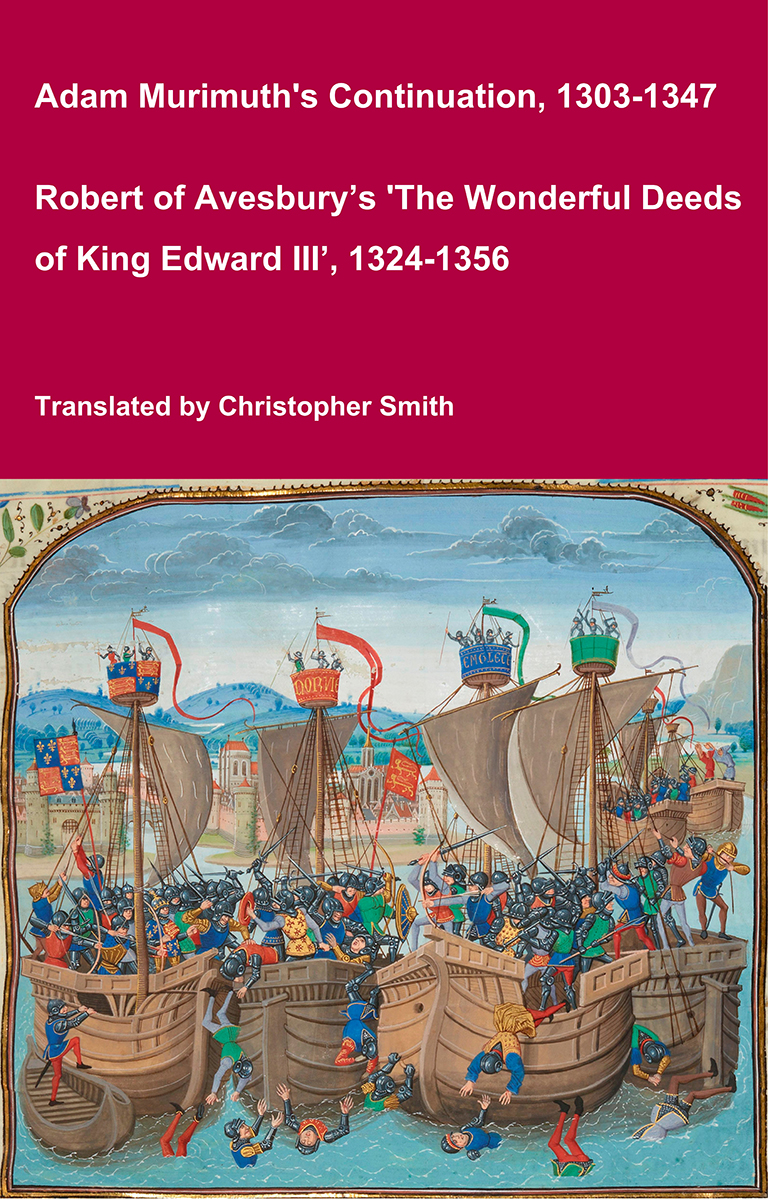
Adam Murimuth's Continuation and Robert of Avesbury’s 'The Wonderful Deeds of King Edward III'
This volume brings together two of the most important contemporary chronicles for the reign of Edward III and the opening phases of the Hundred Years’ War. Written in Latin by English clerical observers, these texts provide a vivid and authoritative window into the political, diplomatic, and military history of fourteenth-century England and its continental ambitions. Adam Murimuth Continuatio's Chronicarum continues an earlier chronicle into the mid-fourteenth century, offering concise but valuable notices on royal policy, foreign relations, and ecclesiastical affairs. Its annalistic structure makes it especially useful for establishing chronology and tracing the development of events year by year. Complementing it, Robert of Avesbury’s De gestis mirabilibus regis Edwardi tertii is a rich documentary chronicle preserving letters, treaties, and official records alongside narrative passages. It is an indispensable source for understanding Edward III’s claim to the French crown, the conduct of war, and the mechanisms of medieval diplomacy. Together, these works offer scholars, students, and enthusiasts a reliable and unembellished account of a transformative period in English and European history. Essential for anyone interested in medieval chronicles, the Hundred Years’ War, or the reign of Edward III.
Available at Amazon in eBook and Paperback format.
1911 Encyclopaedia Britannica is in Modern Era.
1911. SHELLEY, MARY WOLLSTONECRAFT (1797–1851), English writer, only daughter of William Godwin and his wife Mary Wollstonecraft, and second wife of the poet Percy Bysshe Shelley, was born in London on the 30th of August 1797. For the history of her girlhood and of her married life see Godwin, William, and Shelley, P. B.


1816. When she [Mary Godwin aka Shelley [age 18]] was in Switzerland with Shelley [age 23] and Byron [age 27] in 1816 a proposal was made that various members of the party should write a romance or tale dealing with the supernatural. The result of this project was that Mrs Shelley wrote Frankenstein, Byron the beginning of a narrative about a vampyre, and Dr Polidori [age 20], Byron's physician, a tale named The Vampyre, the authorship of which used frequently in past years to be attributed to Byron himself.
Frankenstein, published in 1818, when Mrs Shelley [age 20] was at the utmost twenty-one years old, is a very remarkable performance for so young and inexperienced a writer; its main idea is that of the formation and vitalization, by a deep student of the secrets of nature, of an adult man, who, entering the world thus under unnatural conditions, becomes the terror of his species, a half-involuntary criminal, and finally an outcast whose sole resource is self-immolation. This romance was followed by others: Valperga, or the Life and Adventures of Castruccio, Prince of Lucca (1823), an historical tale written with a good deal of spirit, and readable enough even now; The Last Man (1826), a fiction of the final agonies of human society owing to the universal spread of a pestilence—this is written in a very stilted style, but possesses a particular interest because Adrian is a portrait of Shelley; The Fortunes of Perkin Warbeck (1830); Lodore (1835), also bearing partly upon Shelley's biography, and Falkner (1837). Besides these novels there was the Journal of a Six Weeks Tour (the tour of 1814 mentioned below), which is published in conjunction with Shelley's prose-writings; and Rambles in Germany and Italy in 1840–1842–1843 (which shows an observant spirit, capable of making some true forecasts of the future), and various miscellaneous writings. After the death of Shelley, for whom she had a deep and even enthusiastic affection, marred at times by defects of temper, Mrs Shelley in the autumn of 1823 returned to London. At first the earnings of her pen were her only sustenance; but after a while Sir Timothy Shelley made her an allowance, which would have been withdrawn if she had persisted in a project of writing a full biography of her husband.
In 1838 she [Mary Godwin aka Shelley [age 40]] edited Shelley's works, supplying the notes that throw such invaluable light on the subject. She succeeded, by strenuous exertions, in maintaining her son Percy at Harrow and Cambridge; and she shared in the improvement of his fortune when in 1840 his grandfather acknowledged his responsibilities and in 1844 he succeeded to the baronetcy.
She [Mary Godwin aka Shelley [age 53]] died on the 21st of February 1851. [Note. Some sources state 1st February 1851]