

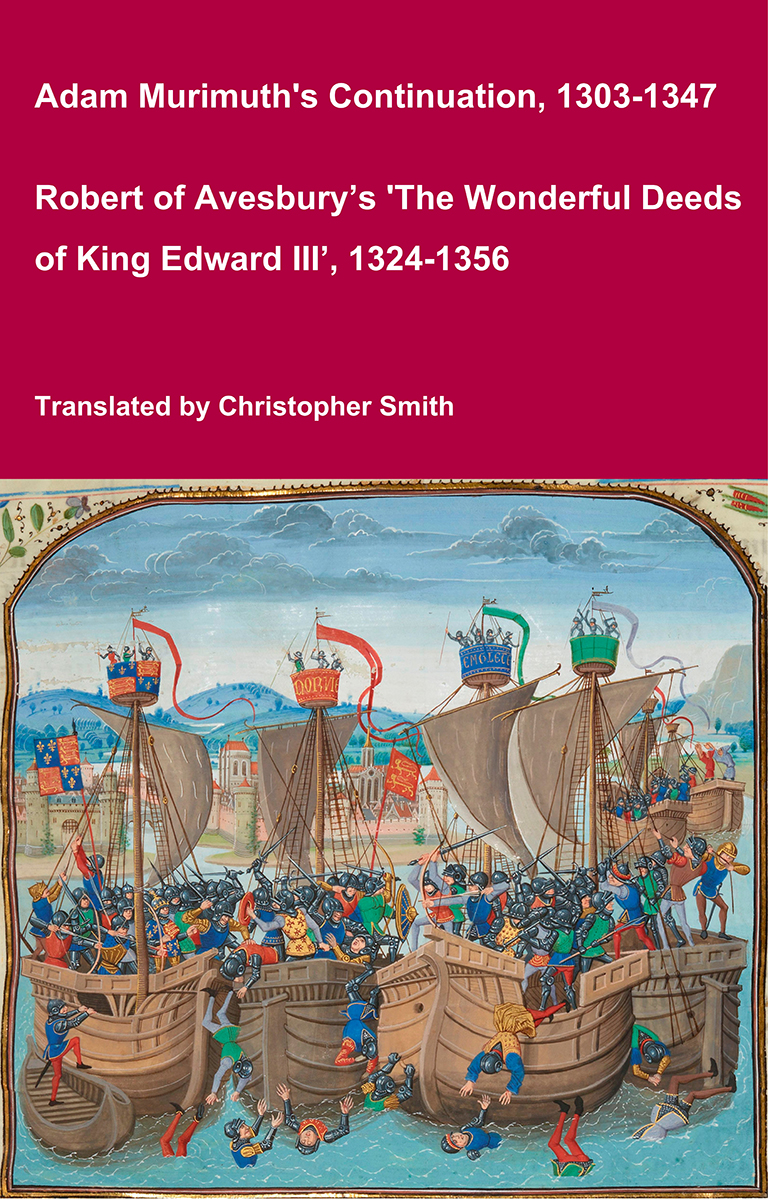
Adam Murimuth's Continuation and Robert of Avesbury’s 'The Wonderful Deeds of King Edward III'
This volume brings together two of the most important contemporary chronicles for the reign of Edward III and the opening phases of the Hundred Years’ War. Written in Latin by English clerical observers, these texts provide a vivid and authoritative window into the political, diplomatic, and military history of fourteenth-century England and its continental ambitions. Adam Murimuth Continuatio's Chronicarum continues an earlier chronicle into the mid-fourteenth century, offering concise but valuable notices on royal policy, foreign relations, and ecclesiastical affairs. Its annalistic structure makes it especially useful for establishing chronology and tracing the development of events year by year. Complementing it, Robert of Avesbury’s De gestis mirabilibus regis Edwardi tertii is a rich documentary chronicle preserving letters, treaties, and official records alongside narrative passages. It is an indispensable source for understanding Edward III’s claim to the French crown, the conduct of war, and the mechanisms of medieval diplomacy. Together, these works offer scholars, students, and enthusiasts a reliable and unembellished account of a transformative period in English and European history. Essential for anyone interested in medieval chronicles, the Hundred Years’ War, or the reign of Edward III.
Available at Amazon in eBook and Paperback format.
A Tour in Scotland is in Georgian Books.

21st September 1769. Cross over the Eimot at Yeoma's bridge, and enter Westmoreland. At a small distance beyond the bridge near the road side is the circle called Arthur's round table, consisting of a high dike of earth, and a deep foss within surrounding an area twenty-nine yards in diameter. There are two entrances exactly opposite to each other; which interrupt the ditch, in those parts filled to a level with the middle. Some suppose this to have been designed for tilting matches, and that the champions entered at each opening. Perhaps that might have been the purpose of it; for the size forbids one to suppose it to be an encampment.
21st September 1769. A little to the North of this, on the summit of a small hill, is Maryborough, a vast circular dike of loose stones: the height and the diameter at the bottom is stupendous: it slopes on both sides, and is entirely formed of pebbles, such as are collected out of rivers. There is an entrance on the East side leading into an area eighty-eight yards in diameter. Near the middle is an upright stone nine feet eight inches high, and seventeen in circumference in the thickest part. There had been three more placed so as to form (with the other) a square. Four again stood on the sides of the entrance, viz. one on each exterior corner; and one on each interior: but excepting that at present remaining, all the others have long since been blasted to clear the ground.