

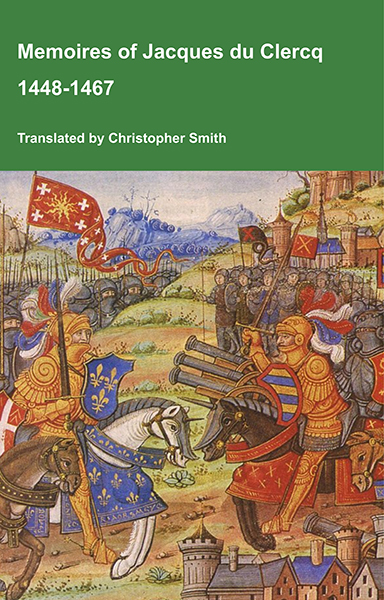
This is a translation of the 'Memoires of Jacques du Clercq', published in 1823 in two volumes, edited by Frederic, Baron de Reissenberg. In his introduction Reissenberg writes: 'Jacques du Clercq tells us that he was born in 1424, and that he was a licentiate in law and a counsellor to Philip the Good, Duke of Burgundy, in the castellany of Douai, Lille, and Orchies. It appears that he established his residence at Arras. In 1446, he married the daughter of Baldwin de la Lacherie, a gentleman who lived in Lille. We read in the fifth book of his Memoirs that his father, also named Jacques du Clercq, had married a lady of the Le Camelin family, from Compiègne. His ancestors, always attached to the counts of Flanders, had constantly served them, whether in their councils or in their armies.' The Memoires cover a period of nineteen years beginning in in 1448, ending in in 1467. It appears that the author had intended to extend the Memoirs beyond that date; no doubt illness or death prevented him from carrying out this plan. As Reissenberg writes the 'merit of this work lies in the simplicity of its narrative, in its tone of good faith, and in a certain air of frankness which naturally wins the reader’s confidence.' Du Clercq ranges from events of national and international importance, including events of the Wars of the Roses in England, to simple, everyday local events such as marriages, robberies, murders, trials and deaths, including that of his own father in Book 5; one of his last entries.
Available at Amazon in eBook and Paperback format.
Anglo-Saxon Chronicle 500-600 is in Anglo-Saxon Chronicle.
501. This year Porta and his two sons, Beda and Mela, came into Britain, with two ships, at a place called Portsmouth. They soon landed, and slew on the spot a young Briton of very high rank.
509. This year St. Benedict, the abbot, father of all the monks16, ascended to heaven.
Note 16. Merely of those called from him "Benedictines". But the compiler of the Cotton MS., who was probably a monk of that order, seems not to acknowledge any other. Matthew of Westminster places his death in 536.
514. This year came the West-Saxons into Britain, with three ships, at the place that is called Cerdic's-ore. And Stuff and Wihtgar fought with the Britons, and put them to flight.
538. This year the sun was eclipsed, fourteen days before the calends of March, from before morning until nine.
20th June 540. This year the sun was eclipsed on the twelfth day before the calends of July; and the stars showed themselves full nigh half an hour over nine.
544. This year died Wihtgar; and men buried him at Carisbrook.
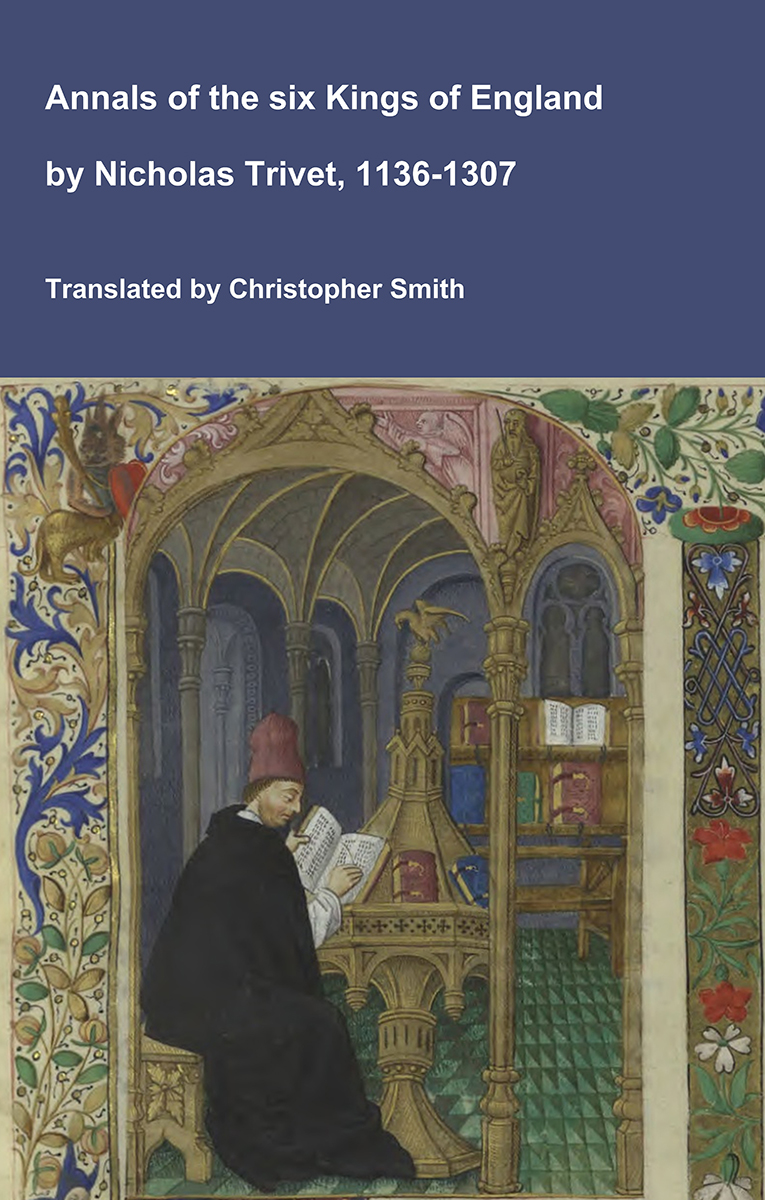
Annals of the six Kings of England by Nicholas Trivet
Translation of the Annals of the Six Kings of England by that traces the rise and rule of the Angevin aka Plantagenet dynasty from the mid-12th to early 14th century. Written by the Dominican scholar Nicholas Trivet, the work offers a vivid account of English history from the reign of King Stephen through to the death of King Edward I, blending political narrative with moral reflection. Covering the reigns of six monarchs—from Stephen to Edward I—the chronicle explores royal authority, rebellion, war, and the shifting balance between crown, church, and nobility. Trivet provides detailed insight into defining moments such as baronial conflicts, Anglo-French rivalry, and the consolidation of royal power under Edward I, whose reign he describes with particular immediacy. The Annals combines careful year-by-year reporting with thoughtful interpretation, presenting history not merely as a sequence of events but as a moral and political lesson. Ideal for readers interested in medieval history, kingship, and the origins of the English state, this chronicle remains a valuable and accessible window into the turbulent world of the Plantagenet kings.
Available at Amazon in eBook and Paperback format.
547. This year Ida began his reign; from whom first arose the royal kindred of the Northumbrians. Ida was the son of Eoppa, Eoppa of Esa, Esa of Ingwy, Ingwy of Angenwit, Angenwit of Alloc, Alloc of Bennoc, Bennoc of Brand, Brand of Balday, Balday of Woden. Woden of Fritholaf, Fritholaf of Frithowulf, Frithowulf of Finn, Finn of Godolph, Godolph of Geata. Ida reigned twelve years. He built Bamburgh-Castle, which was first surrounded with a hedge, and afterwards with a wall.
552. This year Cynric fought with the Britons on the spot that is called Sarum [Map], and put them to flight. Cerdic was the father of Cynric, Cerdic was the son of Elesa, Elesa of Esla, Esla of Gewis, Gewis of Wye, Wye of Frewin, Frewin of Frithgar, Frithgar of Brand, Brand of Balday, Balday of Woden. In this year Ethelbert, the son of Ermenric, was born, who on the two and thirtieth year of his reign received the rite of baptism, the first of all the kings in Britain.
560. This year Ceawlin undertook the government of the West-Saxons; and Ella, on the death of Ida, that of the Northumbrians; each of whom reigned thirty winters. Ella was the son of Iff, Iff of Usfrey, Usfrey of Wilgis, Wilgis of Westerfalcon, Westerfalcon of Seafowl, Seafowl of Sebbald, Sebbald of Sigeat, Sigeat of Swaddy, Swaddy of Seagirt, Seagar of Waddy, Waddy of Woden, Woden of Frithowulf. This year Ethelbert came to the kingdom of the Cantuarians, and held it fifty-three winters. In his days the holy Pope Gregory sent us baptism. That was in the two and thirtieth year of his reign. And Columba, the mass-priest, came to the Picts, and converted them to the belief of Christ. They are the dwellers by the northern moors. And their king gave him the island of Hii, consisting of five hides, as they say, where Columba built a monastary. There he was abbot two and thirty winters; and there he died, when he was seventy-seven years old. The place his successors yet have. The Southern Picts were long before baptized by Bishop Ninnia, who was taught at Rome. His church or monastery is at Hwiterne, hallowed in the name of St. Martin, where he resteth with many holy men. Now, therefore, shall there be ever in Hii an abbot, and no bishop; and to him shall be subject all the bishops of the Scots; because Columba was an abbot—no bishop.
565. ((This year Columba the presbyter came from the Scots among the Britons, to instruct the Picts, and he built a monastery in the island of Hii.))
571. This year Cuthulf fought with the Britons at Bedford, and took four towns, Lenbury, Aylesbury, Benson, and Ensham. And this same year he died.
577. This year Cuthwin and Ceawlin fought with the Britons, and slew three kings, Commail, and Condida, and Farinmail, on the spot that is called Derham, and took from them three cities, Gloucester, Cirencester, and Bath.
583. This year Mauricius succeeded to the empire of the Romans.
588. This year died King Ella; and Ethelric reigned after him five years.
592. This year there was a great slaughter of Britons at Wanborough; Ceawlin was driven from his kingdom, and Ceolric reigned six years.
Chronicle of Walter of Guisborough
A canon regular of the Augustinian Guisborough Priory, Yorkshire, formerly known as The Chronicle of Walter of Hemingburgh, describes the period from 1066 to 1346. Before 1274 the Chronicle is based on other works. Thereafter, the Chronicle is original, and a remarkable source for the events of the time. This book provides a translation of the Chronicle from that date. The Latin source for our translation is the 1849 work edited by Hans Claude Hamilton. Hamilton, in his preface, says: 'In the present work we behold perhaps one of the finest samples of our early chronicles, both as regards the value of the events recorded, and the correctness with which they are detailed; Nor will the pleasing style of composition be lightly passed over by those capable of seeing reflected from it the tokens of a vigorous and cultivated mind, and a favourable specimen of the learning and taste of the age in which it was framed.'
Available at Amazon in eBook and Paperback format.
592. This year Gregory succeeded to the papacy at Rome.
593. This year died Ceawlin, and Cwichelm, and Cryda; and Ethelfrith succeeded to the kingdom of the Northumbrians. He was the son of Ethelric; Ethelric of Ida.
596. This year Pope Gregory sent Augustine [aged 56] to Britain with very many monks, to preach the word of God to the English people.
597. This year began Ceolwulf to reign over the West-Saxons; and he constantly fought and conquered, either with the Angles, or the Welsh, or the Picts, or the Scots. He was the son of Cutha, Cutha of Cynric, Cynric of Cerdic, Cerdic of Elesa, Elesa of Gewis, Gewis of Wye, Wye of Frewin, Frewin of Frithgar, Frithgar of Brand, Brand of Balday, and Balday of Woden. This year came Augustine [aged 57] and his companions to England.17
Note 17. For an interesting and minute account of the arrival of Augustine and his companions in the Isle of Thanet, their entrance into Canterbury, and their general reception in England, vid. Bede. "Hist. Eccles." i. 25, and the following chapters, with the Saxon translation by King Alfred. The succeeding historians have in general repeated the very words of Bede.