

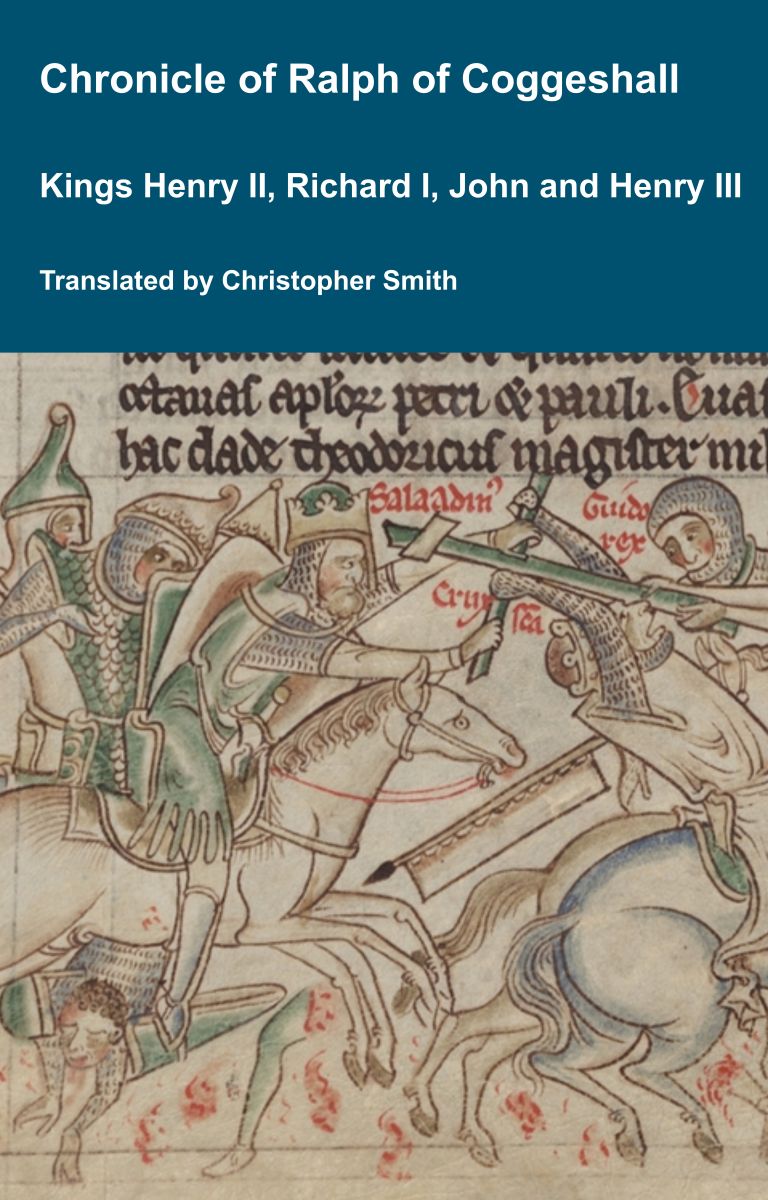
Chronicle of Abbot Ralph of Coggeshall
The Chronicle of Abbot Ralph of Coggeshall (Chronicon Anglicanum) is an indispensable medieval history that brings to life centuries of English and European affairs through the eyes of a learned Cistercian monk. Ralph of Coggeshall, abbot of the Abbey of Coggeshall in Essex in the early 13th century, continued and expanded his community’s chronicle, documenting events from the Norman Conquest of 1066 into the tumultuous reign of King Henry III. Blending eyewitness testimony, careful compilation, and the monastic commitment to record-keeping, this chronicle offers a rare narrative of political intrigue, royal power struggles, and social upheaval in England and beyond. Ralph’s work captures the reigns of pivotal figures such as Richard I and King John, providing invaluable insights into their characters, decisions, and the forces that shaped medieval rule. More than a simple annal, Chronicon Anglicanum conveys the texture of medieval life and governance, making it a rich source for scholars and readers fascinated by English history, monastic authorship, and the shaping of the medieval world.
Available at Amazon in eBook and Paperback format.
Anglo-Saxon Chronicle 800-849 is in Anglo-Saxon Chronicle.
800. This year was the moon eclipsed, at eight in the evening, on the seventeenth day before the calends of February; and soon after died King Bertric and Alderman Worr. Egbert [aged 27] succeeded to the West-Saxon kingdom; and the same day Ethelmund, alderman of the Wiccians, rode over the Thames at Kempsford; where he was met by Alderman Woxtan, with the men of Wiltshire, and a terrible conflict ensued, in which both the commanders were slain, but the men of Wiltshire obtained the victory.
801. Her wæs gehadod Beornmod bisc to Hrofes ceastre2.
Note 801. [Collation]. This year Beornmod was ordained by Bishop of Rochester.
Note 2. D. places this entry in this form under the year 801; but repeats it in the form in which it occurs in E. under the year 802.
802Her aðeostrade se mona on dagunge on xiii kt Iañr. ⁊ Beornmod wæs gehalgod to b to Rofeceastre þy ilcan geare.
Note 802. This year was the moon eclipsed, at dawn, on the thirteenth day before the calends of January; and Bernmod was consecrated Bishop of Rochester.
803. This year died Hibbald, Bishop of Holy-island, on the twenty-fourth of June, and Egbert was consecrated in his stead, on the thirteenth of June following. Archbishop Ethelherd also died in Kent, and Wulfred was chosen archbishop in his stead. Abbot Forthred, in the course of the same year, departed this life.
804. This year Archbishop Wulfred received his pall.
. Parker MS. Her Wulfred ærce bisc pallium onfengr
. Laud MS. Her Wulfred arceb onfeng pallium.
805. This year died King Cuthred in Kent, and Abbess Colburga, and Alderman Herbert.
Parker MS. Her Cuþred cyning forþferde on Cantwarum, ⁊ Ceolburg abbudesse, ⁊ Heabryht aldorman.
Laud MS. Her Cuðred cining forðerde on Cantwarum. ⁊ Ceolburh abbe. ⁊ Heard berht.
806. This year was the moon eclipsed, on the first of September; Erdwulf, king of the Northumbrians, was banished from his dominions; and Eanbert, Bishop of Hexham, departed this life. This year also, on the next day before the nones of June, a cross was seen in the moon, on a Wednesday, at the dawn; and afterwards, during the same year, on the third day before the calends of September, a wonderful circle was displayed about the sun.
807. This year was the sun eclipsed, precisely at eleven in the morning, on the seventeenth day before the calends of August.
812. This year died the Emperor Charlemagne [aged 69], after a reign of five and forty winters; and Archbishop Wulfred, accompanied by Wigbert, Bishop of Wessex, undertook a journey to Rome.
813. This year Archbishop Wulfred returned to his own see, with the blessing of Pope Leo; and King Egbert [aged 40] spread devastation in Cornwall from east to west.
Henrici Quinti, Angliæ Regis, Gesta, is a first-hand account of the Agincourt Campaign, and subsequent events to his death in 1422. The author of the first part was a Chaplain in King Henry's retinue who was present from King Henry's departure at Southampton in 1415, at the siege of Harfleur, the battle of Agincourt, and the celebrations on King Henry's return to London. The second part, by another writer, relates the events that took place including the negotiations at Troye, Henry's marriage and his death in 1422.
Available at Amazon in eBook and Paperback format.
814. This year died Leo, the noble and holy pope; and Stephen succeeded him in the papal government.
816. This year died Pope Stephen; and Paschalis was consecrated pope after him. This same year the school of the English nation at Rome was destroyed by fire.
819. This year died Cenwulf, King of Mercia; and Ceolwulf33 succeeded him. Alderman Eadbert also departed this life.
Note 33. St. Kenelm is said to have succeeded Cenwulf:
"In the foure and twentithe yere of his kyngdom
Kenulf wente out of this worlde, and to the joye of hevene com;
It was after that oure Lord in his moder alygte
Eigte hondred yet and neygentene, by a countes rigte,
Seint Kenelm his yonge sone in his sevende yere
Kyng was ymad after him, theg he yong were."
"Vita S. Kenelmi, MS. Coll. Trin Oxon." No. 57. Arch.
821. This year Ceolwulf was deprived of his kingdom.
822. This year two aldermen were slain, whose names were Burhelm and Mucca; and a synod was holden at Cliff's-Hoo.
823. This year a battle was fought between the Welsh in Cornwall and the people of Devonshire, at Camelford, Cornwall; and in the course of the same year Egbert, king of the West-Saxons [aged 50], and Bernwulf, King of Mercia, fought a battle at Wilton, in which Egbert gained the victory, but there was great slaughter on both sides. Then sent he his son Ethelwulf into Kent, with a large detachment from the main body of the army, accompanied by his bishop, Elstan, and his alderman, Wulfherd; who drove Baldred, the king, northward over the Thames. Whereupon the men of Kent immediately submitted to him; as did also the inhabitants of Surrey, and Sussex, and Essex; who had been unlawfully kept from their allegiance by his relatives. The same year also, the king of the East-Angles, and his subjects besought King Egbert to give them peace and protection against the terror of the Mercians; whose king, Bernwulf, they slew in the course of the same year.
825. This year Ludecan, King of Mercia, was slain, and his five aldermen with him; after which Wiglaf succeeded to the kingdom.
827. This year was the moon eclipsed, on mid-winter's mass-night; and King Egbert [aged 54], in the course of the same year, conquered the Mercian kingdom, and all that is south of the Humber, being the eighth king who was sovereign of all the British dominions. Ella, king of the South-Saxons, was the first who possessed so large a territory; the second was Ceawlin, king of the West-Saxons: the third was Ethelbert, King of Kent; the fourth was Redwald, king of the East-Angles; the fifth was Edwin, king of the Northumbrians; the sixth was Oswald, who succeeded him; the seventh was Oswy, the brother of Oswald; the eighth was Egbert, king of the West-Saxons. This same Egbert led an army against the Northumbrians as far as Dore, where they met him, and offered terms of obedience and subjection, on the acceptance of which they returned home.
830. In this year, Wilaf again took the kingdom of the Mercians, and Bishop Æthelwald passed away, and in the same year King Ecgbryht [aged 57] led an army into North Wales, and he brought them to humble obedience.
Manuscript A. 828. Her eft Wilaf onfeng Miercna rices 7 Ęþelwald biscep forþferde 7 þy ilcan geare lędde Ecgbryht cyning fierd on Norþwalas 7 he hie to eaþmodre hersumnesse gedyde
831. Here Archbishop Wulfred passed away.
Manuscript A. 829. Her Wulfred ærcebiscep forþferde.
832. Here Ceolnoth was chosen as bishop and consecrated, and Abbot Feologith passed away.
Manuscript A. 830. Her Ceolnoþ wæs gecoren to biscepe 7 gehadod 7 Feologid abbud forþferde.
833. This year Archbishop Ceolnoth received the pallium..
Manuscript A. 831. Her Ceolnoþ ærcebiscep onfeng pallium.
The History of William Marshal was commissioned by his son shortly after William’s death in 1219 to celebrate the Marshal’s remarkable life; it is an authentic, contemporary voice. The manuscript was discovered in 1861 by French historian Paul Meyer. Meyer published the manuscript in its original Anglo-French in 1891 in two books. This book is a line by line translation of the first of Meyer’s books; lines 1-10152. Book 1 of the History begins in 1139 and ends in 1194. It describes the events of the Anarchy, the role of William’s father John, John’s marriages, William’s childhood, his role as a hostage at the siege of Newbury, his injury and imprisonment in Poitou where he met Eleanor of Aquitaine and his life as a knight errant. It continues with the accusation against him of an improper relationship with Margaret, wife of Henry the Young King, his exile, and return, the death of Henry the Young King, the rebellion of Richard, the future King Richard I, war with France, the death of King Henry II, and the capture of King Richard, and the rebellion of John, the future King John. It ends with the release of King Richard and the death of John Marshal.
Available at Amazon in eBook and Paperback format.
836. In this year, King Ecgbryht [aged 63] fought against thirty-five shiploads [of Danes] at Charmouth, and there a great slaughter took place, and the Danes held the battlefield; and Hereferth and Wigthegn, two bishops, passed away, and Dudda and Osmund, two aldermen, passed away.
Manuscript A. 833. Her gefeaht Ecgbryht cyning wiþ .xxxv. sciphlæsta æt Carrum 7 þær wearþ micel węl geslægen, 7 þa Denescan ahton węlstowe gewald; 7 Hereferþ 7 Wigþen tuegen biscepas forþferdon, 7 Dudda 7 Osmod tuegen aldormen forþferdon.
838. In this year, a great fleet came to West Wales, and they united together and fought against Ecgbryht [aged 65], king of the West Saxons. When he heard of this, he marched with his army and fought against them at Hengestdun, and there he put to flight both the Welsh and the Danes.
Manuscript A. 835. Her cuom micel sciphere on Westwalas 7 hie to anum gecierdon, 7 wiþ Ecgbryht Westseaxna cyning winnende wæron. Þa he þæt hierde 7 mid fierde ferde 7 him wiþ feaht æt Hengestdune 7 þær gefliemde ge þa Walas ge þa Deniscan.
839. In this year, King Ecgbryht [aged 66] passed away, and previously, King Offa of Mercia and King Beorhtric of Wessex had exiled him for three years from the land of the English to the land of the Franks, before he became king. And Beorhtric supported Offa in this because he had Offa's daughter [Queen Eadburga of Wessex] as his queen. And Ecgbryht reigned for thirty-seven years and seven months, and Æthelwulf, son of Ecgbryht, succeeded to the kingdom of the West Saxons, and he gave his son Æthelstan the kingdom of the Kentish people, East Saxons, Surrey, and South Saxons.
Manuscript A. 836. Her Ecgbryht cyning forþferde, 7 hine hæfde ær Offa Miercna cyning 7 Beorhtric Wesseaxna cyning afliemed .iii. gear of Angelcynnes lande on Fronclond, ær he cyning wære, 7 þy fultomode Beorhtric Offan þy he hæfde his dohtor him to cuene; 7 se Ecgbyht ricsode .xxxvii. wintra, .vii. monaþ, 7 feng Ęþelwulf Ecgbrehting to Wesseaxna rice, 7 he salde his suna Ęþelstane Cantwara rice 7 Eastseaxna 7 Suþrigea 7 Suþseaxna.
840. This year Alderman Wulfherd fought at Hamton with thirty-three pirates, and after great slaughter obtained the victory, but he died the same year. Alderman Ethelhelm also, with the men of Dorsetshire, fought with the Danish army in Portland isle, and for a good while put them to flight; but in the end the Danes became masters of the field, and slew the alderman.
841. Text 838AD. This year Alderman Herbert was slain by the heathens, and many men with him, among the Marshlanders. The same year, afterwards, in Lindsey, East-Anglia, and Kent, were many men slain by the army.
842. Text 839AD. This year there was great slaughter in London, Canterbury, and Rochester.
840. This year King Ethelwulf fought at Charmouth with thirty-five ship's-crews, and the Danes remained masters of the place. The Emperor Louis [aged 62] died this year.
845. This year Alderman Eanwulf, with the men of Somersetshire, and Bishop Ealstan, and Alderman Osric, with the men of Dorsetshire, fought at the mouth of the Parret [Map] with the Danish army; and there, after making a great slaughter, obtained the victory.