

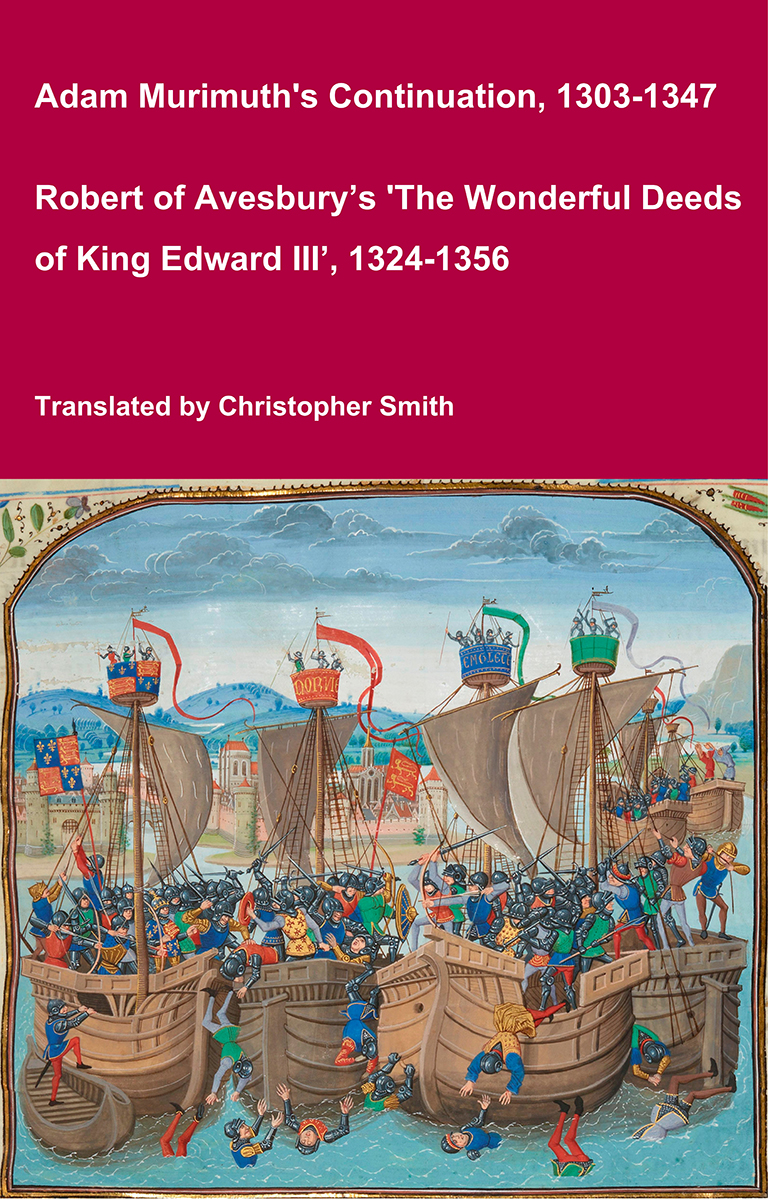
Adam Murimuth's Continuation and Robert of Avesbury’s 'The Wonderful Deeds of King Edward III'
This volume brings together two of the most important contemporary chronicles for the reign of Edward III and the opening phases of the Hundred Years’ War. Written in Latin by English clerical observers, these texts provide a vivid and authoritative window into the political, diplomatic, and military history of fourteenth-century England and its continental ambitions. Adam Murimuth Continuatio's Chronicarum continues an earlier chronicle into the mid-fourteenth century, offering concise but valuable notices on royal policy, foreign relations, and ecclesiastical affairs. Its annalistic structure makes it especially useful for establishing chronology and tracing the development of events year by year. Complementing it, Robert of Avesbury’s De gestis mirabilibus regis Edwardi tertii is a rich documentary chronicle preserving letters, treaties, and official records alongside narrative passages. It is an indispensable source for understanding Edward III’s claim to the French crown, the conduct of war, and the mechanisms of medieval diplomacy. Together, these works offer scholars, students, and enthusiasts a reliable and unembellished account of a transformative period in English and European history. Essential for anyone interested in medieval chronicles, the Hundred Years’ War, or the reign of Edward III.
Available at Amazon in eBook and Paperback format.
Archaeologia Cambrensis 1853 Page 155 is in Archaeologia Cambrensis 1853.
Fall of Part of Denbigh Castle.
Much alarm has been occasioned in Denbigh by the fall of a large portion of the solid old masonry of its ancient castle. Nearly forty yards of wall fell with a crash that was heard at an immense distance. A row of cottages built just below, with one exception, happily escaped without injury, but they were in great danger of being overwhelmed. It appears that the western side of the edifice is built upon a precipitous bank, and it is thought that the long continued rains, succeeded by the recent frosts, have loosened the soil on which the walls stood, and caused the unexpected downfall. We understand that the crown surveyor has received directions to inspect the ruins.