

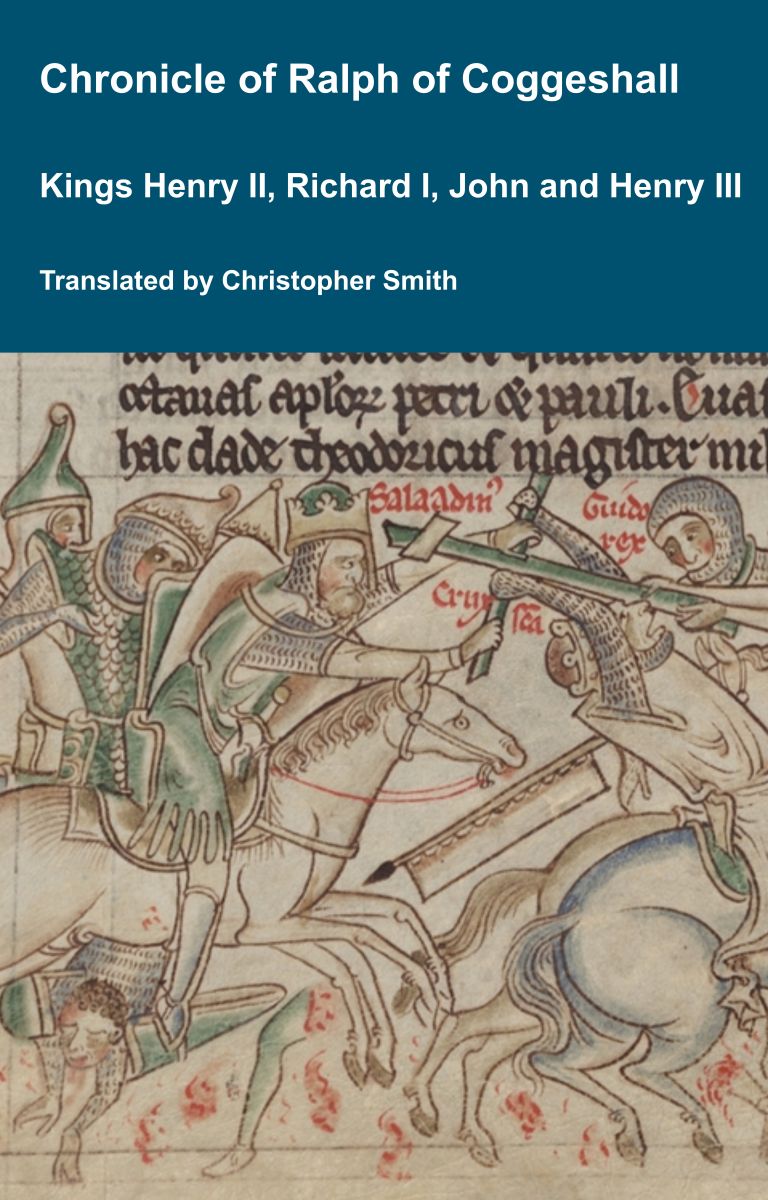
Chronicle of Abbot Ralph of Coggeshall
The Chronicle of Abbot Ralph of Coggeshall (Chronicon Anglicanum) is an indispensable medieval history that brings to life centuries of English and European affairs through the eyes of a learned Cistercian monk. Ralph of Coggeshall, abbot of the Abbey of Coggeshall in Essex in the early 13th century, continued and expanded his community’s chronicle, documenting events from the Norman Conquest of 1066 into the tumultuous reign of King Henry III. Blending eyewitness testimony, careful compilation, and the monastic commitment to record-keeping, this chronicle offers a rare narrative of political intrigue, royal power struggles, and social upheaval in England and beyond. Ralph’s work captures the reigns of pivotal figures such as Richard I and King John, providing invaluable insights into their characters, decisions, and the forces that shaped medieval rule. More than a simple annal, Chronicon Anglicanum conveys the texture of medieval life and governance, making it a rich source for scholars and readers fascinated by English history, monastic authorship, and the shaping of the medieval world.
Available at Amazon in eBook and Paperback format.
Archaeologia Cambrensis 1887 Page 349 is in Archaeologia Cambrensis 1887.

At Rhuddlan the Archdeacon guided the Association in its perambulation of the Castle, and pointed out the principal features; after which he read a brief epitome of the chief events bearing on the history of the place from the time of King Offa's victory on the adjoining marsh, in A.D. 795, down to the dismantling of the Castle by order of the Parliament in 1646. The accompanying plan, enlarged from that in the New Ordnance Survey, will show the arrangement of the fortress and its defences. Placed on the bank of a tidal river, and forming one of the keys of Snowdonia, it was always a point of strategic importance, and sustained a remarkable series of sieges, captures, and recaptures, during the Welsh wars, and its massive walls and simple military character are well in character with those conditions. The main entrance was at a, between the two round towers, b and c; and it was approached by a drawbridge over the moat, the bastions of which are shown on the inner side. Two corresponding towers occupy the opposite angle of the court, and the other angles are each of them strengthened by a single massive round tower. The chief living rooms were within the tower. There ai'e no remains of buildings in the court, but the walls show where the beams rested for the timber floors and roofs. The moat is encased in masonry, and was evidently filled with water which was retained by walls. The slope of the ground from the west prevented its being continued on that side, and its place was supplied by strong walls and towers.
Proceeding from the Castle a distance of about 300 yards, to the south, Twt Hill [Map], the site of the earlier castle built by Llywelyn ap Sitsyllt, King of Gwynedd c. 1015, was passed; and a little further on are the remains of the Dominican Priory [Map], now called the Abbey. Here, again, under the same guidance, were seen the windows of the monks' dormitory, above the present barn; and built up into the Avails, a large monumental slab with an incised effigy of an Archbishop of Rages, a former brother of the house. Near it was a cross ragule, memorial to "De Bridelton' cuius a'ie p'piciet." Other floriated crosses lie near the front door of the farmhouse, whilst in the garden wall are portions of window-tracery. There is a much damaged effigy of a knight in the wall of the stable; and behind the buildings on the opposite side of the yard (the western) may be seen several Pointed windows that show that portion to have been a part of the old monastic building. The property now belongs to Sir W. G. Williams, Bart (age 42)., of Bodelwyddan, and it is much to be desired that these interesting relics should be more carefully protected. The lateness of the hour and the shades of evening rendered it too dark to see the church, and it had reluctantly to be omitted for the day.