

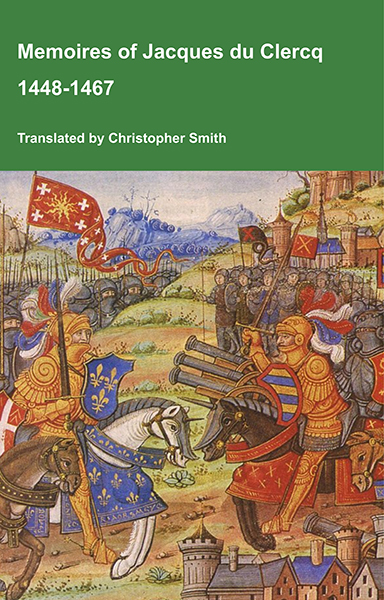
This is a translation of the 'Memoires of Jacques du Clercq', published in 1823 in two volumes, edited by Frederic, Baron de Reissenberg. In his introduction Reissenberg writes: 'Jacques du Clercq tells us that he was born in 1424, and that he was a licentiate in law and a counsellor to Philip the Good, Duke of Burgundy, in the castellany of Douai, Lille, and Orchies. It appears that he established his residence at Arras. In 1446, he married the daughter of Baldwin de la Lacherie, a gentleman who lived in Lille. We read in the fifth book of his Memoirs that his father, also named Jacques du Clercq, had married a lady of the Le Camelin family, from Compiègne. His ancestors, always attached to the counts of Flanders, had constantly served them, whether in their councils or in their armies.' The Memoires cover a period of nineteen years beginning in in 1448, ending in in 1467. It appears that the author had intended to extend the Memoirs beyond that date; no doubt illness or death prevented him from carrying out this plan. As Reissenberg writes the 'merit of this work lies in the simplicity of its narrative, in its tone of good faith, and in a certain air of frankness which naturally wins the reader’s confidence.' Du Clercq ranges from events of national and international importance, including events of the Wars of the Roses in England, to simple, everyday local events such as marriages, robberies, murders, trials and deaths, including that of his own father in Book 5; one of his last entries.
Available at Amazon in eBook and Paperback format.
Archaeologia Scotica Volumes I is in Archaeologia Scotica.
Archaeologia Scotica: Or Transactions of The Society Of Antiquaries of Scotland. Volume I. Edinburgh. Printed For The Society. M.D.CC.XCII.
Remarks made in a Journey to the Orkney Islands. By Principal Gordon, of the Scots College in Paris.
THE Orkney islands, 67 in number, 28 of which are inhabited, lie between 58" 43' and 59° 34' north latitude. The number of inhabitants, upon a calculation made 30 years ago, is supposed to be about 35,000. They are generally strong bodied, and remarkable for the slava cesaries, and the oculi cesii, assigned by Tacitus as distinctive peculiarities of German nations. That, sea green colour of the eye, which I take to be the meaning of the word cesii, is so common in Orkney, that I never met with any person whose eyes were of a different colour. This circumstance alone would form a presumption that the people are originally of German extraction; But what puts it beyond doubt is, the great number of German names, a phlegmatic temper unknown in any other part of the Scottish dominions, and, above all, the Norwegian language, which, in the memory of man, was currently spoken by the country people. Three only of the Orkney islands I visited with some degree of care.
The first was South Ronaldsha; its length is between eight or nine miles, its greatest breadth, from Grimness head to Hoxa head, five miles and a half: At Hoxa head, upon an isthmus, I saw the resmains of what the Orkney people call a Pictish fort, on the supposition that it and such other forts were built by the Picts; but there is little reason to think that the Picts were ever in possession of any part of Orkney. This fort has been of a circular form, with a wallround it, and perhaps two, the one surrounding the other at the distance of about three feet. Some remains were still to'be seen of this double wall. The building is certainly the work of a rude and consequently early period. It does not appear that any kind of cement has been used to tie the stones together: They are laid one upon the other in their natural state, rough and unpolished, with little regard to art or symmetry. Its extent, as far as I could guess, did not exceed 20 feet diameter. The outer wall inclosed a considerable part of the small eminence on which the fort stood. This eminence has certainly been surrounded formerly by sea, and perhaps at no very distant period was still so at high water: For, to the north east of the eminence, there is to this day a small lake of sea water, which is only separated from the sea by a ridge of sand and pebbles cast up by the sea, and the ridge itself is not above twenty feet broad. At the foot of the eminence, to the north, is a small bay or landing places, and on a point of land on the north of the bay, facing the eminence, there has been another fort of the same kind with the one I have now described. This inclines me to believe, that the design of the forts has been to protect the shipping of the Norwegian rovers, who frequented these islands, and to spread an alarm by ssignals from the top of the fort. I was told that there were many such forts in the different islands: Some of them I saw; their situation and structure have been exactly the same with the above mentioned one. They are all upon a rising ground close to the water edge, on small points of land projecting into the sea or lake nigh which they stand. I was likewise told, that human bones were found in the ruins of some of these towers, but I saw none; it would have been necessary to have dug up the stones and rubbish, which I had not an opportunity to do.