This is a translation of the 'Memoires of Jacques du Clercq', published in 1823 in two volumes, edited by Frederic, Baron de Reissenberg. In his introduction Reissenberg writes: 'Jacques du Clercq tells us that he was born in 1424, and that he was a licentiate in law and a counsellor to Philip the Good, Duke of Burgundy, in the castellany of Douai, Lille, and Orchies. It appears that he established his residence at Arras. In 1446, he married the daughter of Baldwin de la Lacherie, a gentleman who lived in Lille. We read in the fifth book of his Memoirs that his father, also named Jacques du Clercq, had married a lady of the Le Camelin family, from Compiègne. His ancestors, always attached to the counts of Flanders, had constantly served them, whether in their councils or in their armies.' The Memoires cover a period of nineteen years beginning in in 1448, ending in in 1467. It appears that the author had intended to extend the Memoirs beyond that date; no doubt illness or death prevented him from carrying out this plan. As Reissenberg writes the 'merit of this work lies in the simplicity of its narrative, in its tone of good faith, and in a certain air of frankness which naturally wins the reader’s confidence.' Du Clercq ranges from events of national and international importance, including events of the Wars of the Roses in England, to simple, everyday local events such as marriages, robberies, murders, trials and deaths, including that of his own father in Book 5; one of his last entries.
Available at Amazon in eBook and Paperback format.
Archaeologia Volume 15 Appendix is in Archaeologia Volume 15.
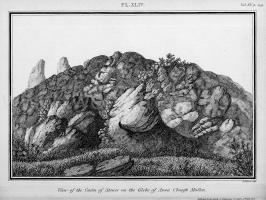
March 14th, 1804. The Rev. the Dean of Raphoe presented to the Society four original drawings of some caves [Ballymacdermot Court Tomb [Map]], which he had discovered on his glebe, in the parish of Killevy, in the county of Armagh in Ireland. Some account of these caves, with engravings, has been published by General Vallencey, in his Collectanea de Rebus Hibernicis; yet, for the satisfaction of such gentlemen as may not have seen that publication, the Dean accompanied his present with a short description, as follows:
In the parish of Killevy, and Town Land of Anna-Clogh Mullen, is a very large cairn of stones, not less than sixty feet long, and about twelve feet high. (Pl.XLIV.) I was requested by my neighbour. Sir Walter Synnot, to have the cairn opened, in expectation of discovering some urns.
I opened it nearly at the centre, and discovered an apartment about six feet eight inches long, six feet two inches wide, the side walls about three feet perpendicular, consisting of single stones of that breadth, laid on their edges, from whence an arch was sprung of dry corbelling stones, and covered at top with a flag about three feet broad. One of the drawings accompanying this, (Pl.XLV.) is a view of the inside of this apartment; and as there were evidently the appearances of door cases of entrance into other apartments, I determined to examine the cairn on the outside, to discover the entrance from without; and remarking that two of the stones towards one end of the cairn rose higher than the rest, I caused all the loose stones to be removed from them; when I was much surprized to discover a regular front composed of large dry stones, between two pillars of rude single stones, each about nine feet high, as described in the drawing representing the front, (Pl. XLV ) with a door-way of entrance into another apartment similar to the one I first discovered, about eight feet wide, and nine feet six inches long; which opened into a second about six feet six inches wide, and six feet long; which opened into the one I first discovered, and this communicated with a fourth about two feet wide and six feet long.
From the tall pillars at the entrance, a circular range of small stones were fixed in the ground to the distance of about thirty-three feet from the centre of the door of entrance, and the whole terminated by a stone at each end, about two feet six inches high, as is represented in the ground plan. (Pl. XLVII.) In none of the apartments did we discover any urns, or any thing that would lead to the discovery of the purposes for which these caves were designed, but unquestionably they are of great antiquity: nor was there any tradition among the inhabitants, either of the cairn containing such apartments, or the occasion on which it had been formed. As the fourth apartment did not extend much beyond the centre of the cairn, my intention was to have explored the remaining half of the cairn, but being very soon after the diseovery removed to the Deanery of Raphoe, no farther examination has been made.