

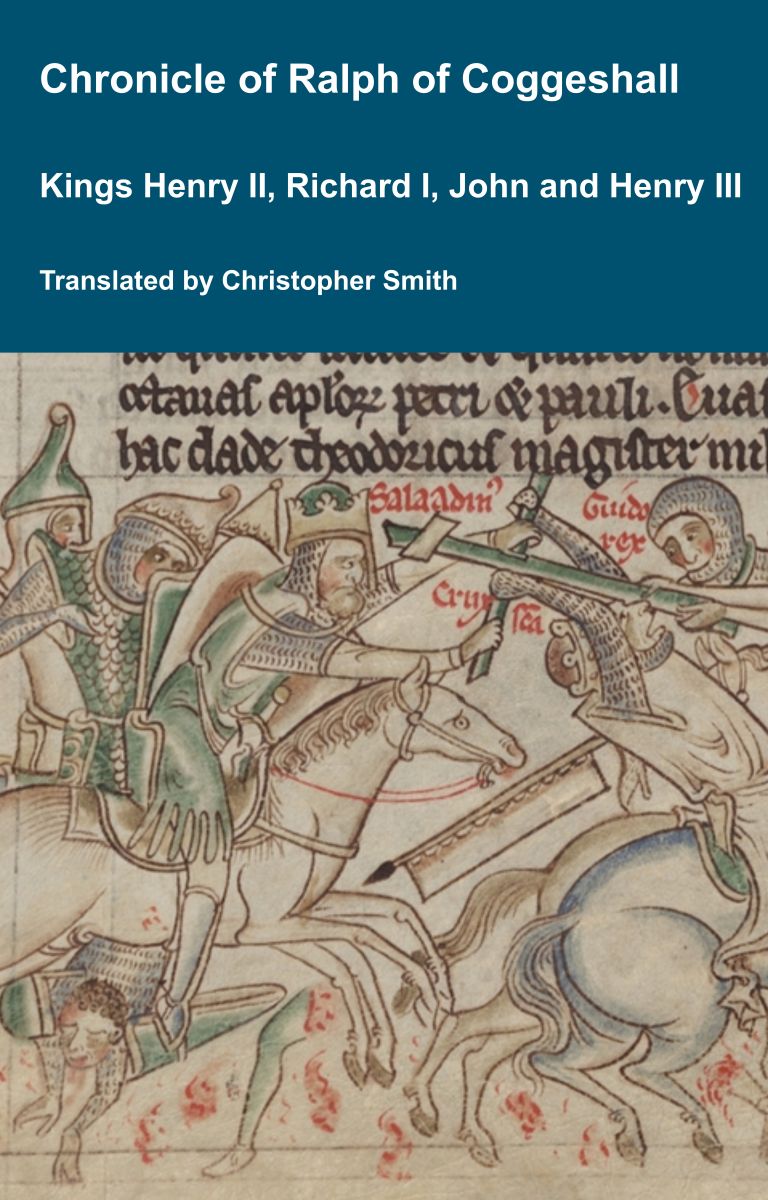
Chronicle of Abbot Ralph of Coggeshall
The Chronicle of Abbot Ralph of Coggeshall (Chronicon Anglicanum) is an indispensable medieval history that brings to life centuries of English and European affairs through the eyes of a learned Cistercian monk. Ralph of Coggeshall, abbot of the Abbey of Coggeshall in Essex in the early 13th century, continued and expanded his community’s chronicle, documenting events from the Norman Conquest of 1066 into the tumultuous reign of King Henry III. Blending eyewitness testimony, careful compilation, and the monastic commitment to record-keeping, this chronicle offers a rare narrative of political intrigue, royal power struggles, and social upheaval in England and beyond. Ralph’s work captures the reigns of pivotal figures such as Richard I and King John, providing invaluable insights into their characters, decisions, and the forces that shaped medieval rule. More than a simple annal, Chronicon Anglicanum conveys the texture of medieval life and governance, making it a rich source for scholars and readers fascinated by English history, monastic authorship, and the shaping of the medieval world.
Available at Amazon in eBook and Paperback format.
Archaeologia Volume 3 Section XXX is in Archaeologia Volume 3.

Extract of a Letter from the Reverend Mr. George Low, to Mr. Paton, of Edinburgh. Communicated by Mr. Gough. Read at the Society of Antiquaries, March 12, 19, 1773.
Stromness, Nov. 27, 1772.
The traditions concerning the antiquities of this country are surprisingly vague, and little to be depended on. There are indeed many remains which bear the damp of the remotest times; such as the burial-places of which I am going to speak, and the circles of stones which are still remaining on the mainland; but all that can be gathered is, that they were formerly held in veneration, but for what reason is not to be by their accounts investigated.
When Mr. Banks was here, I was with, him every day, and he was pleased to make me the director of his Orkney tour. One day we went a grave-digging in the Links of Skail [Map], on the mainland, where there are great numbers of tumuli. We pitched upon one which seemed never to have been moved since its first construction; and Mr. Banks ordered the people to begin at one side, and dig to the other, that we might see the whole fabric of it. It was of a flattish conical shape, something resemblmg the figure in the plate annexed. After digging away a great quantity of sand, till we came near the centre of the hill, the people struck their spades on several large stones; upon which Mr. Banks ordered them to dig round them, and the whole conftruction appeared as I have sketched it with my pen; first, a large quantity of sand, then a large parcel of great stones, which seemed to have been taken from the neighbouring sea shore. When these were removed, the coffin or chest appeared, which was composed of four stones, covered with a very large fifth stone. In these lay the old gentleman (for so it appeared by his teeth he was) on his side, with his hands folded on his breast, his knees drawn up towards his belly, and his heels towards his hips. This was a highly-preserved skeleton, notwithstanding the length of time it must have lain. All the bones remained, only they were softish till they hardened in the air. The flesh was like a whitish earth, lying about the bones of the thicker parts of the body and on the arms, &c. was scattered a fort of blackish fibres, which Dr. Lind supposed might have been been the vascular system. What was remarkable was, a bag of some very coarfe vegetable stuff, which was laid at his feet, and contained the bones of a younger person, which seemed to have been a woman. Upon this were made many ingenious conjectures; that this might have been his wife, who died perhaps at thirty years of age, and might not have been buried till her husband died, and then her bones collected into this bag, and laid at his feet in the same grave. In examining a piece of this bag, to see whether it was made of a vegetable or animal subftance, I discovered it to be full of a species of insects called by Linnaeus Dermestes. These, together with the bag, were reduced to a blackish mass, which might be crumbled to powder between the fingers; but the warp and woof of the latter, as well as the entire shape of the insects, might easily be traced. There can be little said as to the antiquity of this, only that it was made before the introduction of Christianity.