

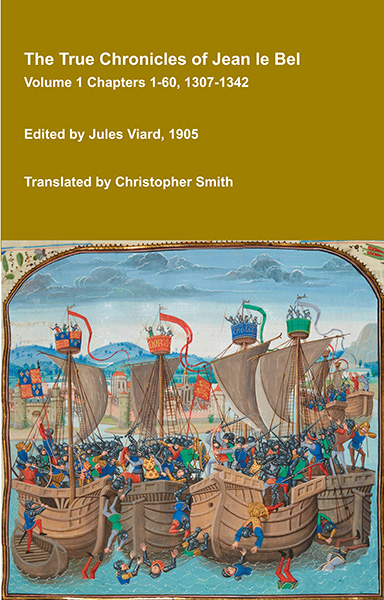
The True Chronicles of Jean le Bel Volume 1 Chapters 1-60 1307-1342
The True Chronicles of Jean le Bel offer one of the most vivid and immediate accounts of 14th-century Europe, written by a knight who lived through the events he describes, and experienced some of them first hand. Covering the early decades of the Hundred Years’ War, this remarkable chronicle follows the campaigns of Edward III of England, the politics of France and the Low Countries, and the shifting alliances that shaped medieval warfare. Unlike later historians, Jean le Bel writes with a strong sense of eyewitness authenticity, drawing on personal experience and the testimony of fellow soldiers. His narrative captures not only battles and sieges, but also the realities of military life, diplomacy, and the ideals of chivalry that governed noble society. A key source for Jean Froissart, Le Bel’s chronicle stands on its own as a compelling and insightful work, at once historical record and literary achievement. This translation builds on the 1905 edition published in French by Jules Viard, adding extensive translations from other sources Rymer's Fœdera, the Chronicles of Adam Murimuth, William Nangis, Walter of Guisborough, a Bourgeois of Valenciennes, Geoffrey le Baker of Swinbroke and Richard Lescot to enrich the original text and Viard's notes.
Available at Amazon in eBook and Paperback format.
Archaeologia Volume 7 Section XX is in Archaeologia Volume 7.
Remarks on the preceding Article. By Mr. Bray. In a letter to the Secretary. Read December 18, 1783.
Sir,
I am very glad to find that the ingenious major Rooke (age 61) has furnished the Society with drawings of that curious remain of very early fortification, the Caers-work [Map] (or, as the name was given me, the Carles-work) near Hathersage in Derbyshire. It was first noticed in print (I believe) in the tour into that country which I ventured to lay before the public this year, but is much better illustrated by the major. If it will not be improper to offer the Society two drawings in addition to those which Mr. Rooke has sent, I will beg you to present them.
The number of curiosities of the highest antiquity which that county affords, well deserves attention, and (I speak experimentally) the traveller who shall go in search of them will no where find a greater variety of scenery, than is there presented in succession to his eye. The antiquary will, however, have to lament that while turnpike roads facilitate his visit, the barbarity of turnpike surveyors will destroy the objects of his search; barrows, druidical temples, rocking stones, and whatever comes in their way, fall a prey to their sacrilegious hands. It has been the case with one rocking stone near this Work, which was too near the road to escape; — nimium vicina Cremona! [Note. A quote from Virgil's Eclogues "Cremona is too close"]
Adjoining to Hathersage church yard is a small circular fortification; perhaps that of the enemy which might cause the rude one on the Moor. I am, &c.
William Bray.