

The Deeds of the Dukes of Normandy
The Gesta Normannorum Ducum [The Deeds of the Dukes of Normandy] is a landmark medieval chronicle tracing the rise and fall of the Norman dynasty from its early roots through the pivotal events surrounding the Norman Conquest of England. Originally penned in Latin by the monk William of Jumièges shortly before 1060 and later expanded at the behest of William the Conqueror, the work chronicles the deeds, politics, battles, and leadership of the Norman dukes, especially William’s own claim to the English throne. The narrative combines earlier historical sources with firsthand information and oral testimony to present an authoritative account of Normandy’s transformation from a Viking settlement into one of medieval Europe’s most powerful realms. William’s history emphasizes the legitimacy, military prowess, and governance of the Norman line, framing their expansion, including the conquest of England, as both divinely sanctioned and noble in purpose. Later chroniclers such as Orderic Vitalis and Robert of Torigni continued the history, extending the coverage into the 12th century, providing broader context on ducal rule and its impact. Today this classic work remains a foundational source for understanding Norman identity, medieval statesmanship, and the historical forces that reshaped England and Western Europe between 800AD and 1100AD.
Available at Amazon in eBook and Paperback format.
Archaeologia Volume 8 Section XXXIV is in Archaeologia Volume 8.

Description of the Druid Temple [La Hogue Bie [Map]] lately discovered on the top of the Hill near St. Hillary in Jersey. Communicated by Mr. Molseworth. Read January 11, 1787.
It is sixty-six feet in circumference, composed of forty-five large stones, measuring seven feet in height, six in breadth, four in thickness, containing four perfect lodges [or cells] and one destroyed. The supposed entrance in it may be called a subterraneous passage, faces the East, and measures fifteen feet in length, four feet two inches and a half in breadth from the inside of the two outward pillars or stones, in height two feet, each pillar being one foot nine inches and a half thick.
The inside of the passage measures five feet three inches in breadth, four feet four inches in height, and the first covering stone three feet in thickness; it gradually decreases the length of the fifteen feet before-mentioned.
The vacancy on the North side, which appears to have been the real vacancy, measures in breadth fix feet nine inches.
The greatest lodge, facing nearly the East, or subterraneous passage, measures, both in depth and length, four feet three inches; the next on the left four feet in breadth, four feet three inches in length, and three feet feven inches in height. The distance from one to the other is two feet sixteen inches; the third, at the distance of five feet nine inches from the second, measures in breadth two feet sixteen inches, in length two feet nineteen, in height four feet.
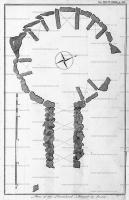
The subterraneous passage in the inside of the temple, describing a perfect lodge, distant from the third ten feet, and the fourth joining both East: and North passages, in breadth measures two feet four inches, and two feet one-eighth in depth. The eastern cavity is still filled up with the same rubbish that covered the temple.
Two medals were found in this temple, one of the emperor Claudius, and the other so worn by time as to render it unintelligible.
About fifty yards South from the temple are five places in the form of our graves, masoned on every side, but not paved, and lying E. and W. A done quite alone lies five feet from the subterraneous passage.