


Text this colour is a link for Members only. Support us by becoming a Member for only £3 a month by joining our 'Buy Me A Coffee page'; Membership gives you access to all content and removes ads.
Text this colour links to Pages. Text this colour links to Family Trees. Place the mouse over images to see a larger image. Click on paintings to see the painter's Biography Page. Mouse over links for a preview. Move the mouse off the painting or link to close the popup.
All About History Books
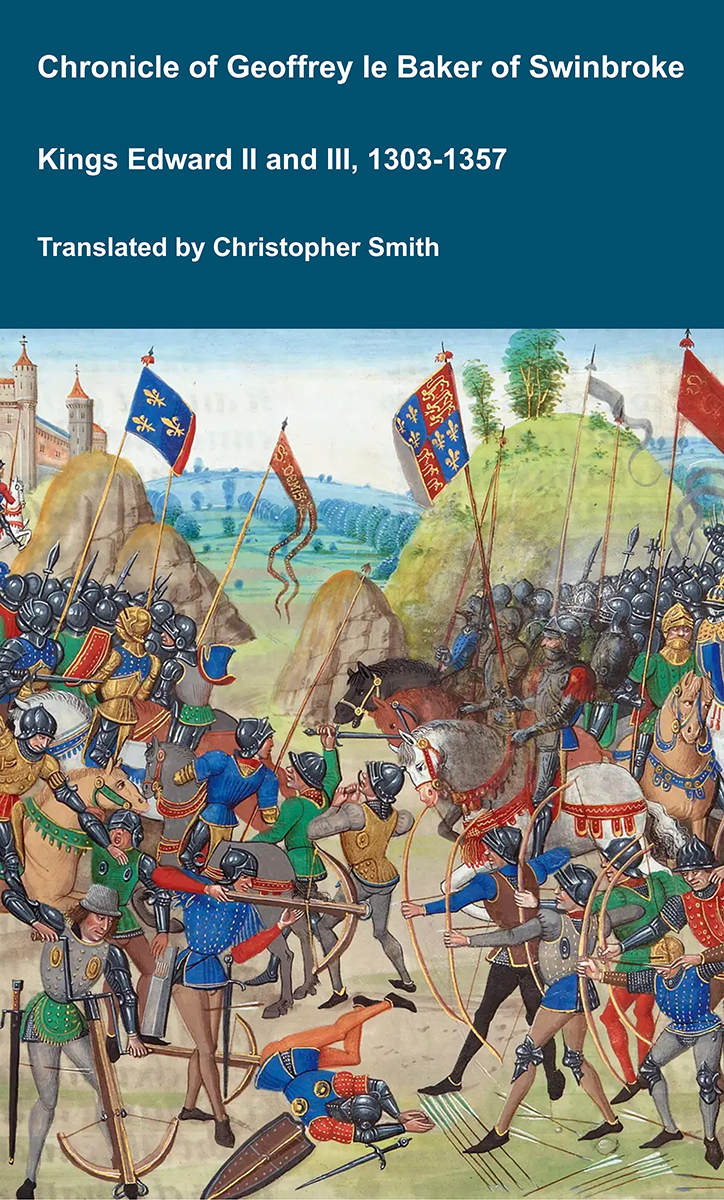
The Chronicle of Geoffrey le Baker of Swinbroke. Baker was a secular clerk from Swinbroke, now Swinbrook, an Oxfordshire village two miles east of Burford. His Chronicle describes the events of the period 1303-1356: Gaveston, Bannockburn, Boroughbridge, the murder of King Edward II, the Scottish Wars, Sluys, Crécy, the Black Death, Winchelsea and Poitiers. To quote Herbert Bruce 'it possesses a vigorous and characteristic style, and its value for particular events between 1303 and 1356 has been recognised by its editor and by subsequent writers'. The book provides remarkable detail about the events it describes. Baker's text has been augmented with hundreds of notes, including extracts from other contemporary chronicles, such as the Annales Londonienses, Annales Paulini, Murimuth, Lanercost, Avesbury, Guisborough and Froissart to enrich the reader's understanding. The translation takes as its source the 'Chronicon Galfridi le Baker de Swynebroke' published in 1889, edited by Edward Maunde Thompson. Available at Amazon in eBook and Paperback.
Blacks Guide to Derbyshire is in Prehistory.
Black's Guide to Buxton and the Peak Country of Derbyshire Edited By A. R Hope Moncrieff. Ninth Edition. London Adam And Charles Black. 1898.
Parsley Hay, where, on getting out of the train, one sees hardly any houses but the forlorn little terminus, and must turn up the road for a modest refreshment room, is also the station for Arbor Low [Map], the Derbyshire Stonehenge, that stands conspicuously elevated a mile to the east on the south of the Bakewell Road. Its Druidical circle, which comes next in importance to those of Stonehenge and Avebury, consists of overthrown stones, mostly 6 to 8 feet high, lying disordered on a platform about 50 yards in diameter, surrounded by a wide ditch. On the east side of the south entrance is a large barrow, the exploration of which has proved the antiquity of this "high place." Some quarter of a mile westwards is another conical tumulus known as Gib Hill [Map], connected with Arbor Low by a bank of earth. On this side the Roman road can be traced, taking its straighter line near the modem turnpike, with which it in part coincides.
Only the present remoteness of Arbor Low prevents it from being more often visited. "Its situation, though considerably elevated, is not so high as some eminences in the neighbouring country; yet it commands an extensive view, especially towards the north-east, in which direction the dreary and sombre wastes of the heath-clad East Moor are perfectly visible, though distant about 15 miles; were it not for a few stone fences, which intervene in the foreground, the solitude of the place and the boundless view of an uncultivated country are such as almost carry the observer back through a multitude of centuries, and make him believe that he sees the same view, and the same state of things as existed in the days of the architects of this once holy fane." — Bateman's Vestiges of the Antiquities of Derbyshire.