

Jean de Waurin's Chronicle of England Volume 6 Books 3-6: The Wars of the Roses
Jean de Waurin was a French Chronicler, from the Artois region, who was born around 1400, and died around 1474. Waurin’s Chronicle of England, Volume 6, covering the period 1450 to 1471, from which we have selected and translated Chapters relating to the Wars of the Roses, provides a vivid, original, contemporary description of key events some of which he witnessed first-hand, some of which he was told by the key people involved with whom Waurin had a personal relationship.
Available at Amazon in eBook and Paperback format.
Book of Daniel Chapter 13 Susanna and the Elders is in Book of Daniel.
1. In Babylon there lived a man named Joakim,
2. who married a very beautiful and God-fearing woman, Susanna, the daughter of Hilkiah;
3. her parents were righteous and had trained their daughter according to the law of Moses.
4. Joakim was very rich and he had a garden near his house. The Jews had recourse to him often because he was the most respected of them all.
5. That year, two elders of the people were appointed judges, of whom the Lord said, "Lawlessness has come out of Babylon, that is, from the elders who were to govern the people as judges."
6. These men, to whom all brought their cases, frequented the house of Joakim.
7. When the people left at noon, Susanna used to enter her husband's garden for a walk.
8. When the elders saw her enter every day for her walk, they began to lust for her.
9. They perverted their thinking; they would not allow their eyes to look to heaven, and did not keep in mind just judgments.
10. Though both were enamored of her, they did not tell each other their trouble,
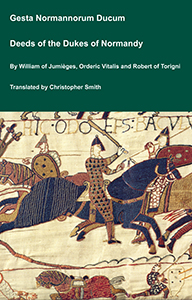
The Deeds of the Dukes of Normandy
The Gesta Normannorum Ducum [The Deeds of the Dukes of Normandy] is a landmark medieval chronicle tracing the rise and fall of the Norman dynasty from its early roots through the pivotal events surrounding the Norman Conquest of England. Originally penned in Latin by the monk William of Jumièges shortly before 1060 and later expanded at the behest of William the Conqueror, the work chronicles the deeds, politics, battles, and leadership of the Norman dukes, especially William’s own claim to the English throne. The narrative combines earlier historical sources with firsthand information and oral testimony to present an authoritative account of Normandy’s transformation from a Viking settlement into one of medieval Europe’s most powerful realms. William’s history emphasizes the legitimacy, military prowess, and governance of the Norman line, framing their expansion, including the conquest of England, as both divinely sanctioned and noble in purpose. Later chroniclers such as Orderic Vitalis and Robert of Torigni continued the history, extending the coverage into the 12th century, providing broader context on ducal rule and its impact. Today this classic work remains a foundational source for understanding Norman identity, medieval statesmanship, and the historical forces that reshaped England and Western Europe between 800AD and 1100AD.
Available at Amazon in eBook and Paperback format.
11. for they were ashamed to reveal their lustful desire to have her.
12. Day by day they watched eagerly for her.
13. One day they said to each other, "Let us be off for home, it is time for the noon meal." So they went their separate ways.
14. But both turned back and arrived at the same spot. When they asked each other the reason, they admitted their lust, and then they agreed to look for an occasion when they could find her alone.
15. One day, while they were waiting for the right moment, she entered as usual, with two maids only, wanting to bathe in the garden, for the weather was warm.
16. Nobody else was there except the two elders, who had hidden themselves and were watching her.
17. "Bring me oil and soap," she said to the maids, "and shut the garden gates while I bathe."
18. They did as she said; they shut the garden gates and left by the side gate to fetch what she had ordered, unaware that the elders were hidden inside.
19. As soon as the maids had left, the two old men got up and ran to her.
20. "Look," they said, "the garden doors are shut, no one can see us, and we want you. So give in to our desire, and lie with us.
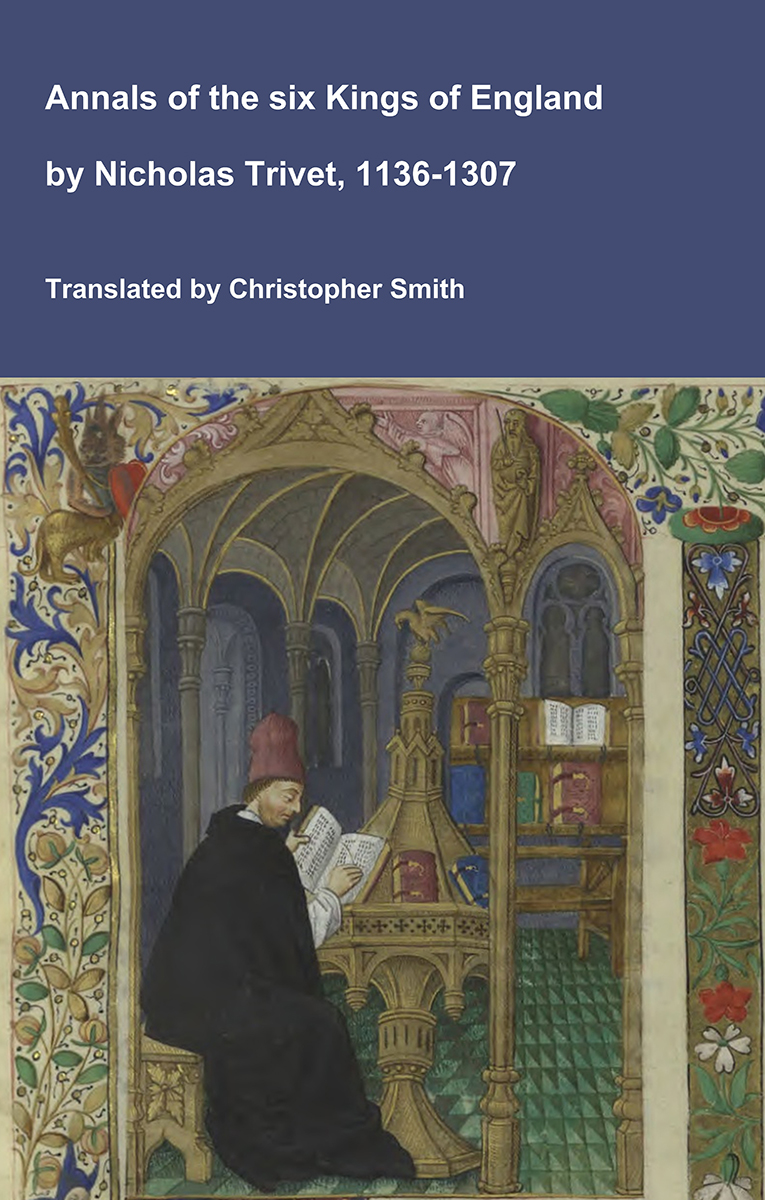
Annals of the six Kings of England by Nicholas Trivet
Translation of the Annals of the Six Kings of England by that traces the rise and rule of the Angevin aka Plantagenet dynasty from the mid-12th to early 14th century. Written by the Dominican scholar Nicholas Trivet, the work offers a vivid account of English history from the reign of King Stephen through to the death of King Edward I, blending political narrative with moral reflection. Covering the reigns of six monarchs—from Stephen to Edward I—the chronicle explores royal authority, rebellion, war, and the shifting balance between crown, church, and nobility. Trivet provides detailed insight into defining moments such as baronial conflicts, Anglo-French rivalry, and the consolidation of royal power under Edward I, whose reign he describes with particular immediacy. The Annals combines careful year-by-year reporting with thoughtful interpretation, presenting history not merely as a sequence of events but as a moral and political lesson. Ideal for readers interested in medieval history, kingship, and the origins of the English state, this chronicle remains a valuable and accessible window into the turbulent world of the Plantagenet kings.
Available at Amazon in eBook and Paperback format.
21. If you refuse, we will testify against you that a young man was here with you and that is why you sent your maids away."
22. "I am completely trapped," Susanna groaned. "If I yield, it will be my death; if I refuse, I cannot escape your power.
23. Yet it is better for me not to do it and to fall into your power than to sin before the Lord."
24. Then Susanna screamed, and the two old men also shouted at her,
25. as one of them ran to open the garden gates.
26. When the people in the house heard the cries from the garden, they rushed in by the side gate to see what had happened to her.
27. At the accusations of the old men, the servants felt very much ashamed, for never had any such thing been said about Susanna.
28. When the people came to her husband Joakim the next day, the two wicked old men also came, full of lawless intent to put Susanna to death.
29. Before the people they ordered: "Send for Susanna, the daughter of Hilkiah, the wife of Joakim." When she was sent for,
30. she came with her parents, children and all her relatives.
31. Susanna, very delicate and beautiful,
32. was veiled; but those transgressors of the law ordered that she be exposed so as to sate themselves with her beauty.
The Deeds of the Dukes of Normandy
The Gesta Normannorum Ducum [The Deeds of the Dukes of Normandy] is a landmark medieval chronicle tracing the rise and fall of the Norman dynasty from its early roots through the pivotal events surrounding the Norman Conquest of England. Originally penned in Latin by the monk William of Jumièges shortly before 1060 and later expanded at the behest of William the Conqueror, the work chronicles the deeds, politics, battles, and leadership of the Norman dukes, especially William’s own claim to the English throne. The narrative combines earlier historical sources with firsthand information and oral testimony to present an authoritative account of Normandy’s transformation from a Viking settlement into one of medieval Europe’s most powerful realms. William’s history emphasizes the legitimacy, military prowess, and governance of the Norman line, framing their expansion, including the conquest of England, as both divinely sanctioned and noble in purpose. Later chroniclers such as Orderic Vitalis and Robert of Torigni continued the history, extending the coverage into the 12th century, providing broader context on ducal rule and its impact. Today this classic work remains a foundational source for understanding Norman identity, medieval statesmanship, and the historical forces that reshaped England and Western Europe between 800AD and 1100AD.
Available at Amazon in eBook and Paperback format.
33. All her companions and the onlookers were weeping.
34. In the midst of the people the two old men rose up and laid their hands on her head.
35. As she wept she looked up to heaven, for she trusted in the Lord wholeheartedly.
36. The old men said, "As we were walking in the garden alone, this woman entered with two servant girls, shut the garden gates and sent the servant girls away.
37. A young man, who was hidden there, came and lay with her.
38. When we, in a corner of the garden, saw this lawlessness, we ran toward them.
39. We saw them lying together, but the man we could not hold, because he was stronger than we; he opened the gates and ran off.
40. Then we seized this one and asked who the young man was,
41. but she refused to tell us. We testify to this." The assembly believed them, since they were elders and judges of the people, and they condemned her to death.
42. But Susanna cried aloud: "Eternal God, you know what is hidden and are aware of all things before they come to be:
The Deeds of the Dukes of Normandy
The Gesta Normannorum Ducum [The Deeds of the Dukes of Normandy] is a landmark medieval chronicle tracing the rise and fall of the Norman dynasty from its early roots through the pivotal events surrounding the Norman Conquest of England. Originally penned in Latin by the monk William of Jumièges shortly before 1060 and later expanded at the behest of William the Conqueror, the work chronicles the deeds, politics, battles, and leadership of the Norman dukes, especially William’s own claim to the English throne. The narrative combines earlier historical sources with firsthand information and oral testimony to present an authoritative account of Normandy’s transformation from a Viking settlement into one of medieval Europe’s most powerful realms. William’s history emphasizes the legitimacy, military prowess, and governance of the Norman line, framing their expansion, including the conquest of England, as both divinely sanctioned and noble in purpose. Later chroniclers such as Orderic Vitalis and Robert of Torigni continued the history, extending the coverage into the 12th century, providing broader context on ducal rule and its impact. Today this classic work remains a foundational source for understanding Norman identity, medieval statesmanship, and the historical forces that reshaped England and Western Europe between 800AD and 1100AD.
Available at Amazon in eBook and Paperback format.
43. you know that they have testified falsely against me. Here I am about to die, though I have done none of the things for which these men have condemned me."
44. The Lord heard her prayer.
45. As she was being led to execution, God stirred up the holy spirit of a young boy named Daniel,
46. and he cried aloud: "I am innocent of this woman's blood."
47. All the people turned and asked him, "What are you saying?"
48. He stood in their midst and said, "Are you such fools, you Israelites, to condemn a daughter of Israel without investigation and without clear evidence?
49. Return to court, for they have testified falsely against her."
50. Then all the people returned in haste. To Daniel the elders said, "Come, sit with us and inform us, since God has given you the prestige of old age."
51. But he replied, "Separate these two far from one another, and I will examine them."
52. After they were separated from each other, he called one of them and said: "How you have grown evil with age! Now have your past sins come to term:
Jean de Waurin's Chronicle of England Volume 6 Books 3-6: The Wars of the Roses
Jean de Waurin was a French Chronicler, from the Artois region, who was born around 1400, and died around 1474. Waurin’s Chronicle of England, Volume 6, covering the period 1450 to 1471, from which we have selected and translated Chapters relating to the Wars of the Roses, provides a vivid, original, contemporary description of key events some of which he witnessed first-hand, some of which he was told by the key people involved with whom Waurin had a personal relationship.
Available at Amazon in eBook and Paperback format.
53. passing unjust sentences, condemning the innocent, and freeing the guilty,a although the Lord says, 'The innocent and the just you shall not put to death.'
54. Now, then, if you were a witness, tell me under what tree you saw them together."
55. "Under a mastic tree,"* he answered. "Your fine lie has cost you your head," said Daniel; "for the angel of God has already received the sentence from God and shall split you in two."
56. Putting him to one side, he ordered the other one to be brought. "Offspring of Canaan, not of Judah," Daniel said to him, "beauty has seduced you, lust has perverted your heart.
57. This is how you acted with the daughters of Israel, and in their fear they yielded to you; but a daughter of Judah did not tolerate your lawlessness.
58. Now, then, tell me under what tree you surprised them together."
59. "Under an oak," he said. "Your fine lie has cost you also your head," said Daniel; "for the angel of God waits with a sword to cut you in two so as to destroy you both."
60. The whole assembly cried aloud, blessing God who saves those who hope in him.
61. They rose up against the two old men, for by their own words Daniel had convicted them of bearing false witness.b They condemned them to the fate they had planned for their neighbor:
62. in accordance with the law of Moses they put them to death. Thus was innocent blood spared that day.
63. Hilkiah and his wife praised God for their daughter Susanna, with Joakim her husband and all her relatives, because she was found innocent of any shameful deed.
64. And from that day onward Daniel was greatly esteemed by the people.