

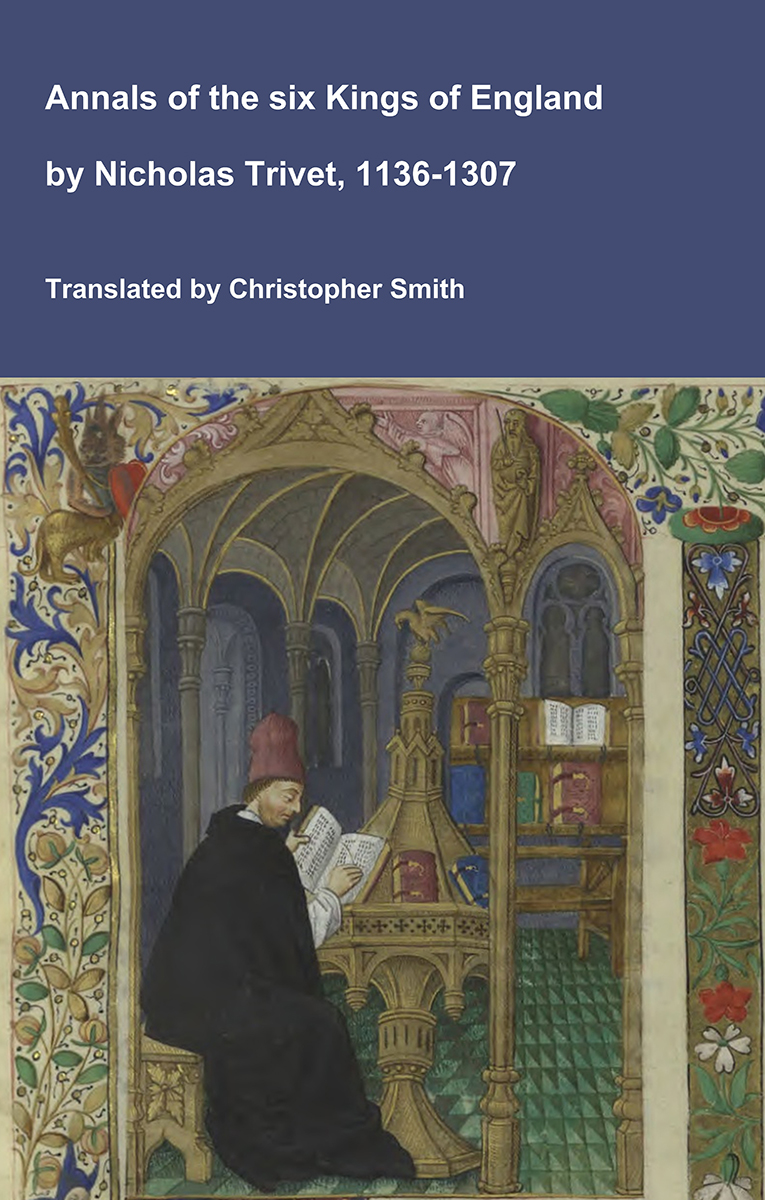
Annals of the six Kings of England by Nicholas Trivet
Translation of the Annals of the Six Kings of England by that traces the rise and rule of the Angevin aka Plantagenet dynasty from the mid-12th to early 14th century. Written by the Dominican scholar Nicholas Trivet, the work offers a vivid account of English history from the reign of King Stephen through to the death of King Edward I, blending political narrative with moral reflection. Covering the reigns of six monarchs—from Stephen to Edward I—the chronicle explores royal authority, rebellion, war, and the shifting balance between crown, church, and nobility. Trivet provides detailed insight into defining moments such as baronial conflicts, Anglo-French rivalry, and the consolidation of royal power under Edward I, whose reign he describes with particular immediacy. The Annals combines careful year-by-year reporting with thoughtful interpretation, presenting history not merely as a sequence of events but as a moral and political lesson. Ideal for readers interested in medieval history, kingship, and the origins of the English state, this chronicle remains a valuable and accessible window into the turbulent world of the Plantagenet kings.
Available at Amazon in eBook and Paperback format.
Cambrian Register is in Prehistory.
From a Manuscript of George Owen, Esq. Of Henllys, Lord Of Kemes, With Additions1 and Observations by John Lewis, Esq. Of Manarnawan, the same that is referred to and cited In Gibson's Edition of Camden, and now first published from the original, by his great grandson, Richard Fenton; Esq. 1603.
Note 1. As the vast mass of supplementary matter collected by my ancestor, was never meant to meet the public eye in the slate I found it, having undergone very little arrangement, and as it was very richly interlarded with perfonal invective and private anecdotes of families, which, from respect to their descendants, men of high honour and character, I could not with any degree of delicacy suffer to go abroad, I have been able to make use of but a very small portion of his collection, which, if ever I have leisure thoroughly to garble and methodize, may serve not only to elucidate the history of Pembrokeshire in particular, but to enrich the general flock of antiquarian knowledge.
Another1 thing worth the noting, is the stone called Maen y Gromlech [Map], upon Pentre Jevan Lande. It is a huge and massie stone, mounted on high, and set on the topps of 3 other high stones, pitched, standing upright in the ground, which far passeth for bignes and hight, Arthur's Stone [Map], in the way betweene Hereford and the Haye, or Leck yr Aft, neere Blaen Porth, in Cardiganshire; or any other that ever I sawe, saving some in Stonehenge, upon. Salisburie Plaine; called Chorca Gigantum, being one of the chiefe wonders of England. The stones whereon this is layd are soe high, that a man on horseback may, well ryde under it without stowping. The stone that is thus mounted is 18 foote long, and 9 foote brodey and 8 foote thicke at one end, but thinner at the other; and fram it, asit is apparent since: his placing there, is broken a piece of & foote brode, and 10 foote long, lieing yet in the place, more than 20 oxen would draw. Doubtlesse this stone was mounted of some great vicotry, or the burial of some notable person, which was the ancient rite, for that it hath pitched stones standing one against the other round about and close to the huge stone, which is mounted high to be seene afarr off, much like to that which is written, Libs 1mo, Machab: cap. 13. of the buriall of the patriarch Jacob, (Et edificavit Simon fuper fepulchrum patris fui & fratrum fuorum edificium altum vifu, Lapide polito retro & ante; & statuit feptem Piramides unam contra unam, patri & matri & quatuor fratribus 8 hies circumpofunt - Columnus magnas & fuper Columnas arma ad memoriam æternum & juxta arma naves fculptas quae videfentur ab hominibus navigantibus mare)-or, such notable thing, but there: is; no reporte or memorie, or other matter to be found, of the cause of the erecting of this trophea. They'call the stone Gromlech, but I thinke the true etymologie is Grymlech, the ftone of firength, for that great strength: was used in the setting of it, to lye in forte as it doth.
Note 1. This account, Mr. Edward Llwyd; of the Ashmolean Museum, acknowledges to have received from my ancestor, John Lewis, Esq. of Manarnavon, which he has introduced into his additions to Camden's Account of Wales; as published by Gibson, but by a marginal memorandum of Mr. Lewis's, prior to his having received any information respecting those ancient monuments from a gentleman of Glamorganshire that served to influence his opinion concerning theitr origin.