

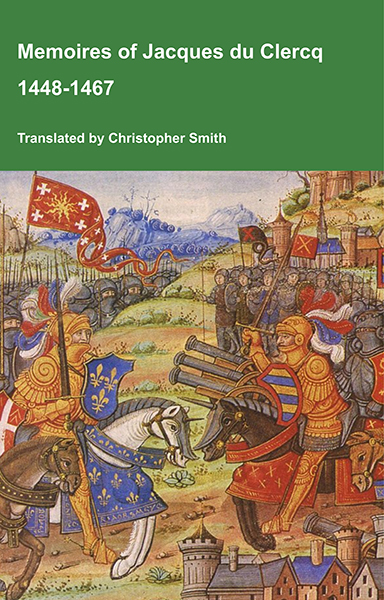
This is a translation of the 'Memoires of Jacques du Clercq', published in 1823 in two volumes, edited by Frederic, Baron de Reissenberg. In his introduction Reissenberg writes: 'Jacques du Clercq tells us that he was born in 1424, and that he was a licentiate in law and a counsellor to Philip the Good, Duke of Burgundy, in the castellany of Douai, Lille, and Orchies. It appears that he established his residence at Arras. In 1446, he married the daughter of Baldwin de la Lacherie, a gentleman who lived in Lille. We read in the fifth book of his Memoirs that his father, also named Jacques du Clercq, had married a lady of the Le Camelin family, from Compiègne. His ancestors, always attached to the counts of Flanders, had constantly served them, whether in their councils or in their armies.' The Memoires cover a period of nineteen years beginning in in 1448, ending in in 1467. It appears that the author had intended to extend the Memoirs beyond that date; no doubt illness or death prevented him from carrying out this plan. As Reissenberg writes the 'merit of this work lies in the simplicity of its narrative, in its tone of good faith, and in a certain air of frankness which naturally wins the reader’s confidence.' Du Clercq ranges from events of national and international importance, including events of the Wars of the Roses in England, to simple, everyday local events such as marriages, robberies, murders, trials and deaths, including that of his own father in Book 5; one of his last entries.
Available at Amazon in eBook and Paperback format.
Cecil Papers is in Tudor Books.
1597. Lord Hunsdon, Lord Chamberlain (age 50), to the QUEEN. [1597]. Through the present weakness of my joints not able to bend by knee before you, I beseech you to pardon my writing about my suit, where means of speaking are denied me.
How long the suit has depended between Lord Rich and others and myself respecting your due and birthright, you know, and how great the charges on my estate; but now finding that there are only two means to raise my loss and expense, either a peremptory command from your Majesty for a speedier proceeding in the cause, or that you should transfer your right to me, and leave to my industry to perform the trial thereof. Considering the fear to offend and the private partiality of those that should do justice I think the second the better course, wherein you shall pass nothing whereof any wise you are possessed, or by the course now held are ever likely to enjoy; and should I succeed I dare assure your Majesty a most honourable present from the fruits of my efforts.
My first proceedings were by the advice of the best learned in the law, and that I am now grown tired proceeds from the law's delays and the cunning of my adversaries.
Furthermore, three years since it pleased you to promise the reference and hearing of my claim to the Earldom of Ormond to your Judges and learned counsel, which claim I put forward to disprove the reproaches which the adversaries direct against the house of which you are descended by the mother's side. And I may not neglect to seek what in right and honour descends upon me.
Lastly, I humbly pray you to signify your pleasure to Mr. Secretary, lest I trouble you with further demands than agree with your liking.
Signed "G. Hunsdon". (58. 28.)