

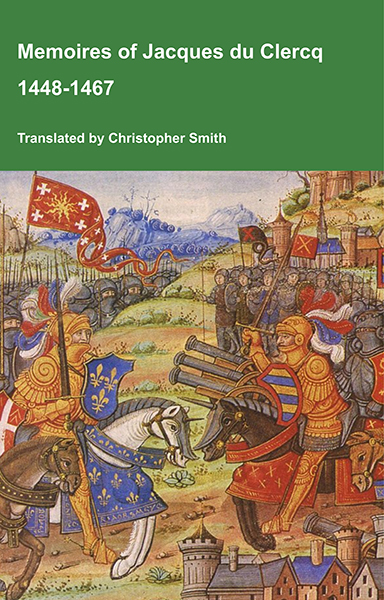
This is a translation of the 'Memoires of Jacques du Clercq', published in 1823 in two volumes, edited by Frederic, Baron de Reissenberg. In his introduction Reissenberg writes: 'Jacques du Clercq tells us that he was born in 1424, and that he was a licentiate in law and a counsellor to Philip the Good, Duke of Burgundy, in the castellany of Douai, Lille, and Orchies. It appears that he established his residence at Arras. In 1446, he married the daughter of Baldwin de la Lacherie, a gentleman who lived in Lille. We read in the fifth book of his Memoirs that his father, also named Jacques du Clercq, had married a lady of the Le Camelin family, from Compiègne. His ancestors, always attached to the counts of Flanders, had constantly served them, whether in their councils or in their armies.' The Memoires cover a period of nineteen years beginning in in 1448, ending in in 1467. It appears that the author had intended to extend the Memoirs beyond that date; no doubt illness or death prevented him from carrying out this plan. As Reissenberg writes the 'merit of this work lies in the simplicity of its narrative, in its tone of good faith, and in a certain air of frankness which naturally wins the reader’s confidence.' Du Clercq ranges from events of national and international importance, including events of the Wars of the Roses in England, to simple, everyday local events such as marriages, robberies, murders, trials and deaths, including that of his own father in Book 5; one of his last entries.
Available at Amazon in eBook and Paperback format.
Chronicle of Athelward is in Early Medieval Books.
Of the reign of king Athehtan, his wars and deeds.
924. 926. The year in which the stout king Athelstan (age 30) gained the crown of the kingdom, was the nine hundred and twenty-sixth from the glorious incarnation of our Saviour.
937. 939. Therefore, after thirteen years, a fierce battle was fought against the barbarians at Brunandune1, wherefore that fight is called great even to the present day: then the barbarian tribes are defeated and domineer no longer; they are driven beyond the ocean: the Scots and Picts also bow the neck; the lands of Britain are consolidated together, on all sides is peace, and plenty of all things, nor ever did a fleet again come to land except in friendship with the English.
Note 1. Brumby, Lincolnshire [Map].
27th October 939. Two years afterwards the venerated king Athelstan (age 45) died.
Of the reign of king Edmund.
After him [King Æthelstan I of England] Edmund succeeded to the neglected kingdom.
944. 948. After seven years, therefore, bishop Wulfstan and the duke of the Mercians expelled certain deserters, namely, Reginald and Anlaf from the city of York, and gave them into the king's hand. In the same year died also queen Elfgiva, wife of king Edmund, and afterwards was canonized. In her tomb, with God's assistance, even to the present day, miracles are performed in the monastery called Shaftesbury [Map].
26th May 946. In the same period also died king Edmund (age 25) on the solemnity of Augustine the Less, who also was the apostle of the English: and he held the kingdom six years and a half.
Of the reign of king Edred.
23rd November 955. Edmund's successor was Edred his brother, to whom all the Northumbrians became subject; and the Scots also give oaths of allegiance and immutable fidelity. Not long after these things he also departed in peace, on the birthday of the blessed pope and martyr Clement. He had held the kingdom nine years and half.
Of king Edwy.
His successor to the throne was Edwy, who, on account of his great personal beauty, was called Pankalus by the people. He held the sovereignty four years, and was much beloved.