


Text this colour links to Pages. Text this colour links to Family Trees. Text this colour are links that disabled for Guests.
Place the mouse over images to see a larger image. Click on paintings to see the painter's Biography Page.
Mouse over links for a preview. Move the mouse off the painting or link to close the popup.
Chronicle of Gregory 1433 is in Chronicle of Gregory.
1433. Ande that same year be ganne the generalle consayle at Basyle of alle Crystyn londys; and thedyr come the Parganers, that is to saye they of Parge1; and Mayster Perrys, clerke, of Ingelonde, a regeaunte2 and a herytyke, come from Oxforde thedyr whym3 as an hery tyke; and there were many artyculys and poyntys of the faythe determyte ande spokyn. And soo they partyde, and wente agayn unto Prage why the out any lettynge; and the cause was for they of Prage hadde worthy clerkys of our faythe in plegge for them of Prage for to goo save and come save, and ellys they hadde gon to the fyre, as moste men supposyd.
Note 1. The heretics of Prague in Bohemia.
Note 2. The writer means, apparently, a renegade, as Fabyan calls him.
Note 3. whym. The writer probably meant to have written "with them."
1432. Ande that same year, a-non aftyr Ester, was the conselle of Ingelonde holdyn at Calys by the counselle of Ingelonde, for there was the Duke of Bedeforde (age 42), Regaunte of Fraunce, and the Duke of Glouceter (age 41), with many moo lordys of the Counselle; and there were cartayne personys done unto dethe, that is to wete, iij sowdyers were banyschide the towne of Caleys.
14th November 1432. And the same year deyde the Duchyes of Bedforde (age 28) in Fraunce, the wife of the Regyaunte (age 43), whos terment was solempny holde at Syn Poulys [Map] in London.
22nd April 1433. And the same year the Duke of Bedforde (age 43), and Regyant of Fraunce, weddyde the dukys (age 43)1 daughter (age 18) of Syn Powle the xxij2 day at Tyruyn [Map]3.
Note 1. He was Count Saint Pol rather than Duke.
Note 2. of April.
Note 3. Thérouanne [Map].
8th July 1433. And that same year the King (age 11) hylde his Parlyment at Wystemystyr, that be ganne the viij day of Juylle; and soo forthe it induryd unto Lammas, and thenne it was enjornyde unto Syntte Edward is day nexte folowynge; unto the whyche Parlyment came the Regaunt of Fraunce. Ande he come unto London on Syn Johnys evyn the Baptyste, and was worthely ressayvyde of the Mayre of London why the alle his aldyrmen and worthy comyners of the cytte.
Around August 1433. And the same year the Erle of Hontyngdone (age 38) wente into Fraunce whythe a fayre mayny for to kepe the contrey, and he dyde many fayre jornayes.
16th September 1433. And that same year a-non aftyr the xij day, the xxix day of Janyver was the Lord Fehewe (age 34) is brothyr a was stallyd Byschoppe of London.
Around October 1433. Ande that same year apperyde stella comata, othyr wyse namyde a blasynge starre, yn the sowthe weste, etc.
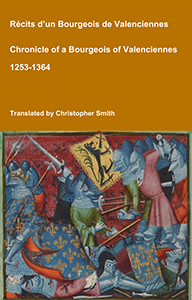
Chronicle of a Bourgeois of Valenciennes
Récits d’un bourgeois de Valenciennes aka The Chronicle of a Bourgeois of Valenciennes is a vivid 14th-century vernacular chronicle written by an anonymous urban chronicler from Valenciennes in the County of Hainaut. It survives in a manuscript that describes local and regional history from about 1253 to 1366, blending chronology, narrative episodes, and eyewitness-style accounts of political, military, and social events in medieval France, Flanders, and the Low Countries. The work begins with a chronological framework of events affecting Valenciennes and its region under rulers such as King Philip VI of France and the shifting allegiances of local nobility. It includes accounts of conflicts, sieges, diplomatic manoeuvres, and the impact of broader struggles like the Hundred Years’ War on urban life in Hainaut. Written from the perspective of a burgher (bourgeois) rather than a monastery or royal court, the chronicle offers a rare lay viewpoint on high politics and warfare, reflecting how merchants, townspeople, and civic institutions experienced the turbulence of the 13th and 14th centuries. Its narrative style combines straightforward reporting of events with moral and civic observations, making it a valuable source for readers interested in medieval urban society, regional politics, and the lived experience of war and governance in pre-modern Europe.
Available at Amazon in eBook and Paperback format.
9th November 1433. Ande that same year, the ix day of November, was the terement of the Erle of Syn Powle worthely i-holde at the chyrche of Syn Poulys [Map] in London.