

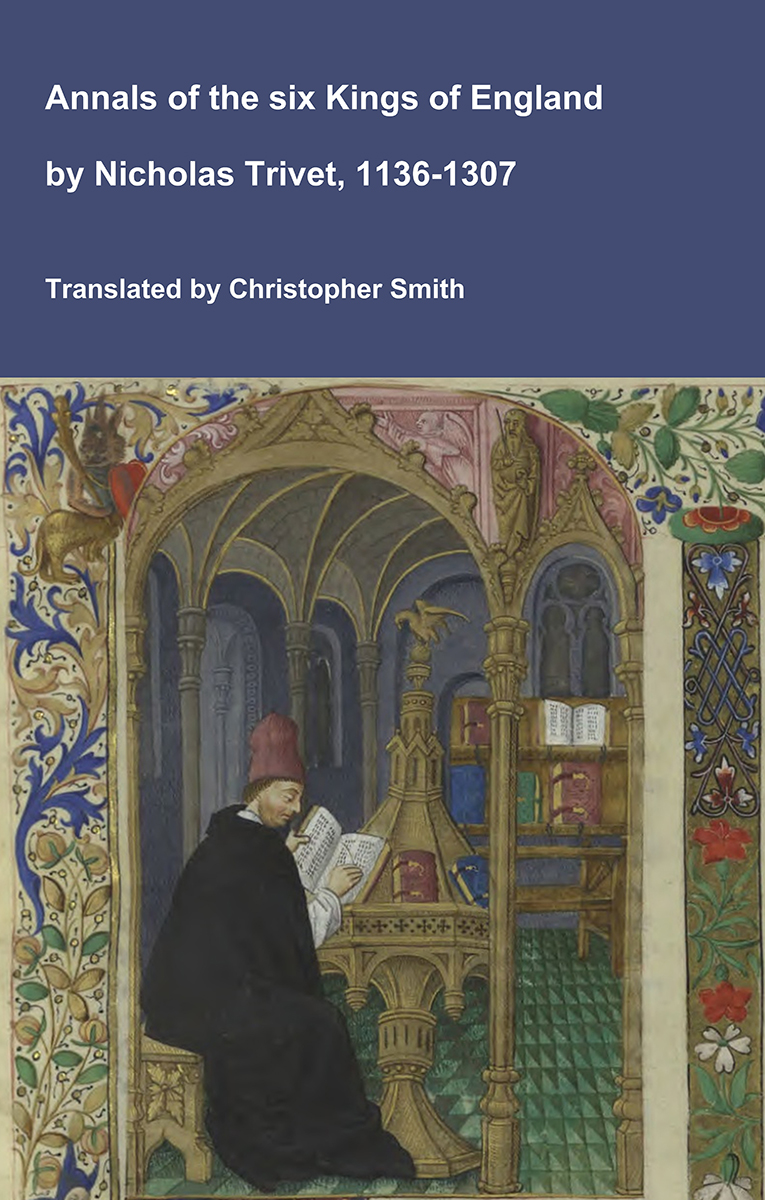
Annals of the six Kings of England by Nicholas Trivet
Translation of the Annals of the Six Kings of England by that traces the rise and rule of the Angevin aka Plantagenet dynasty from the mid-12th to early 14th century. Written by the Dominican scholar Nicholas Trivet, the work offers a vivid account of English history from the reign of King Stephen through to the death of King Edward I, blending political narrative with moral reflection. Covering the reigns of six monarchs—from Stephen to Edward I—the chronicle explores royal authority, rebellion, war, and the shifting balance between crown, church, and nobility. Trivet provides detailed insight into defining moments such as baronial conflicts, Anglo-French rivalry, and the consolidation of royal power under Edward I, whose reign he describes with particular immediacy. The Annals combines careful year-by-year reporting with thoughtful interpretation, presenting history not merely as a sequence of events but as a moral and political lesson. Ideal for readers interested in medieval history, kingship, and the origins of the English state, this chronicle remains a valuable and accessible window into the turbulent world of the Plantagenet kings.
Available at Amazon in eBook and Paperback format.
Chronicle of the Kings of England by Richard Baker is in Late Medieval Books.
King Henry surfeiteth of eating of Lamprey
A discontent of minde upon some differences between him and his son-in-law, the Earl of Anjou, brought upon him a distemper which encreased by eating against his Physicians advice, of a Lamprey, a meat alwayes pleasing to him, but never agreeing with him, cast him into a Feaver, which in few dayes put a period to his life: So certain it is, that one intemperate action is enough to overthrow the temperance of a whole life; as of this King Henry it is said, that he seldom did eat but when he was hungry never did drink but when he was a thirst: yet this but once yieldiing to his sensual appetite, made him forfeit all benefit of his former abstinence, though some write he took his death by a fall off his Horse. He dyed upon the first of December at night, in the year 1155. when he had reigned five and thirty years, lived threescore and seven.
26th December 1135 ... and so upon St. Stephen's day, in Anno 1135, he [King Stephen I England [aged 41]] was Crowned at Westminster, in the presence of but three Bishops, few of the Nobility, and not one Abbit, by William Archbishop of Canterbury, with great solemnity.
19th March 1330. For another Parliament being holden at Winchester, Edmund Earl of Kent [aged 28], the Kings Uncle, is there accused, and condemned upon his confession, for intending to restore his Brother, the late King Edward; an intention only without any fact, yet condemned he was, and brought to the Scaffold: but generally so beloved of the people, that he stood on the Scaffold from one a Clock till five, before any Executioner could be found that would do the Office; till at last a silly wretch of the Marshalsey [Map] was gotten to cut off his head.
But the Authors of his death escaped not long themselves, for in the third year of the Kings Reign, another Parliament is holden at Nottingham, wherein the Queen hath all her great Joynture taken from her, and is put to her Pension of a thousand pounds a year, and her self confined to a Castle, where she remained the rest of her dayes, no fewer then thirty years. A time long enough to finde that her being the Daughter of a King, the Sister of a King, the Wife of a King, and the Mother of a King, were glorious Titles, but all not worth the liberty of a mean Estate.
[19th October 1330] And as for Mortimer, (lying then in the Castle of Nottingham and lately created Earl of the Marches of Wales) he was seised on in this manner; the King taking with him William Montacute [aged 29], Robert Holland, and others, go secretly one night by Torch-light, through a privy way under ground, till they come to the Queens [aged 35] Chamber; where leaving the King without, they entred and found the Queen with Mortimer [aged 43], ready to go to bed: then laying hands on him, they led him forth, after whom the Queen followed, crying, Bel fits, ayes pitie du gentil Mortimer; good fon, good fon, take pity upon the gentle Mortimer, suspecting that her son had been among them. This course was taken to apprehend him for avoiding of tumult, he having no fewer then ninescore Knights and Gentlemen, besides other meaner servants continually about him.
29th November 1330. But thus seised on, he is committed presently to the Tower, accused of divers great crimes, whereof these were chief; That he had procured the late Kings death; That he had been the Author of the Scots safe escaping st Stanhope Park, corrupted with the gift of thirty thousand pounds; That he had procured the late Marriage and Peace with Scotland, so dishononrable to the King and Kingdom; That he had been too familiar with the Queen, as by whom she was thought to be with Childe. Of which Articles he was found guilty and condemned; and thereupon is drawn and hanged upon the common Gallows at.the Elms, now called Tyburn, where his body remained two dayes as an opprobrious spectacle for all beholders.