


Text this colour links to Pages. Text this colour links to Family Trees. Text this colour are links that are disabled for Guests.
Place the mouse over images to see a larger image. Click on paintings to see the painter's Biography Page. Mouse over links for a preview. Move the mouse off the painting or link to close the popup.
All About History Books
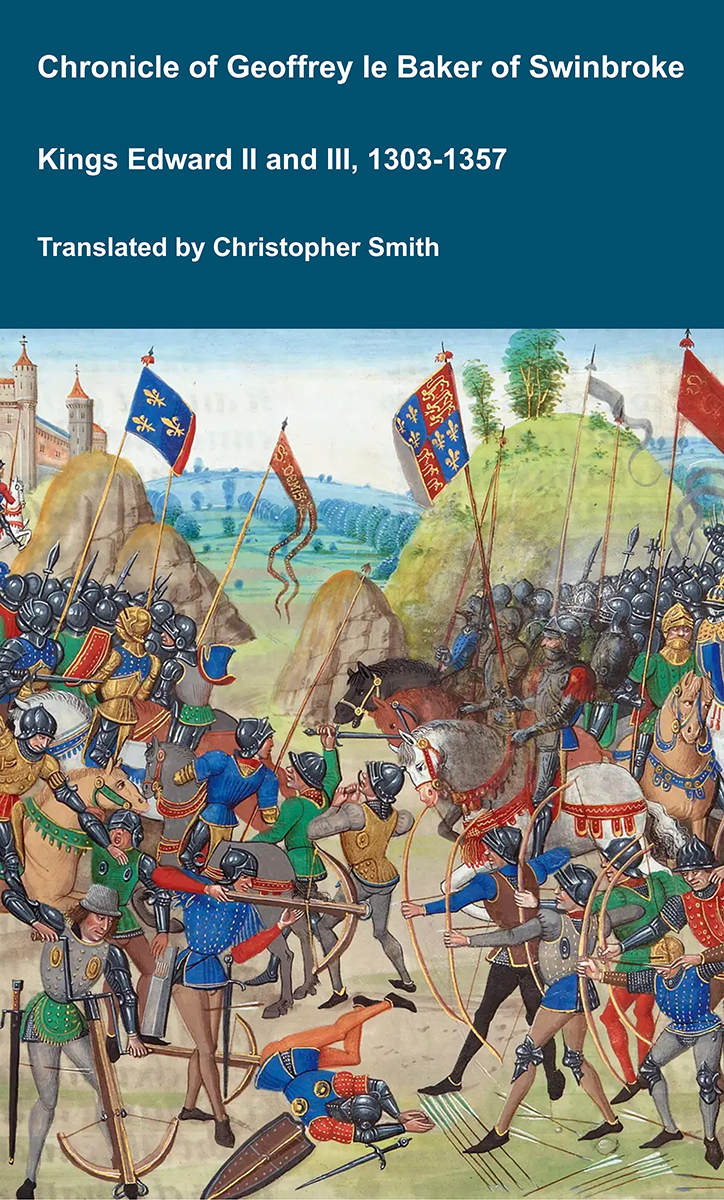
The Chronicle of Geoffrey le Baker of Swinbroke. Baker was a secular clerk from Swinbroke, now Swinbrook, an Oxfordshire village two miles east of Burford. His Chronicle describes the events of the period 1303-1356: Gaveston, Bannockburn, Boroughbridge, the murder of King Edward II, the Scottish Wars, Sluys, Crécy, the Black Death, Winchelsea and Poitiers. To quote Herbert Bruce 'it possesses a vigorous and characteristic style, and its value for particular events between 1303 and 1356 has been recognised by its editor and by subsequent writers'. The book provides remarkable detail about the events it describes. Baker's text has been augmented with hundreds of notes, including extracts from other contemporary chronicles, such as the Annales Londonienses, Annales Paulini, Murimuth, Lanercost, Avesbury, Guisborough and Froissart to enrich the reader's understanding. The translation takes as its source the 'Chronicon Galfridi le Baker de Swynebroke' published in 1889, edited by Edward Maunde Thompson. Available at Amazon in eBook and Paperback.
Chronicle of the Monastery of Melsa is in Late Medieval Books.
Late Medieval Books, Chronicle of the Monastery of Melsa 1346
And meanwhile, every day, Edward and his men endured attacks from the French on all sides, but he gained victory over them all. Philip, however, blocked a gate of Paris, called the Gate of Hell, with lime and stones, recalling the ancient saying: 'Through the Gate of Hell, the English king entered.' King Edward, after crossing the repaired bridge at Pistiacum (Pontoise) with his men, realizing that access to Paris was not possible due to the destruction of the bridges, set out towards Picardy, intending thereby to provoke Philip into battle. After capturing and returning several towns, he often triumphed over the French. Meanwhile, Philip began to break the usual causeways and crossings of the Seine River.
Et interim indies Edwardus cum suis a Francis undique insultus patiebatur, sed de eisdem omnibus victoria est potitus. Philippus autem quandam portam Parisiorum, Portam Inferi nuncupatam, calce et lapidibus fecit obturare, memorans illud antiquitus; "Per portam inferi rex Anglicus introivit" Rex autem Edwardus pontem de Pistiaco reparatum cum suis pertransivit, sed perpendens accessum Parisiorum sibi propter pontium fractionem non patere, versus Pikardiam est profectus, ut saltem sic Philippum ad belli collisionem provocaret; et, captis ac redditis quibusdam villis, de Francigenis sepius triumphavit. Interim calcetz et passagia fluvii de Seyn usitata frangere coepit Philippus.
24 Aug 1346. Therefore, King Edward, having been informed by an Englishman born in Royston near Nafferton, who had lived in those parts for 16 years, directed his course through a certain ford of the aforementioned river into the towns of Saint-Valery and Crotoy, where the sea ebbs and flows. There, he crossed with his men at a place where the inhabitants of that land had never before dared to cross, except six or four at a time. But King Edward, with his army, crossed a league closer to the sea than others had ever crossed before, at a place where no one had previously crossed. Upon his arrival there, a large number of fighters and the communities of the entire surrounding region gathered to oppose Edward's passage. But King Edward, with his men, though continually facing resistance from enemies, crossed over thousands of front lines almost within a single hour of the day. After defeating the French—indeed, more than 8,000 of them were killed—King Edward and all his men remained unharmed. Immediately, the English took the town of Crotoy and the castle of Noyel.
Unde continuo rex Edwardus per quemdam Anglicum natum in Roestona prope Naffretonam, qui in illis partibus per 16 annos morabatur, informatus, per quoddam vadum preedicti fluminis in villas Sancti Valerii et Crotoye, ubi mare fluit et refluit, iter suum dirigebat. Ibique cum suis pertransivit ubi per prius terre illius incolse [nunquam], nisi 6 vel 4 simul, ausi sunt pertransire. Edwardus vero rex cum exercitu suo propinquius mari quam alii per unam leugam transvadavit ; ubi nunquam per prius aliquis pertransivit. Ad cujus illuc adventum, copiosus numerus pugnatorum et totius circaregionis communitatum Edwardo inobviam convenerunt, ad ipsius passagium perturbandum. Sed rex Edwardus cum suis continuo viribus tamen, licet resistentibus inimicis, per millenos frontorios quasi in una diei hora transvadavit, et victis Francigenis, videlicet 8,000 et amplius eorum interfectis, rex Edwardus et sui singuli incolumes remanserunt. Et continuo Anglici villam de Crotoy et castrum de Noyel acceperunt.
On that same day, King Philip suddenly appeared with a large army. Therefore, King Edward took up his position in the field, waiting for the said Philip until the following day until evening. But as Philip moved towards Abbéville, King Edward withdrew towards Crécy, to his own land rightfully due to him by ancient hereditary right, so that he might confront Philip on the other side of the forest.
Ipsoque die apparuit subito rex Philippus cum exercitu copioso. Unde rex Edwardus campum arripuit, ubi dictum Philippum in diem alterum usque in vesperam attendebat. Sed, Philippo versus Abbatis Villam tendente, Edwardus rex versus Cressy, ad solum proprium jure hereditario sibi debitum ab antiquo, se traxit, ut ipsum Philippum ex altera parte forest obviaret.
26 Aug 1346. Where King Edward, having left his horses and wagons behind to prevent his men from fleeing more freely, divided his army into three battalions and chose a field between the town and the forest of Crécy. In these three battalions, there were estimated to be a total of 8,000 men at arms, with archers placed strategically on either side. And when Edward was thus positioned with his men on that Saturday, the 26th day of August, behold, Philip appeared with 30,000 armed men and innumerable commoners, arranged in order. There, they fought continuously from the hour of vespers until night. The French, forming one large battalion from their three divisions, fiercely attacked the first battalion of the English, in which was Edward, Prince of Wales, the eldest son of King Edward. And immediately, a great multitude of crows and ravens appeared flying and croaking around the French, and a terrifying thunderstorm followed, with thunder roaring twice and rain falling, which brought down the dust that had been lifted into the air. It had not rained on that land since the day King Edward entered the kingdom of France, for 6 weeks and 8 days.
Ubi rex Edwardus, equis suis et cariagiis post tergum dimissis, ne sui liberius ad fugam convolarent, exercituque suo in tres acies diviso, inter villam et forestam de Cressy campum preelegit. In istis siquidem tribus aciebus 8,000 hominum ad arma fuerunt totaliter eestimati, aliis hinc inde dispositis de sagittariis constitutis. Et ipso Edwardo sic cum suis ibidem constituto, sabbato 26 die Augusti, ecce Philippus cum 30,000 armatorum et communitatibus innumerabilibus, ordine disposito, apparebat. Ibique ab hora vesperarum usque ad noctem continue decertarunt. Franci autem de tribus ocuneis unam aciem maximam componebant, et Anglorum primam aciem, in quo erat Edwardus Princeps Wallis, regis Edwardus primogenitus, acrius invadebant. Et statim videbatur maxima multitudo corvorum et cornicum circumquaque volantium et orocitantium super Francos; et tonitruum terribilem bis tonantem pluvia, que pulverem per aiera levatum dejecit, sequebatur. Nec pluerat super terram illam a die quo rex Edwardus regnum Francie ingressus est, per 6 videlicet septimanas et 8 dies.
But, the French, repeatedly repulsed in the conflict and attempting to regroup, were finally defeated when the Bishop of Durham came to the aid of Edward, Prince of Wales. Philip, now for the third time confused and wounded, realizing that his forces could no longer hold their ground, fled under the banner of the Dauphin of Auvergne and retreated to Amiens. All his remaining men also fled, and the English pursued them. However, as the day was drawing to a close, the English returned to King Edward on the battlefield, spending the past day and the following night fasting and keeping watch; they seized the wine and provisions that the French had brought with them, and captured and burned the wagons and carts loaded with crossbows, arrows, lances, and other weapons. The next night, more French forces came to aid Philip, but unaware of his misfortune, they wandered like sheep without a shepherd, in groups of hundreds and two hundreds, into the English lines, mistakenly thinking they were among their fellow Frenchmen. Their watchword, which they shouted, betrayed them, and they were immediately intercepted and all were killed. On the following Sunday, two large groups of French cavalry approached the English, ready to fight. Then the Earl of Warwick and others, mounting their horses, went out to meet the French. But the French, unable to withstand the English in the first clash, immediately turned to flight; the English pursued them for five miles, causing great slaughter.
Sed, spe in conflictu repulsi Franci et sepius se ‘relevantes, tandem, veniente episcopo Dunelmensi in auxilium Edwardi Principis Walliee, victi sunt. Et Philippus quidem sic jam tertio confusus et vulneratus, perpendens suos subsistere non valere, sub vexillo Dolphini de Alvernia fugiens Ambianis se recepit. Sui etiam vivi relicti omnes fugerunt, et eos Anglici per-. sequebantur. Sed, inclinata jam die, ad regem Edwardum in dictum campum redeuntes, diem praeteritum et noctem sequentem jejuni et vigiles perduxerunt ; et vinum ac victualia que Franci secum detulerant preeoccuparunt, cariagiaque et currus arcubalistis, telis, lanceis et aliis armis onerata, capta incenderunt. Nocte vero sequente venerunt alii Franci in subsidium Philippi; sed ejus infortunium ignorantes, velut! oves errantes: absque pastore, vicissim et gregatim per centenos et ducentenos, inter Anglicos, sperantes ipsos esse suos Francigenas, inciderunt, et verbum suum vigile vociferantes, quod illos prodidit, continuo preeoccupati fuerunt et omnes pariter interfecti. Die vero dominica sequente, duo cunei magni equitum Anglicis appropinquabant, cum eis confligere praeparati. Tunc comes de Warwyk et alii, equis ascensis, obviam Gallicis processerunt. Sed Franci, in primo congressu Anglicis resistere non valentes, in fugam continuo convertuntur; quos Anglici per 5 milliaria persequebantur, cedem plurimam facientes.
Late Medieval Books, Chronicle of the Monastery of Melsa Appendices
Late Medieval Books, Chronicle of the Monastery of Melsa Appendices, Chronicle of the Monastery of Melsa Appendix 9
About King Edward II and his deeds
John de Mowbray, Roger de Clifford, and other nobles captured with him were unjustly hanged in various places in England. Indeed, King Edward himself took great delight in the vice of sodomy. He had an excessive affection for the aforementioned Peter de Gaveston and the two Hugh Despensers, who had been the instigators of the aforementioned evils. Fortune and favor seemed to be with him at all times. He hardly dared to confront his enemies in the field.
Johannes de Mowbray, Eogerus de Clyfforth, et alii nobiliores cum eo capti, in diversis locis Anglian injuste sunt suspensi. Ipse quidem Edwardus rex in vitio sodomitico nimium delectabat; dictum Petrum de Gavestona et duos Hugones Dispensatores, qui pranscriptorum malorum fuerant incentores, nimis peramabat. Fortuna ac gratia omni suo tempore carcre videbatur. Inimicos suos in campo attendere vix audebat.