

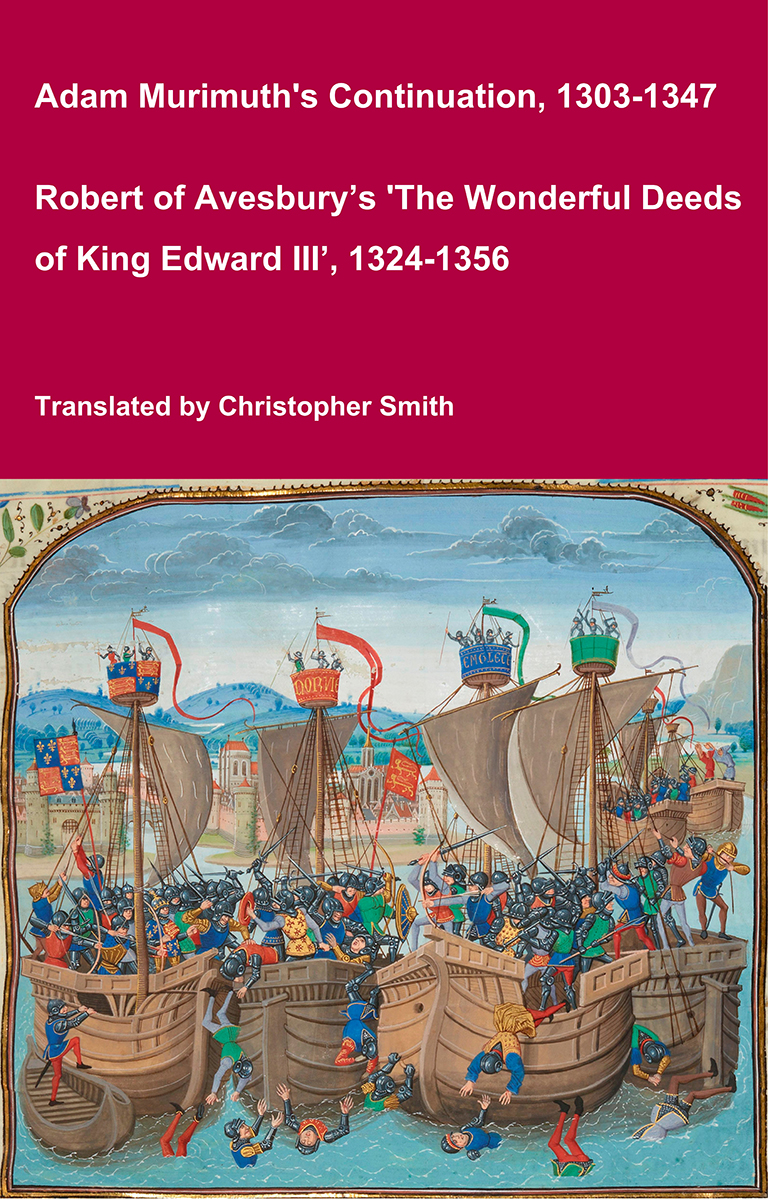
Adam Murimuth's Continuation and Robert of Avesbury’s 'The Wonderful Deeds of King Edward III'
This volume brings together two of the most important contemporary chronicles for the reign of Edward III and the opening phases of the Hundred Years’ War. Written in Latin by English clerical observers, these texts provide a vivid and authoritative window into the political, diplomatic, and military history of fourteenth-century England and its continental ambitions. Adam Murimuth Continuatio's Chronicarum continues an earlier chronicle into the mid-fourteenth century, offering concise but valuable notices on royal policy, foreign relations, and ecclesiastical affairs. Its annalistic structure makes it especially useful for establishing chronology and tracing the development of events year by year. Complementing it, Robert of Avesbury’s De gestis mirabilibus regis Edwardi tertii is a rich documentary chronicle preserving letters, treaties, and official records alongside narrative passages. It is an indispensable source for understanding Edward III’s claim to the French crown, the conduct of war, and the mechanisms of medieval diplomacy. Together, these works offer scholars, students, and enthusiasts a reliable and unembellished account of a transformative period in English and European history. Essential for anyone interested in medieval chronicles, the Hundred Years’ War, or the reign of Edward III.
Available at Amazon in eBook and Paperback format.
Creevey Papers is in Georgian Books.
Henry Brougham, M.P., to Mr. Creevey (at Cantley1) 26th July [1821].
Dear C,
The Queen [aged 53] certainly goes to Scotland. . I should not wonder if she were to go thro' the manufacturing districts. Possibly Birmingham (where the K. refused to go) may be in her way. It is on the cards that she should be found in the W. Riding and in Lancashire. For aught I know H. M. may then pass across towards Durham and Newcastle. Indeed the great towns are peculiarly interesting to a person of her contemplative cast. One whose mind is improved by foreign travel naturally loves tracts of country where the population is much crowded, and it is worthy of H. M.'s enlightened mind to patronise the ingenuous artizan. The coal trade, too, is highly interesting. I only hope she may not call at Howick on her way .... The time of her setting out is not fixed, depending naturally upon her beloved husband's motions .... The Chamberlain's place is not yet given away. The Ministers are believed to have resolved to bear this no longer, and to have agreed on a remonstrance to the K. about the Green Ribbons2. He will, of course, say something civil that means little — make some promise that means less — let them name to one place, name to the other himself— and so settle matters as to enable him to go over to Ireland .... The Queen has lost incalculably by getting out of her carnage and tramping about; going and being refused, and damaging the Coronation, was all very well, but the way of doing it was very bad ...."
Note 1. Michael Angelo Taylor's place in Yorkshire,
Note 2. The King had been creating Knights of the Thistle without taking the advice of his Ministers.


 Become a Member via our Buy Me a Coffee page to read more.
Mr. Creevey to Miss Ord.
Condover Hall, Sept. I, 1828.
"... Our coach was full, but we dropt two at Oxford, and to my great delight we left the other filthy wretch at Birmingham at 6 in the morning. He had been eating prawns all night, and flinging the skins at the bottom of the coach. However, I changed coaches at Birmingham, so it was all mighty well. Having breakfasted then at that early hour, I came alone to Shrewsbury . . and embarked in a chay for Condover Hall, just 5 miles from Salop. Altho' the two Stoke young ladies . . have always praised the house much to me, their praises have been much— very much — below its deserts. It is a charming and most incomparable house
[1st September 1828]. Dear Mr. and Mrs. Smythe Owen and I have lived in the most perfect harmony since 4 o'clock on Saturday afternoon, but other human being have I seen none, except the parson at church yesterday, whom I was in hopes to have seen more of. He is Mr. Leicester, nephew to the late Lord de Tabley. ... Having known his father in the days of my youth at Cambridge as by far the most ultra and impertinent dandy of his day, I was curious to see the son. It was precisely the same thing over again. This beautiful youth [Reverend Frederick Leicester [aged 26]] (for such he is), aged 27, has been appointed by the Court of Chancery guardian to his nephew [Note. cousin] Lord de Tabley [aged 16], aged 16. About 6 weeks ago, he was married to his aunt Lady de Tabley [aged 34], who expects to be confined next month. I am sorry she is not [illegible] for this second marriage. On her part she forfeits £500 a year out of her jointure of £1500; and his diocesan, the Bishop of Lichfield, has given him notice he shall eject him from his living for marrying his aunt, which reduces his income to nothing. ..."


