

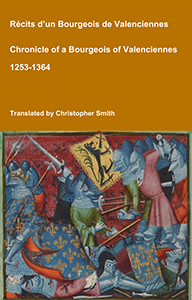
Chronicle of a Bourgeois of Valenciennes
Récits d’un bourgeois de Valenciennes aka The Chronicle of a Bourgeois of Valenciennes is a vivid 14th-century vernacular chronicle written by an anonymous urban chronicler from Valenciennes in the County of Hainaut. It survives in a manuscript that describes local and regional history from about 1253 to 1366, blending chronology, narrative episodes, and eyewitness-style accounts of political, military, and social events in medieval France, Flanders, and the Low Countries. The work begins with a chronological framework of events affecting Valenciennes and its region under rulers such as King Philip VI of France and the shifting allegiances of local nobility. It includes accounts of conflicts, sieges, diplomatic manoeuvres, and the impact of broader struggles like the Hundred Years’ War on urban life in Hainaut. Written from the perspective of a burgher (bourgeois) rather than a monastery or royal court, the chronicle offers a rare lay viewpoint on high politics and warfare, reflecting how merchants, townspeople, and civic institutions experienced the turbulence of the 13th and 14th centuries. Its narrative style combines straightforward reporting of events with moral and civic observations, making it a valuable source for readers interested in medieval urban society, regional politics, and the lived experience of war and governance in pre-modern Europe.
Available at Amazon in eBook and Paperback format.
Criticisms and Dramatic Essays by Hazlitt is in Georgian Books.
Then there was Miss Farren, with her fine-lady airs and graces, with that elegant turn of her head, and motion of her fan, and tripping of her tongue; and Miss Pope, the very picture of a Duenna, a maiden lady, or an antiquated dowager — the latter spring of beauty, the second childhood of vanity, more quaint, fantastic, and old-fashioned, more pert, frothy, and lightheaded than any thing that can be imagined; embalmed in the follies, preserved in the spirit of aflfectation of the last age: — and then add to these, Mrs. Jordan, the child of nature, whose voice was a cordial to the heart, because it came from it, rich, full, like the luscious juice of the rich grape; to hear whose laugh was to drink nectar; whose smile "made a sunshine," not "in the shady place," but amidst dazzling lights and in glad theatres: — who "talked far above singing," and whose singing was like the twang of Cupid's bow. Her person was large, soft, and generous hke her soul. It has been attempted to compare Miss Kelly to her. There is no comparison. Miss Kelly is a shrewd, clever, arch, lively jgirl; tingles all over with suppressed sensibility; licks her Hps at mischief, bites her words in two, or lets a sly meaning out of the corner of her eyes; is fidgetty with curiosity, or unable to stand still for spite:— she is always uneasy and always uneasy and always interesting but Mrs. Jordan was all exuberance and grace, "her bounty was as boundless as the sea; her lvoe as deep."


