

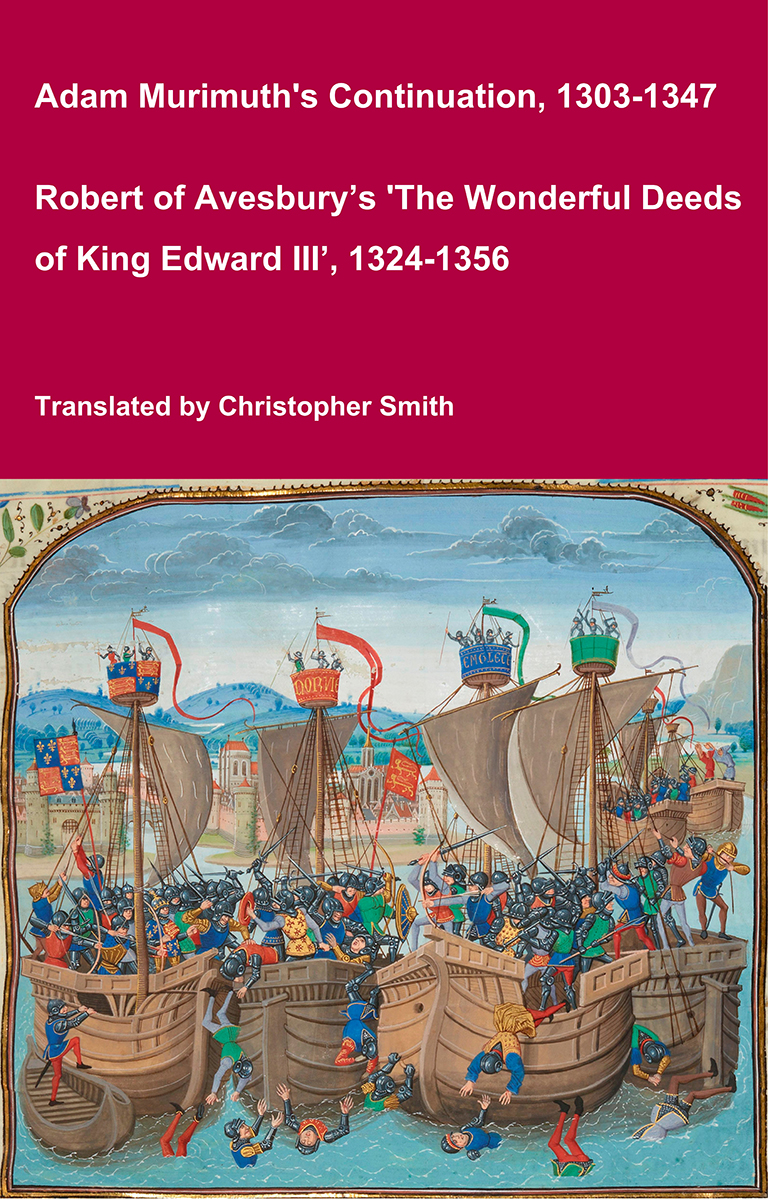
Adam Murimuth's Continuation and Robert of Avesbury’s 'The Wonderful Deeds of King Edward III'
This volume brings together two of the most important contemporary chronicles for the reign of Edward III and the opening phases of the Hundred Years’ War. Written in Latin by English clerical observers, these texts provide a vivid and authoritative window into the political, diplomatic, and military history of fourteenth-century England and its continental ambitions. Adam Murimuth Continuatio's Chronicarum continues an earlier chronicle into the mid-fourteenth century, offering concise but valuable notices on royal policy, foreign relations, and ecclesiastical affairs. Its annalistic structure makes it especially useful for establishing chronology and tracing the development of events year by year. Complementing it, Robert of Avesbury’s De gestis mirabilibus regis Edwardi tertii is a rich documentary chronicle preserving letters, treaties, and official records alongside narrative passages. It is an indispensable source for understanding Edward III’s claim to the French crown, the conduct of war, and the mechanisms of medieval diplomacy. Together, these works offer scholars, students, and enthusiasts a reliable and unembellished account of a transformative period in English and European history. Essential for anyone interested in medieval chronicles, the Hundred Years’ War, or the reign of Edward III.
Available at Amazon in eBook and Paperback format.
Effigy of Lady and Child is in Monumental Effigies of Great Britain.

THIS singular monument is in Scarcliffe Church, Derbyshire [Map]. The style in which it is executed shows it to be of the thirteenth century. The head is surmounted with a very elegant circlet, and rests on a couchant lion; the hair is disposed in braids; the tunic is confined at the neck by a large fermail or broach; a band appears to attach the mantle to the shoulders, and is held in the right hand; the mantle is caught up under the right arm. The left supports a male child, who displays a long scroll, on which has been inscribed in uncial characters some leonine verses, which are now much defaced.
HIC SV......MVLIER IACET INTVMVLATA:
CONSTANS.............:
...........PROLES RE....ERE HVMATA:
CVM PECC..............VACVATA:
CRIMINE PVRGATA CVM PROLE IOIIANNE BEATA:
.................DELOCATA. AMEN:
Details. 1. Profile of the head, showing the hair, &c. 2. The circlet enlarged.