The History of William Marshal was commissioned by his son shortly after William’s death in 1219 to celebrate the Marshal’s remarkable life; it is an authentic, contemporary voice. The manuscript was discovered in 1861 by French historian Paul Meyer. Meyer published the manuscript in its original Anglo-French in 1891 in two books. This book is a line by line translation of the first of Meyer’s books; lines 1-10152. Book 1 of the History begins in 1139 and ends in 1194. It describes the events of the Anarchy, the role of William’s father John, John’s marriages, William’s childhood, his role as a hostage at the siege of Newbury, his injury and imprisonment in Poitou where he met Eleanor of Aquitaine and his life as a knight errant. It continues with the accusation against him of an improper relationship with Margaret, wife of Henry the Young King, his exile, and return, the death of Henry the Young King, the rebellion of Richard, the future King Richard I, war with France, the death of King Henry II, and the capture of King Richard, and the rebellion of John, the future King John. It ends with the release of King Richard and the death of John Marshal.
Available at Amazon in eBook and Paperback format.
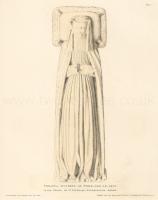
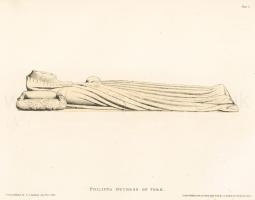
Effigy of Philippa Duchess of York is in Monumental Effigies of Great Britain.
WAS the daughter of John Lord Mohun, of Dunster, in the county of Somerset, who died towards the latter end of the fourteenth century, leaving as his heirs three daughters, Philippa, Elizabeth, the wife of William de Montacute, Earl of Salisbury, (of whom we have already treated,) and Maud, wife of John Lord Strange, of Knockyn, in the county of Salop. Philippa, represented by this effigy, married Edward Plantagenet, son and heir of Edmund of Langley, Duke of York, fifth son of Edward the Third, who succeeded to his father's honours, and was by Richard the Second created Earl of Rutland, of Cork, Duke of Albemarle, or Aumarle, and Constable of England. By this marriage there was no issue, and Edmund Duke of York was slain in the memorable battle of Azincourt, A. D. 1415. Philippa was afterwards espoused to Sir Walter Fitzwalter [Note. There is some confusion here since Walter Fitzwalter, who died in 1386, is understood to have been Philippa's first husband?], Knight, whose arms are impaled with hers in the chapel of St. Nicholas, in the Abbey Church of Westminstera, where she was buried, with this inscription on her tombb.
Philippa, filia et cohæeres Johannis D'ni Mohun de Dunster, uxor Edwardi Ducis Eboracensis, moritur anno D'ni M.CCCC.XXXIII.
Note a. Camden gives her another husband, Sir John Golofre, making him the second, and Edward Plantagenet the last. Among the escutcheons on her tomb is certainiy the coat attributed to Goiofre, impaling Mohun.
Note b. Her last will was dated in the Isle of Wight, in the 3d of Henry V. She had a grant of the Lordship of Wight, which had been before granted to her husband the Duke of York.