William of Worcester's Chronicle of England
William of Worcester, born around 1415, and died around 1482 was secretary to John Fastolf, the renowned soldier of the Hundred Years War, during which time he collected documents, letters, and wrote a record of events. Following their return to England in 1440 William was witness to major events. Twice in his chronicle he uses the first person: 1. when writing about the murder of Thomas, 7th Baron Scales, in 1460, he writes '… and I saw him lying naked in the cemetery near the porch of the church of St. Mary Overie in Southwark …' and 2. describing King Edward IV's entry into London in 1461 he writes '… proclaimed that all the people themselves were to recognize and acknowledge Edward as king. I was present and heard this, and immediately went down with them into the city'. William’s Chronicle is rich in detail. It is the source of much information about the Wars of the Roses, including the term 'Diabolical Marriage' to describe the marriage of Queen Elizabeth Woodville’s brother John’s marriage to Katherine, Dowager Duchess of Norfolk, he aged twenty, she sixty-five or more, and the story about a paper crown being placed in mockery on the severed head of Richard, 3rd Duke of York.
Available at Amazon in eBook and Paperback format.
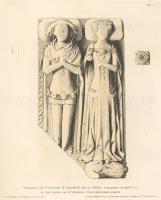
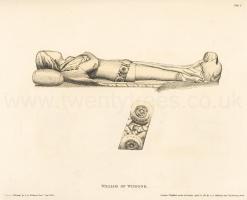
Effigy of William of Windsor and Blanche de la Tour is in Monumental Effigies of Great Britain.
EDWARD gave another of his sons by Philippa the name of William, who died so young that nothing more is known of him than the place of his birth, as affixed to his name, and that he was buried at Westminster, in the chapel of St. Edmund [Map], in the abbey church. In the same tomb are also deposited the remains of Blanch de la Tour, their third daughter, so called from her birthplace, the Tower of London [Map]. She was born and died in 1340. Their effigies in alabaster, scarcely eighteen inches in length, are placed on an altar-tomb. Sandford says that an inscription on brass, which had been affixed on the monument, was not extant in his time. The costume of the male figure much resembles that of William of Hatfield. The cote hardie of the female, flanches, jewelled stomacher, girdle, cordon and clasps of the mantle, are worthy attention.
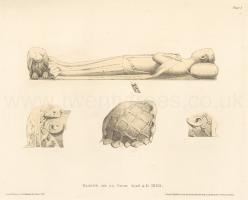
Details. Plate 1. One of the fermails of the Princess's mantle. Plate II. Ornaments on the Prince's girdle. Plate III. Details of the Princess's circlet and reticulated head-dress.