

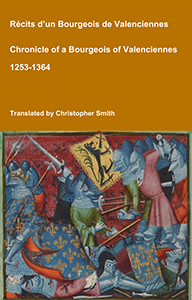
Chronicle of a Bourgeois of Valenciennes
Récits d’un bourgeois de Valenciennes aka The Chronicle of a Bourgeois of Valenciennes is a vivid 14th-century vernacular chronicle written by an anonymous urban chronicler from Valenciennes in the County of Hainaut. It survives in a manuscript that describes local and regional history from about 1253 to 1366, blending chronology, narrative episodes, and eyewitness-style accounts of political, military, and social events in medieval France, Flanders, and the Low Countries. The work begins with a chronological framework of events affecting Valenciennes and its region under rulers such as King Philip VI of France and the shifting allegiances of local nobility. It includes accounts of conflicts, sieges, diplomatic manoeuvres, and the impact of broader struggles like the Hundred Years’ War on urban life in Hainaut. Written from the perspective of a burgher (bourgeois) rather than a monastery or royal court, the chronicle offers a rare lay viewpoint on high politics and warfare, reflecting how merchants, townspeople, and civic institutions experienced the turbulence of the 13th and 14th centuries. Its narrative style combines straightforward reporting of events with moral and civic observations, making it a valuable source for readers interested in medieval urban society, regional politics, and the lived experience of war and governance in pre-modern Europe.
Available at Amazon in eBook and Paperback format.
Flowers of History by Matthew Paris Volume 2 Chapter 1 1066 1087 is in Flowers of History by Matthew Paris.
1066 Coronation of William the Conqueror
1068 Coronation of Queen Matilda
1069 Sveyn II's Raid on England
1075 Death of Queen Edith of Wessex
1290 Death of Queen Eleanor of Castile
22nd July 1298 Battle of Falkirk
Coronation of King William the First the Conqueror
Before 25th December 1066. William, Duke of Normandy [aged 38], proceeded to the city of London, was received with great exultation by both clergy and people, and was proclaimed king by universal acclamation, and on the day of the birth of our Lord he received the crown of the kingdom of England from Aeldred, archbishop of York. For he refused to accept the office of consecration from Stigand archbishop of Canterbury, although of ancient right that solemn office is known to belong to that see, because he had no legal right to occupy that pre-eminent dignity. Then, haying received homage and the oath of fealty, and hostages likewise, from the nobles, and being confirmed in his kingdom, be became the terror of all those who had aspired to the kingdom. And having arranged his affairs in the different cities and castles, and having placed his own servants in them, he sailed back to Normandy [Map] with the English hostages, and with inestimable treasures. And, when he put the hostages in prison, and committed them to the custody of safe keepers, he returned again to England, where he distributed with a liberal hand the estates and possessions of the Epglish among his Norman comrades who had helped him to subdue the country in the battle of Hastings; expelling all the legitimate owners successively, and becoming a tyrant rather than a king, he burdened the little that remained to them with the yoke of perpetual slavery. And when he saw himself now raised to such a lofty dignity, and confirmed in his proud kingdom, he became rapidly changed into another man; and, alas! alas! trampled under foot the nobles of the land, whom their hereditary blood had elevated from the times of old. And the nobles of the kingdom being indignant at this, fled, some of them to Malcolm, king of Scotland [aged 35], others, preferring to end their unhappy lives rather than to endure a shameful slavery, sought the desert places and woods, and there living the life of wild beasts, and repenting of having made submission to the Normans, and being weighed down as to their inmost hearts with violent grief, though it was now too late, had recourse to the only hope left them, and prepared secret plots and intrigues. But the noble counts, the brothers Edwin and Morcar, and many other nobles, and many also of the bishops and clergy and many others, whom it would take too long to enumerate by name, when they saw that theirs was the weaker side, and as they disdained to become slaves, abandoned England altogether.
Before 25th December 1066. And as they all fled to Malcolm, king of Scotland [aged 35], they were all honourably received by him. Then also, Edgar Atheling [aged 15], the legitimate heir of the kingdom of England, seeing his country plundered and disturbed on all sides, embarked on board ship with his mother Agatha, and his sisters Margaret [aged 21] and Christina [aged 9], and endeavoured to return into Hungary, where he had been born; but, a tempest arising, he was compelled to land on the coast of Scotland. And, in consequence of the occasion thus offered, it came to pass that Margaret was given as a bride to King Malcolm, whose exemplary life and virtuous death are plainly set forth in a book specially composed on that subject. But his sister Christina became a nun, and deserves our benediction as one who was married for ever to a heavenly bridegroom.
Before 25th December 1066. Queen Margaret [aged 21] had six sons and two daughters, three of whom, namely, Edgar, Alexander, and David, became kings, as they were entitled to by the nobility of their family, and through them the noble blood of the kings of England, who were expelled from their own proper territories by the Normans, devolved upon the kings of Scotland.
Why King William the First was not crowned by the Archbishop of Canterbury
25th December 1066. William [aged 38] was consecrated king, and crowned on the day of the Nativity of our Lord, on the second day of the week, by Ealdred, archbishop of York, as I have said before, because Stigand, archbishop of Canterbury, had been suspended by pope Alexander [aged 56] as a schismatic. At that time there was a very powerful officer, Eadric, surnamed Silvaticus, the son of Aelfric, the son of Edric Streona; and the chatelains of Hereford, and Richard, the son of Scrob, frequently laid waste his territories, because he disdained to submit to the king, but, as often as they attacked him they lost a great number of their soldiers and men-at-arms. Therefore Edric invited Bleothwin and Biwathe, kings of Wales, to come to his assistance; and, about the day of The Assumption of the blessed Virgin, he laid waste the province of Hereford, as far as the bridge over the river Wye, and carried off a large booty.
The Abbey of Battle is built
1067. King William [aged 39], exulting in his victory, gave praise to God. The same year also, the king built an abbey, which, in reference to the battle that had been fought there, he called Battle [Map], in order that glory, and praise, and thanks, might be offered up in it to God for ever for the victory which he had given him, and also that offices for the souls of the dead who were slain there might be perfonned by the monks who were established in it, with the offering of salutary victims; and he endowed and enriched the church with estates and priyileges, and committed it to the patronage and protection of the kings who should reign in England after him.
William's Duchess is consecrated Queen
11th May 1068. Matilda [aged 37], the wife of king William [aged 40], was consecrated queen on the day of Pentecost, by Aeldred, archbishop of York, on the twenty-second of March. [Note. The date a mistake. Pentecost the fiftieth day after Easter so usually in May. Pentcost known as White Sunday, or Whit-Sunday.] This year also, William had a son born in England, who was called Henry. For his first-born, William Rufus [aged 12], and also Robert [aged 17], were born in Normandy, before their father had conquered England.
Two sons of Sweyn came into England to subdue it
1069. Between the time of the two festivals of the blessed Virgin Mary, in the autumn, the two sons of Sweyn [aged 50] [King Harald III of Denmark [aged 29] and King Canute "The Holy" IV of Denmark [aged 27]] came with three hundred ships from Denmark into England, in order to subdue it in a hostile manner, and to take king William prisoner [aged 41], or else expel him from England. But when their arrival was noised abroad, the counts, and barons, and nobles of the land went forth to meet them, being oppressed by the intolerable arrogance of the Normans; and they made a treaty with them, and so joined the army of the Danes, in order to overthrow king William. But William, that most prudent king, when he saw the danger that threatened him, humbled himself to them, and checked the insolence of the Normans; and having in this way recalled many of the English nobles to their allegiance, and having sagaciously made a treaty with them all, he took the city of York [Map] by storm, which was a great rendezvous of the Danes, and made himself master of every thing in it, and slew many thousand men there.
Chronicle of a Bourgeois of Valenciennes
Récits d’un bourgeois de Valenciennes aka The Chronicle of a Bourgeois of Valenciennes is a vivid 14th-century vernacular chronicle written by an anonymous urban chronicler from Valenciennes in the County of Hainaut. It survives in a manuscript that describes local and regional history from about 1253 to 1366, blending chronology, narrative episodes, and eyewitness-style accounts of political, military, and social events in medieval France, Flanders, and the Low Countries. The work begins with a chronological framework of events affecting Valenciennes and its region under rulers such as King Philip VI of France and the shifting allegiances of local nobility. It includes accounts of conflicts, sieges, diplomatic manoeuvres, and the impact of broader struggles like the Hundred Years’ War on urban life in Hainaut. Written from the perspective of a burgher (bourgeois) rather than a monastery or royal court, the chronicle offers a rare lay viewpoint on high politics and warfare, reflecting how merchants, townspeople, and civic institutions experienced the turbulence of the 13th and 14th centuries. Its narrative style combines straightforward reporting of events with moral and civic observations, making it a valuable source for readers interested in medieval urban society, regional politics, and the lived experience of war and governance in pre-modern Europe.
Available at Amazon in eBook and Paperback format.
How King William feeling secure at length becomes a tyrant instead of a King
4th April 1070. On the fourth day of April, king William [aged 42], being now become more secure on his throne, violated his promises in many respects; and he caused the monasteries to be searched throughout the whole of England, and commanded the money found in them, and the charters, in the privileges granted by which the nobles of England placed their trust, and which the king, when in a position of difficulty, had sworn to observe himself, to be carried off by force from the churches where they had been deposited, and where they had hitherto lain in security, and to be taken to his own treasury.
After 4th April 1070. Moreover, the whole Anglican Church held a great council in Easter week, at Winchester, Hampshire [Map], by the management of the king, where many of the things which concerned the kingdom were changed. At that council too, Stigand, archbishop of Canterbury, was ignominiously degraded, and his brother, Aylmer, bishop of East Anglia, and many other bishops and abbots were deposed at the same time. Aegelwin, bishop of Durham, alone, of all the prelates of England, seeing the unjust oppression of his brethren, and sympathizing with them, and feeling zeal for God, went of his own accord into banishment from England, wishing to entangle the oppressors in the knot of excommunication. Stigand was succeeded by Lanfranc [aged 65], a monk, a man of elegant learning, and adorned with many and various other accomplishments, who, among other magnificent works, composed a treatise on the Sacrament of the Altar, confirming the Catholic Faith. Aylmer was succeeded by Arfast, the king's chaplain; and he transferred the seat of his diocese to Thetford.
The English being expelled by the Normans, are injuriously and wickedly treated
24th April 1071. Lanfranc [aged 66], abbot of Caen, was consecrated archbishop of Canterbury, on the twenty-fourth of April. And this Lanfranc, when archbishop, established the order of monks according to the rule of Saint Benedict in many of the convents of England. And he did so, first of all, in the church of Canterbury; after that, in the church of Saint Alban [Map], the protomartyr of the English, where also, when the abbot Frederic died, he appointed his [Lanfranc's] nephew Paul as his successor; who, relying on the support of his uncle, restored the church, and reformed the brotherhood, which had fallen into some irregularities.
1071. This year also, the English being very injuriously treated by the Normans, fled to the fens of Ely, and to the island of Thorney, where they made themselves a camp of refuge, and elected Hereward [aged 36], a warrior of great energy and bravery, as their general. But king William [aged 43], alluring some by promises and terrifying others by threats, and corrupting others again by bribes, at last surrounded all the fugitives with a numerous army, and compelled them to return and to submit unto his authority.
King William received homage from the king of Scotland
8th April 1071. A general council of the kingdom of England was held, to discuss the question of the primacy of the church of Canterbury, as superior to the church of York, on the eighth of April. And at last it was decreed that the archbishop of Canterbury had the preeminence, and that the archbishop of York was subordinate to him in everything.
1071. Moreover, king William [aged 43] went to Scotland, and invaded it in a hostile manner, thinking that some of his indomitable enemies, and some of the refugees were there at the king's court, and that some of his own subjects were sheltered there. But as he found no such persons there, when he had received the homage of the king of Scotland [aged 39], he returned to his own country.
1071. In the same year, king William [aged 43] invaded Scotland with a great army, and Malcolm, king of Scotland [aged 39], came peaceably to Berwick [Map] to meet him, and became his subject. At this time, count Ranulph of Micenis governed the earldom of Carlisle, who had given efficacious assistance to king William in his conquest of England. He began to build the city of Carlisle [Map], and to strengthen the citizens with many privileges. But when king William was returning from Scotland through Cumberland, seeing so royal a city, he took it from count Ranulph, and gave him instead of it the earldom of Chester, which was endowed with many honours and privileges. And king William commanded Carlisle to be fortified with very strong towers and ramparts. Moreover, king William the Conqueror, on his return from Scotland, built a new castle at Durham [Map], to serve as a protection against the irruptions of the Scots.
Chronicle of Walter of Guisborough
A canon regular of the Augustinian Guisborough Priory, Yorkshire, formerly known as The Chronicle of Walter of Hemingburgh, describes the period from 1066 to 1346. Before 1274 the Chronicle is based on other works. Thereafter, the Chronicle is original, and a remarkable source for the events of the time. This book provides a translation of the Chronicle from that date. The Latin source for our translation is the 1849 work edited by Hans Claude Hamilton. Hamilton, in his preface, says: 'In the present work we behold perhaps one of the finest samples of our early chronicles, both as regards the value of the events recorded, and the correctness with which they are detailed; Nor will the pleasing style of composition be lightly passed over by those capable of seeing reflected from it the tokens of a vigorous and cultivated mind, and a favourable specimen of the learning and taste of the age in which it was framed.'
Available at Amazon in eBook and Paperback format.
King William subdued Normandy, which had rebelled against him
1072. Pope Alexander died on the last day of March, and was succeeded by Hildebrand, who took the name of Gregory. The same year, the monks of Saint Ouen [Map] came with a band of armed men, and attacked John, archbishop of Rouen, as he was celebrating mass, on the festival of the above-named saint. On which account it was decided in a council which was assembled in that city, over which William, king of England [aged 44], presided, that the monks who were guilty of this crime, should be thrown into prison by the abbot.
1072. Moreover the same year, king William [aged 44], supported by the assistance of the English, reduced Normandy, which had rebelled against him, to submit to his authority by force of arms. After that, having established peace everywhere, and arranged everything well, and having received the English with the fulness of his affection, he returned to England.
Some Priests who had been guilty of Simony, and who had taken wives, are excommunicated by pope Gregory. Wolstan is restored to his bishopric
1073. Gregory, who is also called Hildebrand, held a synod, and anathematized those guilty of simony. Some priests who had taken wives he removed from their holy office, by a new example, and as it seemed to many an inconsiderate prejudice, in contradiction to the opinions of the ancient fathers. The blessed Wolstan [aged 65], who had been unjustly deposed by archbishop Lanfranc [aged 68], was restored to his diocese, in consequence of a miracle. After he had fixed his pastoral staff on the tomb of the blessed Edward, no one except himself could draw it out again.
1073. But the pope, to punish those priests who had married wives more rigorously, and by punishing them to recall them from those illicit embraces, forbade the laity to hear mass from them, and ordered also the tithes which were due to such priests to be burnt in the fire.
1073. The same year, Canute [aged 31], son of Sweyn [aged 54], and count Haco, came from Denmark, with a powerful and hostile army, and with two hundred large ships; but their enterprise was frustrated, by the circumspection and prudence of the most invincible king William [aged 45].
Edith, queen of England, died. The king cursed his son Robert, surnamed Cortehose
1075. Queen Edith [aged 49] died on the fifth of April. The same year, king William [aged 47] gave the daughter of William, the son of Osbert, to earl Radolph [aged 33], as his wife, and gave him also the government of Norfolk and Suffolk. This Radolph was of British extraction, on his mother's side, and his father was an Englishman. He was born in Norfolk, and there he celebrated his marriage, which was the cause of destruction to many persons. At that wedding there were present earl Roger and earl Waltheof; and many bishops and abbots; and they took counsel how to expel king William from his kingdom. And this speedily became known to the king, who was in Normandy, and immediately the king returned to England, and took Waltheof, and Roger, who was his own kinsman, and threw them into prison. As to the rest who were present at the wedding, he deferred his determination.
1075. The same year, on Easter day, the above-named king William [aged 47] gave his daughter Cecilia [aged 19] to be dedicated to the service of God with devout solemnity in the church at Feschamp. Also king William cursed his son Robert [aged 24], because he had often provoked him to anger, and in the bitterness of his soul he drove him from his sight and presence. And Robert at the end of his life found out undeniably how great was the effect of the paternal malediction, when having become blind, he was exposed to the hatred and persecution of his brothers, and so died miserably in prison.
A general Earthquake in England
William of Worcester's Chronicle of England
William of Worcester, born around 1415, and died around 1482 was secretary to John Fastolf, the renowned soldier of the Hundred Years War, during which time he collected documents, letters, and wrote a record of events. Following their return to England in 1440 William was witness to major events. Twice in his chronicle he uses the first person: 1. when writing about the murder of Thomas, 7th Baron Scales, in 1460, he writes '… and I saw him lying naked in the cemetery near the porch of the church of St. Mary Overie in Southwark …' and 2. describing King Edward IV's entry into London in 1461 he writes '… proclaimed that all the people themselves were to recognize and acknowledge Edward as king. I was present and heard this, and immediately went down with them into the city'. William’s Chronicle is rich in detail. It is the source of much information about the Wars of the Roses, including the term 'Diabolical Marriage' to describe the marriage of Queen Elizabeth Woodville’s brother John’s marriage to Katherine, Dowager Duchess of Norfolk, he aged twenty, she sixty-five or more, and the story about a paper crown being placed in mockery on the severed head of Richard, 3rd Duke of York.
Available at Amazon in eBook and Paperback format.
27th March 1076. On the twenty-seventh day of March the earth trembled, and a general earthquake took place all over England, and a heavy frost and great abundance of ice continued from the beginning of November to the middle of April. This year, duke Waltheof was beheaded.
This is the thirteenth year of the first cycle of nineteen years, after the repetition of the great year of Dionysius, two of which have now elapsed since the passion of our Lord.
The monastic orders revived in England owing to the example and doctrine of archbishop Lanfranc
16th April 1077. On Palm Sunday, which fell on the sixteenth of April, a star appeared about six o'clock, while the sky was quite clear. This year, Lauzo, the prior of Saint Pancras, came into England, and Paul, a monk of Cadomum, a nephew of archbishop Lanfranc [aged 72], was created abbot of Saint Alban's. And by his means, with the assistance of Lanfranc, the whole monastic order in England was again brought into a flourishing state. Likewise the abbot Paul himself enriched his church with ample possessions and many privileges.
The emperor is excommunicated for disobedience
1078. A violent quarrel arose between pope Gregory and the emperor Henry. At last the emperor was excommunicated1. After that, he ravaged the province of Swabia. King William [aged 50] held his court at Gloucester [Map], and conferred bishoprics on those of his chaplains, giving the diocese of London to Maurice, of Norwich to William, and of Chichester to Robert. The same year, Guiscard, the noble dake of Apolia, died, and was succeeded by his two sons, Roger and Beaumont. This year also, a naval war of deadly animosity broke out between the states of Venice and Baris, for the sake of the body of Saint Nicholas. The same year, count William de Warenne, who had come into England with William the Bastard, founded the abbey of Saint Pancras of Lewes [Map].
Note 1. This was the origin of the wars between the Guelfs and Ghibelins.
Wales is subdued by the English and Antioch is taken by the Pagans
1079. John, archbishop of Rouen, died, and was succeeded by William, who had been abbot of Cadomum. The restoration of the church of the bishopric of Winchester was commenced. On the night of the nativity of our Lord a violent storm of wind shook several solid buildings.
1080. This year also, king William [aged 52] led a powerful army into Wales, and subjugated it; and received homage and hostages for their fidelity from the petty kings of the viscounty. The same year, Antioch was taken by the pagans, together with the adjacent province, which had been a Christian land ever since the time of Saint Peter, without any disturbances. The same year, Malcolm, king of Scotland [aged 48], became furious a second time after the Assumption of the blessed Virgin Mary, and ravaged the whole of Northumberland, as far as the river Tyne. But when he heard of this, the king of England sent his son Robert [aged 29] with an army into Scotland, who returned without having succeeded in his objects, and built a new castle in the river Tyne, and then returned to his father. The same year also, the king sent his brother Odo, bishop of Bayeux, with a large army, to lay waste Northumberland, the people of which district had risen in insurrection against the king, and had murdered Walcher, bishop of Durham, a man of exemplary character, at Gateshead.
A false King is slain by the Emperor
1080. Pope Hildebraud, who is also called Gregory, predicted, as if he had been informed of it by divine revelation, that a false king would die this year. His prediction, indeed, was true; but he was deceived in his opinion and conjecture as to who the false king was, for he interpreted the phrophecy according to his own wish, as if it concerned the emperor Henry. But the emperor fought a sever battle, in which he slew the false king of Saxony, whose name was Radulf, with many princes of Saxony. That same year, the town of Newcastle upon Tyne, Northumberland [Map] was founded by King William [aged 52].
In the year of grace 1296, on the third day before the Kalends of April [30th March 1296], the town and castle of Berwick having been taken by the illustrious King Edward, the English slew all whom they found there, except for a few who afterwards abjured the town. [It is reported that sixty thousand persons of both sexes among the Scots were killed.] On the eighth day before the Ides of April [6th April], the king of Scotland, for himself and for all Scots holding any land in England, rendered homage to the king of England by written instrument.
Anno gratiæ MCCXCVI Tertio kalendas Aprilis per magnificum regem Edwardum villa et castro de Berewyk captis, omnes ibidem inventos Anglici peremerunt, paucis exceptis qui villam ipsam postmodum abjurarunt; [hominum autem Scotorum promiscui sexus peremptorum sexaginta milia referuntur]. Octavo idus Aprilis rex Scotie pro se et Scotis omnibus tenentibus terram quamcumque in Anglia homagium regi Anglie reddidit per scripturam.
While the king of England was staying at Berwick for the strengthening of the walls and ditches of that town, the Scots, namely the lords of Ross, Menteith, and Atholl, earls, and the lords Richard Siward and William Sinclair, barons, entered England with other knights, burned the towns of Hexham and Corbridge, and committed slaughter without regard for any human condition. Then, returning into Scotland, they vigorously besieged the castle of Patrick, earl of Dunbar. But the garrison of the said castle deceitfully requested aid from the king of England, meanwhile allowing the aforesaid earls to enter the castle. When this was heard, the king of England sent two thousand armoured horse with forty banners to suppress this uprising. The Scots who were strong remained, while the rest—about five thousand—turned their backs (i.e. fled).
Rege Anglie apud Berewyk pro fortificatione murorum ac fossatorum ejusdem villie morante, Scoti, seilicet domini de Ros, de Menetethe, et de Asseles, comites, et domini Ricardus Syward et Willelmus de sancto Claro, barones, cum aliis commilitonibus Angliam ingressi, villas de Hecclesham et de Corebrigge [combusserunt et] sine deletu conditionis humans homicidium perpetrarunt; deinde regressi in Scotiam castrum Patricii comitis de Dunbar acriter obsederunt. Verum custodes castri predicti simulate a rege Anglie auxilium postularunt, premissis interim prefatis comitibus illud castrum intrare. Quo audito misit rex Anglie duo milia eoopertorum equorum cum XL vexillis pro oppressione hujusmodi removenda. Scoti itaque potentes remanserunt, cseteris ad V milia terga vertentibus.
Many of them were executed by hanging. At last, after a two-year truce had been concluded between the kings of France and England and their allies, the King of England returned from Flanders and landed at Sandwich on the twelth kalends of April [21st March 1298].
De quibus plures ibidem suspendio perierunt. Tandem acceptis treugis inter reges Franciæ et Angliæ et sibi confœderatos per biennium, rediens rex Angliæ de Flandria duodecimo kal. Aprilis applicuit apud Sandwycum.
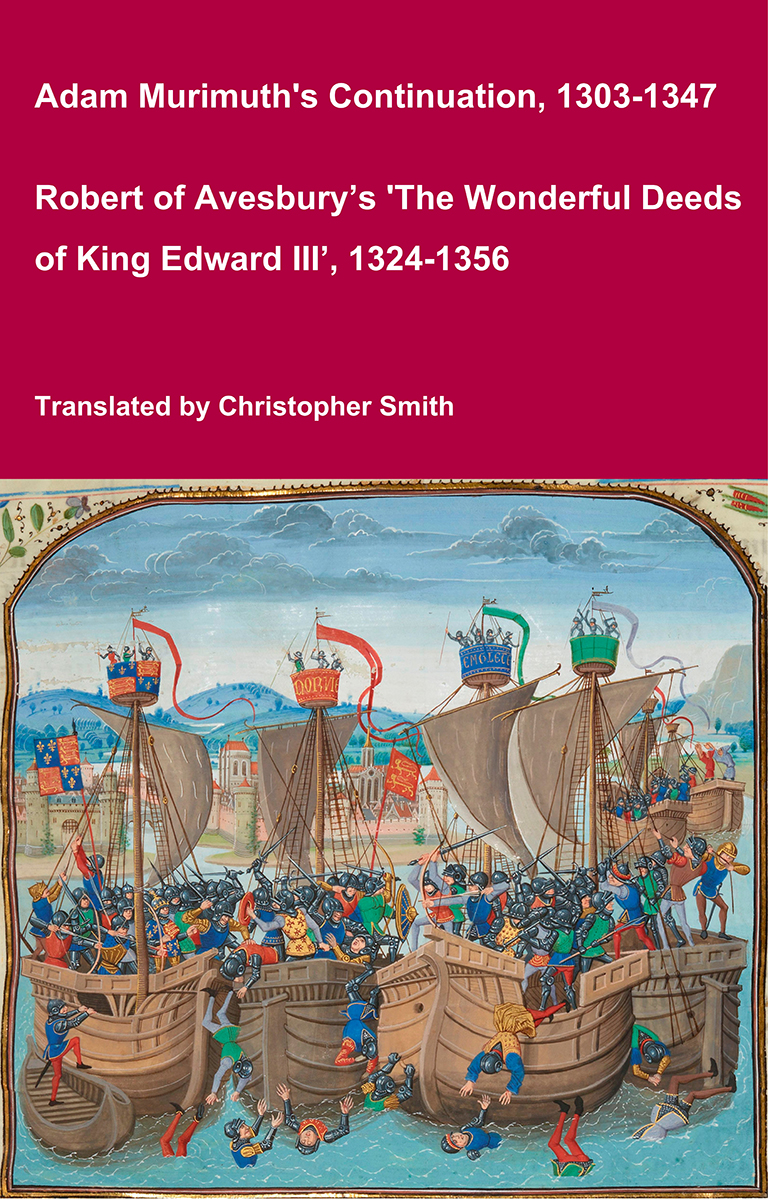
Adam Murimuth's Continuation and Robert of Avesbury’s 'The Wonderful Deeds of King Edward III'
This volume brings together two of the most important contemporary chronicles for the reign of Edward III and the opening phases of the Hundred Years’ War. Written in Latin by English clerical observers, these texts provide a vivid and authoritative window into the political, diplomatic, and military history of fourteenth-century England and its continental ambitions. Adam Murimuth Continuatio's Chronicarum continues an earlier chronicle into the mid-fourteenth century, offering concise but valuable notices on royal policy, foreign relations, and ecclesiastical affairs. Its annalistic structure makes it especially useful for establishing chronology and tracing the development of events year by year. Complementing it, Robert of Avesbury’s De gestis mirabilibus regis Edwardi tertii is a rich documentary chronicle preserving letters, treaties, and official records alongside narrative passages. It is an indispensable source for understanding Edward III’s claim to the French crown, the conduct of war, and the mechanisms of medieval diplomacy. Together, these works offer scholars, students, and enthusiasts a reliable and unembellished account of a transformative period in English and European history. Essential for anyone interested in medieval chronicles, the Hundred Years’ War, or the reign of Edward III.
Available at Amazon in eBook and Paperback format.
In the year of grace 1298, as the King of England was staying at Westminster on the fourth day before the Kalends of April (29th March 1298), a great fire broke out in the lesser hall of the palace. The flames reached the roof of the building and, driven by the wind, devoured the structures of the nearby abbey. Departing from there, the king traveled to York, sending there the barons of the Exchequer and the justices of the Bench, to hold a parliament with the great men of the realm after the feast of the Holy Trinity.
Anno gratiæ MCXCVIIIo. Accedente rege Angliæ apud Westmonasterium iv. kal. Aprilis, accensoque igne vehementi in minori aula palatii, ac flamma tecturam domus attingente ventoque agitata, abbatiæ vicinæ ædificia devoravit. Rex inde proficiscens divertit se apud Eboracum, mittens illuc barones de scaccario et justiciarios de banco, post festum sanctæ Trinitatis parliamentum cum majoribus populi habiturus.
22nd July 1298. From there he set out, accompanied by a great host of earls and knights, to subdue the rebellious Scots. Now the Scots, both clerics and laymen, had gathered themselves into a single wedge-shaped formation, numbering more than 200,000 men, and were found ready either to die or to fight bravely. And a terrible battle was joined on the feast of Saint Mary Magdalene, in the field near Falkirk. The Scots were immediately broken and fell: 200 knights and more than 40,000 foot soldiers were killed, while the rest fled straightaway, some even throwing themselves into the river. Among the English, Brian de Jay, the Master of the Templars in England, was killed, along with around thirty foot soldiers.
Exinde se movens, stipalus agmine comitum et militum copioso, rebelles Scotos expugnare curavit. Porro Scoti tam tonsorati quam laici, in unum cuneum adunati, amplius quam ducenta milia viroram, mori aut pugnare fortiter sunt inventi. Et commissum est bellum terribile in die sanctæ Marie Magdalene in campo juxta Fouchirke. Et statin disgregati Scoti ceciderunt, equites ducenti, pedites vero XL milia et amplius, ceteris vero protinus in fugam conversis, nonnullis præcipitantibugse in flumen. Ex Anglicis quidem Brianus de Jay, magister Templariorum in Anglia, et quidam peditum, ferme triginta.
In that year, Lady Margaret [aged 20], sister of Lord Philip, King of France, arrived at Dover around the Nativity of the Blessed Mary, and two days later [10th September 1299], Lord Edward, King of England [aged 60], joined her to himself in marriage at Canterbury by the authority of the Pope.
Quo anno domina Margareta, soror domini Philippi regis Franciæ, Doveriæ applicuit circa nativitatem beatæ Mariæ, quam post biduum dominus Edwardus rex Angliæ auctoritate Pape Cantuariæ in uxorem sibi copulavit.
And on the feast of Saint Andrew [30th November 1299], the earth shook in Rome for three days, and shortly after in England at dusk; a comet also appeared in the North, emitting fiery rays sideways toward the East for three days after sunset, foretelling great slaughter of men. In the same year, after the magnates had been summoned on the second Sunday of Lent at Westminster, the lord king caused the form of peace, sealed by Pope Boniface as arbiter and final judge between the kings, to be read aloud, along with other bulls concerning his position; to which all the people, together with the clergy, gave their consent. When this had been done, the prelates and other nobles requested that the Great Charter of Liberties and the Charter of the Forest be ratified, but they did not obtain their request.
Et in festo sancti Andreæ Romæ terra tremuit per triduum, et cito post in Anglia in crepusculo; cometa quoque apparuit in Septentrione, emittens radios lateraliter versus Orientem ignivomos triduo post occasum solis, præmonstrans cædem magnam hominum. Eodem anno citatis magnatibus Dominica secunda Quadragesime apud Westmonasterium, dominus rex fecit recitare formam pacis bullatam per Papam Bonefacium, tanquam arbitrum et diffinitorem inter reges, et alias bullas statum suum tangentes; quibus consensum præbuit plebs omnis cum clero. Quo facto petierunt prælati et alii majores magnam cartam libertatum et de foresta ratificari, nec optinuerunt.
On the following day, the king girded his son with the knightly belt in his palace and granted him the Duchy of Aquitaine. The prince, now made a knight, proceeded to Westminster Abbey to likewise adorn his companions with the glory of knighthood. But such was the great crush of people before the high altar that two knights died, and many fainted—despite the fact that each had at least three attendants to guide and protect him. Because of the pressing crowd, the prince was forced to knight his companions not before the altar, but upon it, having the throng driven back by warhorses.
Die autem crastina cinxit rex filium suum baltheo militari in palatio suo, et dedit ei ducatum Aquitaniæ. Princeps ergo, factus miles, perrexit in ecclesiam Westmonasterii, ut consocios suos militari gloria pariter venustaret. Porro tanta erat ibi pressura gentium ante magnum altare, quod duo milites morerentur, quamplures syncopizarent, etiam cum quilibet ad minus tres milites ad se ducendum et tuendum haberet. Princeps autem, propter turbam comprimentem, non secus, sed super magnum altare, divisa turba per dextrarios bellicosos, socios suos cinxit.
Then, in grand pomp, two swans (or cygnets) were brought before the king, adorned with golden nets or gilded bands—a spectacle most pleasing to all who beheld it. Upon seeing them, the king made a solemn vow: to God of Heaven and by the swans, he pledged to go to Scotland to avenge the death of John Comyn and the broken faith of the Scots, whether alive or dead. He charged the prince and the other great lords of the realm, by the loyalty they owed him, that if he should die before fulfilling this, they must carry his body with them into battle in Scotland, and not bury it until the Lord had granted victory and triumph over the traitorous king and the perjured people.
Tunc allati sunt in pompatica gloria duo cygni vel olores ante regem, phalerati retibus aureis vel fistulis deauratis, desiderabile spectaculum intuentibus. Quibus visis, rex votum vovit, Deo cœli et cygnis se proficisci in Scotiam, mortem Johannis Comyn et fidem tesam Scotomm vivus sive mortuus vindicaturus, adjurans principem et ceteros prsecelsos viros terrae, fide sibi debita, si ipse prius in fata decederet, corpus suum secum in Scotiam in bello deferrent, nee sepelirent illud quousque Dominus de perfido coronato et gente perjura dedisset victoriam et triumphum
On the third day before the Kalends of December [28th November 1290], in the nineteenth year of the reign of King Edward just beginning, Queen Eleanor, the consort of King Edward himself, died at Hardby [Harby, Leicestershire] in the county of Lincoln, after first devoutly receiving the sacraments of those departing and pouring forth prayer to her lord the king. He assented to her petitions, that all things unjustly taken by her or by her ministers from anyone whatsoever should be restored, and that satisfaction should be made to those who had been wronged, insofar as seemed most consonant with justice.
Tertio kal. Decembris, anno regni regis Edwardi Death of xix. inchoante, obiit Alienora regina, consors ipsius Alienora regis, apud Herdebi in comitatu Lincolniæ, defungenat Harloy. tium sacramentis prius devote receptis, et fusa prece ad dominum suum regem precibus ejus annuentem, ut omnia per ipsam vel ministros suos injuste quibuslibet ablata restituerentur, et læsis satisfieret, prout videretur magis consonum rationi.
Afterwards, her entrails were buried at Lincoln, and her body was brought to London on the nineteenth day before the Kalends of January [14th December], and on the following night it remained in the church of the Holy Trinity in London. On the next day, namely Friday [15th], the eighteenth day before the Kalends of January, the said body, adorned with royal insignia, was borne, King, prelates, and the nobles of the realm following, to the Friars Minor; and after Mass had been celebrated there, it was taken to St Paul’s and spent the night there.
Tandem extis Her ejus apud Lincolniam tumulatis, corpus ejus xix. kal. Januarii Londonias est allatum, et nocte sequente in ecclesia sanctæ Trinitatis Londoniis morabatur. In crastino vero, scilicet die Veneris, xviii. kal. Januarii, dictum corpus insigniis regalibus insignitum, sequentibus rege, prælatis, et regni proceribus, usque ad fratres Minores ferebatur, ibique missa celebrata est delatum ad sanctum Paulum ibique pernoctabat.
On the following day, namely Saturday, the seventeenth day before the Kalends of January [16th December], after many Masses had been celebrated there by bishops, the body was carried to the Friars Preachers; and after Mass had been celebrated there, it was borne in like solemn manner to Westminster. On the next day, Sunday, namely the sixteenth day before the Kalends of January [17th December], after all things had been carried out according to royal magnificence beyond what had hitherto been seen or heard, it was committed to burial at the feet of the illustrious memory of King Henry of England, father of the aforesaid King Edward.
In crastino vero, scilicet die Sabbati, xvii. kal. Januarii, multis inibi missis per episcopos celebratis, ferebatur corpus apud fratres Prædicatores; et missa ibidem celebrata, usque Westmonasterium simili scemate portabatur. Et in crastino, die Dominica, xvi. videlicet kal. Januarii, peractis omnibus secundum magnificentiam regiam ultra quod hactenus visum est vel auditum, tradebatur sepulturæ ad pedes inclitæ recordationis Henrici regis Angliæ, patris regis Edwardi memorati.
And on the following Tuesday, namely the fourteenth day before the Kalends of January [19th December], the heart of the said queen was solemnly buried at London among the Friars Preachers.
Et die Martis sequente, scilicet xiv. kal. Januarii, cor dictæ reginæ apud fratres Prædicatores Londoniis solempniter est humatum.
Her body, moreover, having been embalmed with spices, was preserved until the king her son returned from Scotland, and on the Sunday immediately after the Nativity of the Blessed Virgin he honourably committed it to burial at Amesbury with royal magnificence. The same king also, having summoned the prelates and nobles of the realm at Westminster on the third day before the Kalends of December, solemnly celebrated the anniversary of Eleanor, his late consort, at the beginning of the twentieth year of his reign; and on the third day before the Nones of December following, he caused the heart of his said mother to be solemnly buried among the Friars Minor in London.
[Corpus autem ejus conditum aromatibus servabatur, donee rex filius ejus de Scotia reversus illud apud Ambresbire Dominica proxima post Nativitatem beatæ Virginis secundum magnificentiam regiam honorifice traderet sepulturæ. Idem etiam rex, prælatis et proceribus regni convocatis apud Westmonasteriuni iii. kal. Decembris, anniversarium Alienoræ quondam consortis suæ solempniter celebravit, anno regiii sui xx. inchoante, et iii. non. Decembris sequente cor matris suæ prædictæ apud fratres Minores Londoniis fecit solempniter tumulari.]
[10th February 1306] After all these events had taken place, fresh disturbances and wars broke out in Scotland. For Robert Bruce, earl of Carrick, conferred at first secretly, and afterwards openly, with some of the great nobles of Scotland, saying to them, "Ye know that by the right of hereditary relationship this kingdom belongs to me, and how this nation intended to have crowned my father king, but the cunning of the king of England disappointed him of his desire. If, therefore, you will crown me king, I will fight your battles, and deliver this kingdom and this people from its slavery to the English." This he said, and presently he received the consent of many perjured men. And when he asked of John Comyn, a very noble and powerful knight, whether he also agreed to this, he steadily replied, that he did not. And he said, "All the nations know that the king of England has four times subdued our nation and country, and that we all, both knights and clergy, have sworn fealty and homage to him for the present and all future generations. Far be it from me to do this; I will never consent to this measure, that I may be free from perjury." Bruce persuades, Comyn dissuades; the one threatens, the other is perplexed; at last, Bruce, drawing his sword, strikes the unarmed Comyn on the head. And when he had thrown him down, as he was striving to wrest the sword from the hands of his assassin (for he was a man of great personal strength), the servants of the traitor ran up, and stabbed him with their swords, and released their master. But the lord John escaped as well as he could to the altar; and Robert pursued him, and, as he would not agree to his proposals, the wicked and inhuman man there sacrificed the pious victim. These things were done in the church of the Minor Brothers, at Dumfries, on the twenty-ninth of January, in the year subsequent to this one. Behold the beginning of the homicide, aspiring to the kingdom by the shedding of the blood of Abel.