

The History of William Marshal was commissioned by his son shortly after William’s death in 1219 to celebrate the Marshal’s remarkable life; it is an authentic, contemporary voice. The manuscript was discovered in 1861 by French historian Paul Meyer. Meyer published the manuscript in its original Anglo-French in 1891 in two books. This book is a line by line translation of the first of Meyer’s books; lines 1-10152. Book 1 of the History begins in 1139 and ends in 1194. It describes the events of the Anarchy, the role of William’s father John, John’s marriages, William’s childhood, his role as a hostage at the siege of Newbury, his injury and imprisonment in Poitou where he met Eleanor of Aquitaine and his life as a knight errant. It continues with the accusation against him of an improper relationship with Margaret, wife of Henry the Young King, his exile, and return, the death of Henry the Young King, the rebellion of Richard, the future King Richard I, war with France, the death of King Henry II, and the capture of King Richard, and the rebellion of John, the future King John. It ends with the release of King Richard and the death of John Marshal.
Available at Amazon in eBook and Paperback format.
Galatians is in Saint Paul's Letters.
NIV. 1 Then after fourteen years, I went up again to Jerusalem, this time with Barnabas. I took Titus along also. 2 I went in response to a revelation and, meeting privately with those esteemed as leaders, I presented to them the gospel that I preach among the Gentiles. I wanted to be sure I was not running and had not been running my race in vain. 3 Yet not even Titus, who was with me, was compelled to be circumcised, even though he was a Greek. 4 This matter arose because some false believers had infiltrated our ranks to spy on the freedom we have in Christ Jesus and to make us slaves. 5 We did not give in to them for a moment, so that the truth of the gospel might be preserved for you.
NIV. 6 As for those who were held in high esteem-whatever they were makes no difference to me; God does not show favoritism-they added nothing to my message. 7 On the contrary, they recognized that I had been entrusted with the task of preaching the gospel to the uncircumcised, just as Peter had been to the circumcised. 8 For God, who was at work in Peter as an apostle to the circumcised, was also at work in me as an apostle to the Gentiles. 9 James, Cephas and John, those esteemed as pillars, gave me and Barnabas the right hand of fellowship when they recognized the grace given to me. They agreed that we should go to the Gentiles, and they to the circumcised. 10 All they asked was that we should continue to remember the poor, the very thing I had been eager to do all along.
NIV. 11 When Cephas came to Antioch, I opposed him to his face, because he stood condemned. 12 For before certain men came from James, he used to eat with the Gentiles. But when they arrived, he began to draw back and separate himself from the Gentiles because he was afraid of those who belonged to the circumcision group. 13 The other Jews joined him in his hypocrisy, so that by their hypocrisy even Barnabas was led astray.
NIV. 14 When I saw that they were not acting in line with the truth of the gospel, I said to Cephas in front of them all, "You are a Jew, yet you live like a Gentile and not like a Jew. How is it, then, that you force Gentiles to follow Jewish customs?.
NIV. 15 "We who are Jews by birth and not sinful Gentiles 16 know that a person is not justified by the works of the law, but by faith in Jesus Christ. So we, too, have put our faith in Christ Jesus that we may be justified by faith in Christ and not by the works of the law, because by the works of the law no one will be justified.
NIV. 17 "But if, in seeking to be justified in Christ, we Jews find ourselves also among the sinners, doesn't that mean that Christ promotes sin? Absolutely not! 18 If I rebuild what I destroyed, then I really would be a lawbreaker.
NIV. 19 "For through the law I died to the law so that I might live for God. 20 I have been crucified with Christ and I no longer live, but Christ lives in me. The life I now live in the body, I live by faith in the Son of God, who loved me and gave himself for me. 21 I do not set aside the grace of God, for if righteousness could be gained through the law, Christ died for nothing!".
NIV. 3 So also, when we were underage, we were in slavery under the elemental spiritual forces of the world. 4 But when the set time had fully come, God sent his Son, born of a woman, born under the law, 5 to redeem those under the law, that we might receive adoption to sonship. 6 Because you are his sons, God sent the Spirit of his Son into our hearts, the Spirit who calls out, "Abba, Father." 7 So you are no longer a slave, but God's child; and since you are his child, God has made you also an heir.

John Evelyn's Diary. 1st January 1660. Annus Mirabilis. Begging God's blessings for the following year, I went to Exeter Chapel [Map], when Mr. Gunning (age 46) began the year on Galatians iv. 3-7, showing the love of Christ in shedding his blood so early for us.
Note 1. Unbeknown to Evelyn the diarist Samuel Pepys, whose diary was commenced this day, was also present. See Samuel Pepy's Diary.
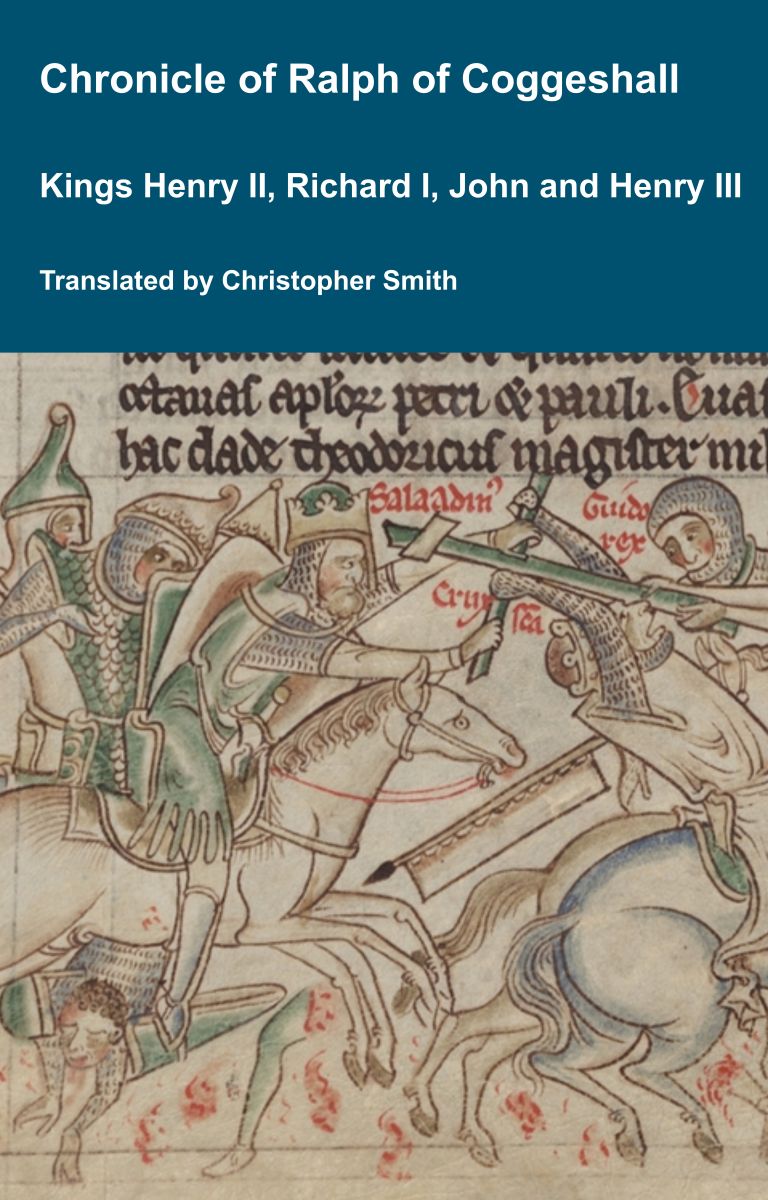
Chronicle of Abbot Ralph of Coggeshall
The Chronicle of Abbot Ralph of Coggeshall (Chronicon Anglicanum) is an indispensable medieval history that brings to life centuries of English and European affairs through the eyes of a learned Cistercian monk. Ralph of Coggeshall, abbot of the Abbey of Coggeshall in Essex in the early 13th century, continued and expanded his community’s chronicle, documenting events from the Norman Conquest of 1066 into the tumultuous reign of King Henry III. Blending eyewitness testimony, careful compilation, and the monastic commitment to record-keeping, this chronicle offers a rare narrative of political intrigue, royal power struggles, and social upheaval in England and beyond. Ralph’s work captures the reigns of pivotal figures such as Richard I and King John, providing invaluable insights into their characters, decisions, and the forces that shaped medieval rule. More than a simple annal, Chronicon Anglicanum conveys the texture of medieval life and governance, making it a rich source for scholars and readers fascinated by English history, monastic authorship, and the shaping of the medieval world.
Available at Amazon in eBook and Paperback format.
NIV. You, my brothers and sisters, were called to be free. But do not use your freedom to indulge the flesh; rather, serve one another humbly in love.
KJB. For, brethren, ye have been called unto liberty; only use not liberty for an occasion to the flesh, but by love serve one another.