

Henrici Quinti, Angliæ Regis, Gesta, is a first-hand account of the Agincourt Campaign, and subsequent events to his death in 1422. The author of the first part was a Chaplain in King Henry's retinue who was present from King Henry's departure at Southampton in 1415, at the siege of Harfleur, the battle of Agincourt, and the celebrations on King Henry's return to London. The second part, by another writer, relates the events that took place including the negotiations at Troye, Henry's marriage and his death in 1422.
Available at Amazon in eBook and Paperback format.
 John Evelyn's Diary January 1698
 Whitehall Palace
 Sayes Court, Deptford
 John Evelyn's Diary June 1698
 Greenwich Hospital
John Evelyn's Diary 1698 is in John Evelyn's Diary 1690s.
2nd January 1698. Dr. Fulham (age 37), who lately married my niece, preached against atheism, a very eloquent discourse, somewhat improper for most of the audience at [Wotton], but fitted for some other place, and very apposite to the profane temper of the age.
30th January 1698. The imprisonment of the great banker, Duncombe: censured by Parliament; acquitted by the Lords; sent again to the Tower by the Commons.
30th January 1698. The Czar of Muscovy being come to England, and having a mind to see the building of ships, hired my house at Sayes Court, Deptford [Map], and made it his court and palace, newly furnished for him by the King (age 47).

8th May 1698. An extraordinary great snow and frost, nipping the corn and other fruits. Corn at nine shillings a bushel [£18 a load].
30th May 1698. I dined at Mr. Pepys's (age 65), where I heard the rare voice of Mr. Pule, who was lately come from Italy, reputed the most excellent singer we had ever had. He sung several compositions of the late Dr. Purcell.


5th June 1698. Dr. White, late Bishop of Norwich, who had been ejected for not complying with Government, was buried in St. Gregory's Churchyard, or vault, at St. Paul's. His hearse was accompanied by two non-juror bishops, Dr. Turner of Ely, and Dr. Lloyd, with forty other non-juror clergymen, who would not stay the Office of the burial, because the Dean of St. Paul's had appointed a conforming minister to read the Office; at which all much wondered, there being nothing in that Office which mentioned the present King.
8th June 1698. I went to congratulate the marriage of Mr. Godolphin (age 19) with the Earl of Marlborough's (age 48) daughter (age 16).


9th June 1698. To Deptford, to see how miserably the Czar had left my house [Map], after three months making it his Court. I got Sir Christopher Wren (age 74), the King's surveyor, and Mr. London, his gardener, to go and estimate the repairs, for which they allowed £150 in their report to the Lords of the Treasury. I then went to see the foundation of the Hall and Chapel at Greenwich Hospital [Map].
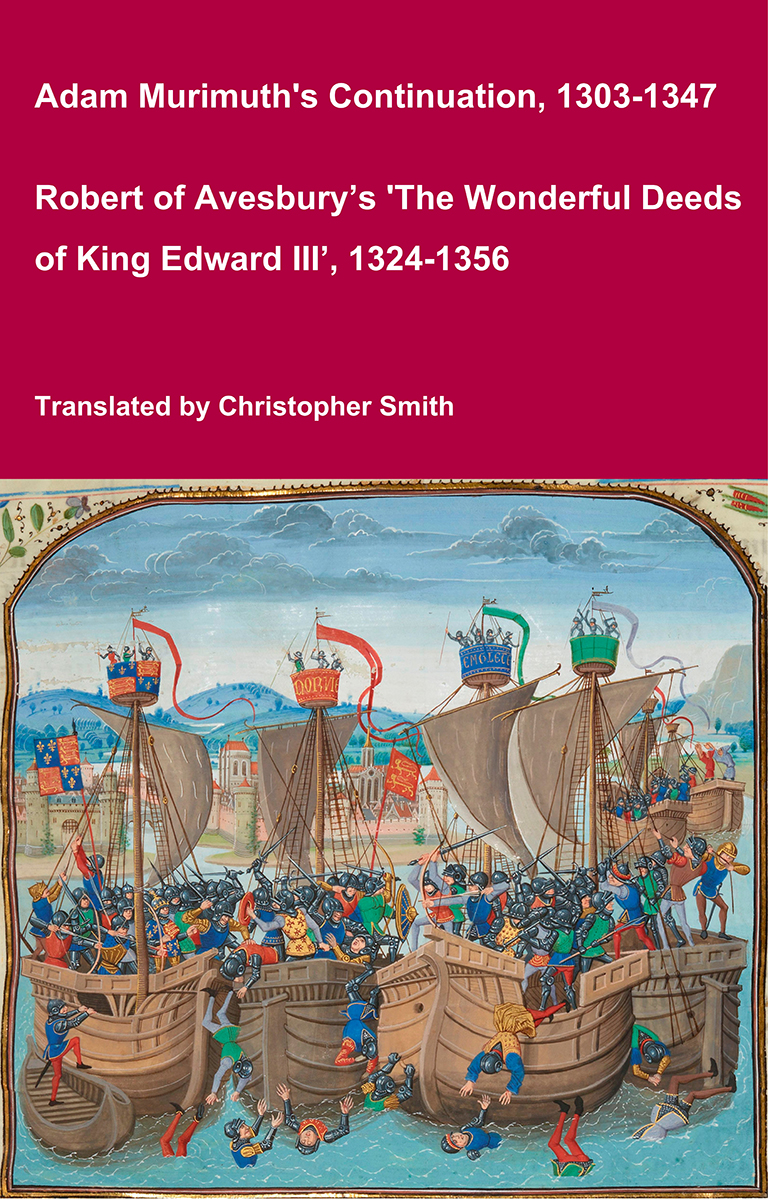
Adam Murimuth's Continuation and Robert of Avesbury’s 'The Wonderful Deeds of King Edward III'
This volume brings together two of the most important contemporary chronicles for the reign of Edward III and the opening phases of the Hundred Years’ War. Written in Latin by English clerical observers, these texts provide a vivid and authoritative window into the political, diplomatic, and military history of fourteenth-century England and its continental ambitions. Adam Murimuth Continuatio's Chronicarum continues an earlier chronicle into the mid-fourteenth century, offering concise but valuable notices on royal policy, foreign relations, and ecclesiastical affairs. Its annalistic structure makes it especially useful for establishing chronology and tracing the development of events year by year. Complementing it, Robert of Avesbury’s De gestis mirabilibus regis Edwardi tertii is a rich documentary chronicle preserving letters, treaties, and official records alongside narrative passages. It is an indispensable source for understanding Edward III’s claim to the French crown, the conduct of war, and the mechanisms of medieval diplomacy. Together, these works offer scholars, students, and enthusiasts a reliable and unembellished account of a transformative period in English and European history. Essential for anyone interested in medieval chronicles, the Hundred Years’ War, or the reign of Edward III.
Available at Amazon in eBook and Paperback format.
6th August 1698. I dined with Pepys (age 65), where was Captain Dampier (age 46), who had been a famous buccaneer, had brought hither the painted Prince Job, and printed a relation of his very strange adventure, and his observations. He was now going abroad again by the King's (age 47) encouragement, who furnished a ship of 290 tons. He seemed a more modest man than one would imagine by the relation of the crew he had assorted with. He brought a map of his observations of the course of the winds in the South Sea, and assured us that the maps hitherto extant were all false as to the Pacific Sea, which he makes on the south of the line, that on the north end running by the coast of Peru being extremely tempestuous.
25th September 1698. Dr. Foy came to me to use my interest with Lord Sunderland (age 57) for his being made Professor of Physic at Oxford, in the King's gift. I went also to the Archbishop (age 61) in his behalf.
7th December 1698. Being one of the Council of the Royal Society, I was named to be of the committee to wait on our new President (age 47), the Lord Chancellor, our Secretary, Dr. Sloane, and Sir R. Southwell (age 62), last Vice-President, carrying our book of statutes; the office of the President being read, his Lordship subscribed his name, and took the oaths according to our statutes as a Corporation for the improvement of natural knowledge. Then his Lordship made a short compliment concerning the honor the Society had done him, and how ready he would be to promote so noble a design, and come himself among us, as often as the attendance on the public would permit; and so we took our leave.


18th December 1698. Very warm, but exceedingly stormy.