

Jean de Waurin's Chronicle of England Volume 6 Books 3-6: The Wars of the Roses
Jean de Waurin was a French Chronicler, from the Artois region, who was born around 1400, and died around 1474. Waurin’s Chronicle of England, Volume 6, covering the period 1450 to 1471, from which we have selected and translated Chapters relating to the Wars of the Roses, provides a vivid, original, contemporary description of key events some of which he witnessed first-hand, some of which he was told by the key people involved with whom Waurin had a personal relationship.
Available at Amazon in eBook and Paperback format.
 John Evelyn's Diary February 1703
 King's Bench Prison
 Rome, Italy
 John Evelyn's Diary July 1703
 John Evelyn's Diary August 1703
 Greenwich Hospital
 John Evelyn's Diary December 1703
 Sayes Court, Deptford
John Evelyn's Diary 1703 is in John Evelyn's Diary 1700s.

1st January 1703. News of Vice-Admiral Benbow's conflict with the French fleet in the West Indies, in which he gallantly behaved himself, and was wounded, and would have had extraordinary success, had not four of his men-of-war stood spectators without coming to his assistance; for this, two of their commanders were tried by a Council of War, and executed; a third was condemned to perpetual imprisonment, loss of pay, and incapacity to serve in future. The fourth died.

1st January 1703. Sir Richard Onslow (age 48) and Mr. Oglethorpe (son of the late Sir Theo. O.) fought on occasion of some words which passed at a committee of the House. Mr. Oglethorpe was disarmed. The Bill against occasional conformity was lost by one vote. Corn and provisions so cheap that the farmers are unable to pay their rents.
1st February 1703. A famous cause at the King's Bench [Map] between Mr. Fenwick and his wife, which went for him with a great estate. The Duke of Marlborough (age 52) lost his only son (age 16) at Cambridge by the smallpox. A great earthquake at Rome, Italy [Map], etc. A famous young woman (age 23), an Italian, was hired by our comedians to sing on the stage, during so many plays, for which they gave her £500; which part by her voice alone at the end of three scenes she performed with such modesty and grace, and above all with such skill, that there was never any who did anything comparable with their voices. She was to go home to the Court of the King of Prussia, and I believe carried with her out of this vain nation above £1,000, everybody coveting to hear her at their private houses.


26th May 1703. This day died Mr. Samuel Pepys (age 70), a very worthy, industrious and curious person, none in England exceeding him in knowledge of the navy, in which he had passed through all the most considerable offices, Clerk of the Acts and Secretary of the Admiralty, all which he performed with great integrity. When King James II went out of England, he laid down his office, and would serve no more; but withdrawing himself from all public affairs, he lived at Clapham with his partner, Mr. Hewer (age 61), formerly his clerk, in a very noble house and sweet place, where he enjoyed the fruit of his labors in great prosperity. He was universally beloved, hospitable, generous, learned in many things, skilled in music, a very great cherisher of learned men of whom he had the conversation. His library and collection of other curiosities were of the most considerable, the models of ships especially. Besides what he published of an account of the navy, as he found and left it, he had for divers years under his hand the History of the Navy, or Navalia, as he called it; but how far advanced, and what will follow of his, is left, I suppose, to his sister's son, Mr. Jackson (age 30), a young gentleman, whom Mr. Pepys had educated in all sorts of useful learning, sending him to travel abroad, from whence he returned with extraordinary accomplishments, and worthy to be heir. Mr. Pepys had been for near forty years so much my particular friend, that Mr. Jackson sent me complete mourning, desiring me to be one to hold up the pall at his magnificent obsequies; but my indisposition hindered me from doing him this last office.


13th June 1703. Rains have been great and continual, and now, near midsummer, cold and wet.
11th July 1703. I went to Addiscombe, sixteen miles from Wotton, to see my son-in-law's new house, the outside, to the coving, being such excellent brickwork, based with Portland stone, with the pilasters, windows, and within, that I pronounced it in all the points of good and solid architecture to be one of the very best gentlemen's houses in Surrey, when finished. I returned to Wotton in the evening, though weary.
25th July 1703. The last week in this month an uncommon long-continued rain, and the Sunday following, thunder and lightning.
12th August 1703. The new Commission for Greenwich Hospital [Map] was sealed and opened, at which my son-in-law, Draper, was present, to whom I resigned my office of Treasurer. From August 1696, there had been expended in building £89,364 14s. 8d.
31st October 1703. This day, being eighty-three years of age, upon examining what concerned me, more particularly the past year, with the great mercies of God preserving me, and in the same measure making my infirmities tolerable, I gave God most hearty and humble thanks, beseeching him to confirm to me the pardon of my sins past, and to prepare me for a better life by the virtue of his grace and mercy, for the sake of my blessed Savior.
21st November 1703. The wet and uncomfortable weather staying us from church this morning, our Doctor officiated in my family; at which were present above twenty domestics. He made an excellent discourse on 1 Cor. xv., v. 55, 56 [Note. This reference is somewhat confusing. Beleived to be to 1 Corinthians Chapter 15?], of the vanity of this world and uncertainty of life, and the inexpressible happiness and satisfaction of a holy life, with pertinent inferences to prepare us for death and a future state. I gave him thanks, and told him I took it kindly as my funeral sermon.
26th November 1703 and 27th November 1703. The effects of the Hurricane and tempest of wind, rain, and lightning, through all the nation, especially London, were very dismal. Many houses demolished, and people killed. As to my own losses, the subversion of woods and timber, both ornamental and valuable, through my whole estate, and about my house the woods crowning the garden mount, the growing along the park meadow, the damage to my own dwelling, farms, and outhouses, is almost tragical, not to be paralleled, with anything happening in our age. I am not able to describe it; but submit to the pleasure of Almighty God.
7th December 1703. I removed to Dover Street, where I found all well; but houses, trees, garden, etc., at Sayes Court, Deptford [Map], suffered very much.
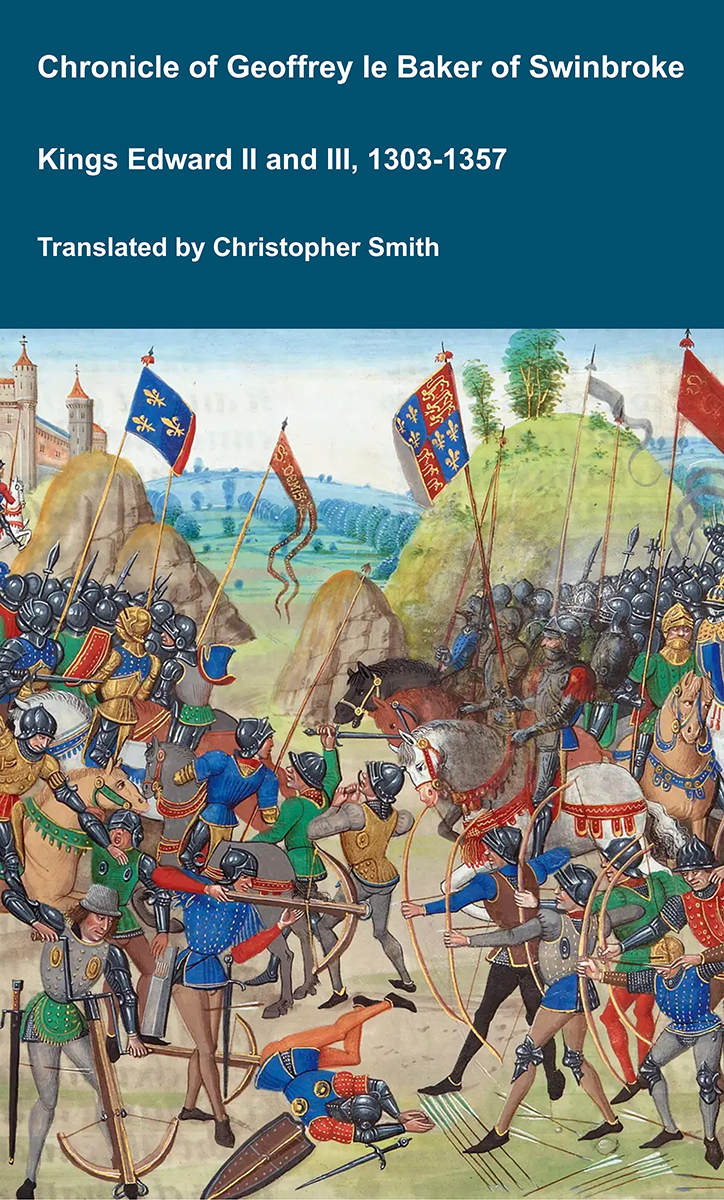
Chronicle of Geoffrey le Baker of Swinbroke
Baker was a secular clerk from Swinbroke, now Swinbrook, an Oxfordshire village two miles east of Burford. His Chronicle describes the events of the period 1303-1356: Gaveston, Bannockburn, Boroughbridge, the murder of King Edward II, the Scottish Wars, Sluys, Crécy, the Black Death, Winchelsea and Poitiers. To quote Herbert Bruce 'it possesses a vigorous and characteristic style, and its value for particular events between 1303 and 1356 has been recognised by its editor and by subsequent writers'. The book provides remarkable detail about the events it describes. Baker's text has been augmented with hundreds of notes, including extracts from other contemporary chronicles, such as the Annales Londonienses, Annales Paulini, Murimuth, Lanercost, Avesbury, Guisborough and Froissart to enrich the reader's understanding. The translation takes as its source the 'Chronicon Galfridi le Baker de Swynebroke' published in 1889, edited by Edward Maunde Thompson.
Available at Amazon in eBook and Paperback format.
31st December 1703. I made up my accounts, paid wages, gave rewards and New Year's gifts, according to custom.