Chronicle of Geoffrey le Baker of Swinbroke
Baker was a secular clerk from Swinbroke, now Swinbrook, an Oxfordshire village two miles east of Burford. His Chronicle describes the events of the period 1303-1356: Gaveston, Bannockburn, Boroughbridge, the murder of King Edward II, the Scottish Wars, Sluys, Crécy, the Black Death, Winchelsea and Poitiers. To quote Herbert Bruce 'it possesses a vigorous and characteristic style, and its value for particular events between 1303 and 1356 has been recognised by its editor and by subsequent writers'. The book provides remarkable detail about the events it describes. Baker's text has been augmented with hundreds of notes, including extracts from other contemporary chronicles, such as the Annales Londonienses, Annales Paulini, Murimuth, Lanercost, Avesbury, Guisborough and Froissart to enrich the reader's understanding. The translation takes as its source the 'Chronicon Galfridi le Baker de Swynebroke' published in 1889, edited by Edward Maunde Thompson.
Available at Amazon in eBook and Paperback format.
Keiller's Slides is in Keiller Collection.

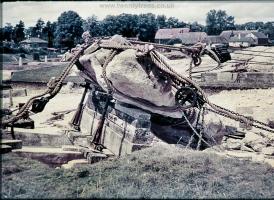
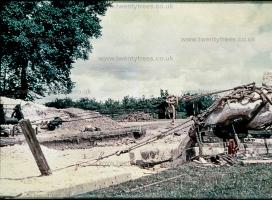
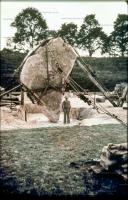
1938 to 1939. Keiller's Slides comprise 550 Slides taken by Alexander Keiller (age 48) during the archaeological work undertaken between 1938 and 1939. They show general views around the henge and along West Kennet Avenue, both before and after restoration work. Others show the excavation of banks and ditches and the re-erection of stones in progress. There are also several slides which depict maps and plans of the area, archaeological finds from the site.
General view of stones 15a and 15b [Map] in West Kennet Avenue, showing the west faces.
General view of stones 26a and 26b [Map] in West Kennet Avenue, showing the west faces.
General view of West Kennet Avenue towards the henge, with stone 37a [Map] in the foreground.
General view of stones 13a and 13b [Map] in West Kennet Avenue, showing the west faces.
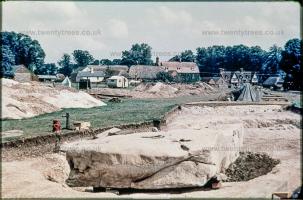
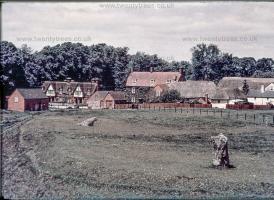
1938. General view of the south west sector of the henge at Avebury, prior to restoration.
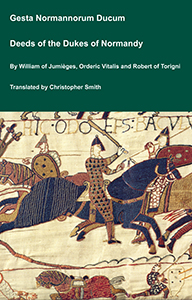
The Deeds of the Dukes of Normandy
The Gesta Normannorum Ducum [The Deeds of the Dukes of Normandy] is a landmark medieval chronicle tracing the rise and fall of the Norman dynasty from its early roots through the pivotal events surrounding the Norman Conquest of England. Originally penned in Latin by the monk William of Jumièges shortly before 1060 and later expanded at the behest of William the Conqueror, the work chronicles the deeds, politics, battles, and leadership of the Norman dukes, especially William’s own claim to the English throne. The narrative combines earlier historical sources with firsthand information and oral testimony to present an authoritative account of Normandy’s transformation from a Viking settlement into one of medieval Europe’s most powerful realms. William’s history emphasizes the legitimacy, military prowess, and governance of the Norman line, framing their expansion, including the conquest of England, as both divinely sanctioned and noble in purpose. Later chroniclers such as Orderic Vitalis and Robert of Torigni continued the history, extending the coverage into the 12th century, providing broader context on ducal rule and its impact. Today this classic work remains a foundational source for understanding Norman identity, medieval statesmanship, and the historical forces that reshaped England and Western Europe between 800AD and 1100AD.
Available at Amazon in eBook and Paperback format.
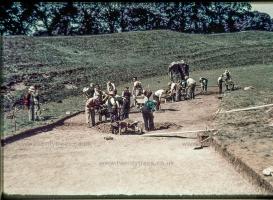
1938. General view of men working on an excavation around an unidentified stone in the henge at Avebury
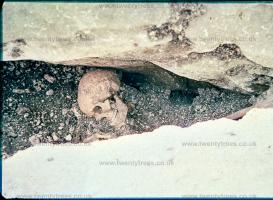
1938. General view of the skull of the Barber Surgeon in situ during the excavation of stone 9 [Map] in the south west sector of the henge at Avebury. Items found with the body including three silver coins dated to around 1320–25, as well as a pair of iron scissors and an iron probe led to him being identified as an itinerant mediaeval barber surgeon.
1938. General view of men working to excavate and re-erect an unidentified stone in the henge at Avebury.