

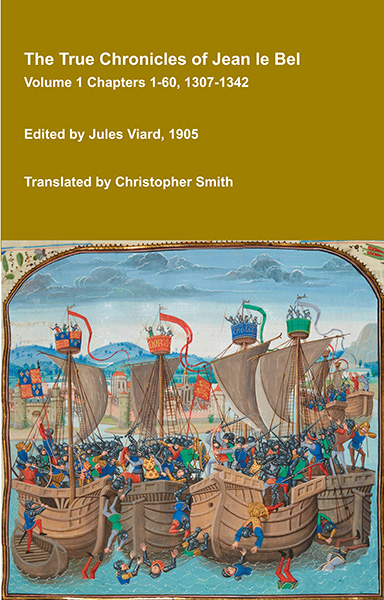
The True Chronicles of Jean le Bel Volume 1 Chapters 1-60 1307-1342
The True Chronicles of Jean le Bel offer one of the most vivid and immediate accounts of 14th-century Europe, written by a knight who lived through the events he describes, and experienced some of them first hand. Covering the early decades of the Hundred Years’ War, this remarkable chronicle follows the campaigns of Edward III of England, the politics of France and the Low Countries, and the shifting alliances that shaped medieval warfare. Unlike later historians, Jean le Bel writes with a strong sense of eyewitness authenticity, drawing on personal experience and the testimony of fellow soldiers. His narrative captures not only battles and sieges, but also the realities of military life, diplomacy, and the ideals of chivalry that governed noble society. A key source for Jean Froissart, Le Bel’s chronicle stands on its own as a compelling and insightful work, at once historical record and literary achievement. This translation builds on the 1905 edition published in French by Jules Viard, adding extensive translations from other sources Rymer's Fœdera, the Chronicles of Adam Murimuth, William Nangis, Walter of Guisborough, a Bourgeois of Valenciennes, Geoffrey le Baker of Swinbroke and Richard Lescot to enrich the original text and Viard's notes.
Available at Amazon in eBook and Paperback format.
Saga of Harald Hardrade is in Late Medieval Books.
Of the Beginning of the Battle.
[25th September 1066]. Now the battle began. The Englishmen made a hot assault upon the Northmen, who sustained it bravely. It was no easy matter for the English to ride against the Northmen on account of their spears; therefore they rode in a circle around them. And the fight at first was but loose and light, as long as the Northmen kept their order of battle; for although the English rode hard against the Northmen, they gave way again immediately, as they could do nothing against them. Now when the Northmen thought they perceived that the enemy were making but weak assaults, they set after them, and would drive them into flight; but when they had broken their shield-rampart the Englishmen rode up from all sides, and threw arrows and spears on them. Now when King Harald Sigurdson saw this, he went into the fray where the greatest crash of weapons was, and there was a sharp conflict, in which many people fell on both sides. King Harald then was in a rage, and ran out in front of the array, and hewed down with both hands; so that neither helmet nor armour could withstand him, and all who were nearest gave way before him. It was then very near with the English that they had taken to flight. So says Arnor, the earls' skald: --
"Where battle-storm was ringing,
Where arrow-cloud was singing,
Harald stood there,
Of armour bare,
His deadly sword still swinging.
The foeman feel its bite;
His Norsemen rush to fight,
Danger to share,
With Harald there,
Where steel on steel was ringing."
Fall of King Harald
King Harald Sigurdson was hit by an arrow in the windpipe, and that was his death-wound. He fell, and all who had advanced with him, except those who retired with the banner. There was afterwards the warmest conflict, and Earl Toste had taken charge of the king's banner. They began on both sides to form their array again, and for a long time there was a pause in fighting. Then Thiodolf sang these verses: --
"The army stands in hushed dismay;
Stilled is the clamour of the fray.
Harald is dead, and with him goes
The spirit to withstand our foes.
A bloody scat the folk must pay
For their king's folly on this day.
He fell; and now, without disguise,
We say this business was not wise."
But before the battle began again Harald Godwinson offered his brother, Earl Toste, peace, and also quarter to the Northmen who were still alive; but the Northmen called out, all of them together, that they would rather fall, one across the other, than accept of quarter from the Englishmen. Then each side set up a war-shout, and the battle began again. So says Arnor, the earls' skald: --
"The king, whose name would ill-doers scare,
The gold-tipped arrow would not spare.
Unhelmed, unpanzered, without shield,
He fell among us in the field.
The gallant men who saw him fall
Would take no quarter; one and all
Resolved to die with their loved king,
Around his corpse in a corpse-ring."