

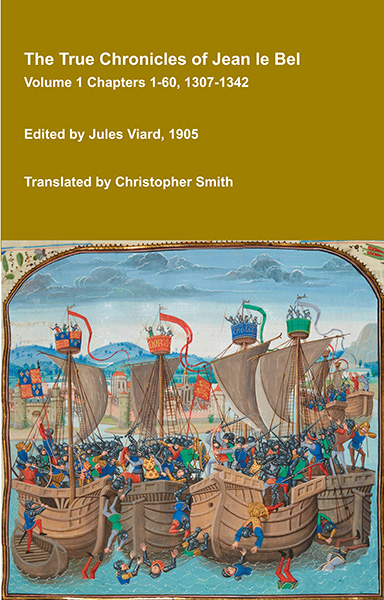
The True Chronicles of Jean le Bel Volume 1 Chapters 1-60 1307-1342
The True Chronicles of Jean le Bel offer one of the most vivid and immediate accounts of 14th-century Europe, written by a knight who lived through the events he describes, and experienced some of them first hand. Covering the early decades of the Hundred Years’ War, this remarkable chronicle follows the campaigns of Edward III of England, the politics of France and the Low Countries, and the shifting alliances that shaped medieval warfare. Unlike later historians, Jean le Bel writes with a strong sense of eyewitness authenticity, drawing on personal experience and the testimony of fellow soldiers. His narrative captures not only battles and sieges, but also the realities of military life, diplomacy, and the ideals of chivalry that governed noble society. A key source for Jean Froissart, Le Bel’s chronicle stands on its own as a compelling and insightful work, at once historical record and literary achievement. This translation builds on the 1905 edition published in French by Jules Viard, adding extensive translations from other sources Rymer's Fœdera, the Chronicles of Adam Murimuth, William Nangis, Walter of Guisborough, a Bourgeois of Valenciennes, Geoffrey le Baker of Swinbroke and Richard Lescot to enrich the original text and Viard's notes.
Available at Amazon in eBook and Paperback format.
Serious Admonitions to Youth is in Georgian Books.
Serious admonitions to youth, in a short account of the life, trial, condemnation and execution. Of Mrs. Mary Channing (age 18). Who, for poisoning her husband, was burnt at Dorset ... 1706.
About Noon, two Men were executed, the one for House breaking and the other for murdering his Wife; the latter of which, shewed not the least Care for his Soul, but died an ignorant, hardened Wretch, denying to the very last the Fact for which he suffered.
[21st March 1706] After the Under Sheriff had taken some Refreshment, she [Mary Brookes aka Channing (age 18)] was brought out of Prison, and drag'd by her Fathers and Husband's Houses, to the Place of Execution [Maumbury Rings [Map]]. Here Mr. Hutchins and other Clergy continued a long time with her in Prayer, and supposing that Death being now in View, might mollifie her hard Heart, repeated their Exhortations to Confession, but to no purpose., they found no tthe least Alteration. In the midst of her Prayers she was strangely concern'd at the Sight of Mr. Richard Channing her Husband's eldest Brother, and 'twas with some Difficulty Mr. Hutchins brought her again to a calm Attendance on her Devotians. She manifested nothing of Alteration when fixed to the Srake, but justified her Innocence to the very last, and left the World with a Courage seldom found in her Sex. She being first strangled, the Fire was kindled five in the Afternoon, and in the sight of many thousand Spoctmors she was consum'd to Ashes.