

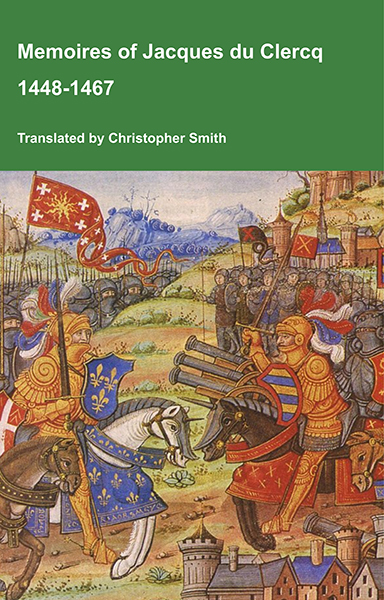
This is a translation of the 'Memoires of Jacques du Clercq', published in 1823 in two volumes, edited by Frederic, Baron de Reissenberg. In his introduction Reissenberg writes: 'Jacques du Clercq tells us that he was born in 1424, and that he was a licentiate in law and a counsellor to Philip the Good, Duke of Burgundy, in the castellany of Douai, Lille, and Orchies. It appears that he established his residence at Arras. In 1446, he married the daughter of Baldwin de la Lacherie, a gentleman who lived in Lille. We read in the fifth book of his Memoirs that his father, also named Jacques du Clercq, had married a lady of the Le Camelin family, from Compiègne. His ancestors, always attached to the counts of Flanders, had constantly served them, whether in their councils or in their armies.' The Memoires cover a period of nineteen years beginning in in 1448, ending in in 1467. It appears that the author had intended to extend the Memoirs beyond that date; no doubt illness or death prevented him from carrying out this plan. As Reissenberg writes the 'merit of this work lies in the simplicity of its narrative, in its tone of good faith, and in a certain air of frankness which naturally wins the reader’s confidence.' Du Clercq ranges from events of national and international importance, including events of the Wars of the Roses in England, to simple, everyday local events such as marriages, robberies, murders, trials and deaths, including that of his own father in Book 5; one of his last entries.
Available at Amazon in eBook and Paperback format.
Some Remarkable Passages of the Life and Death of Mr Alexander Peden is in Georgian Books.
SOME REMARKABLE PASSAGES OF THE LIFE AND DEATH OF MR. ALEXANDER PEDEN, LATE MINISTER OF THE GOSPEL AT NEW GLENLUCE IN GALLOWAY. From the Fourth Aberdeen Edition.
JUDG. ii, 10. And also all that generation were gathered unto their fathers; and there arose another generation after them, which knew not the Lord, nor yet the works which he had done for Israel.
PSAL. lxxviii, 3, 4. Which we have heard and known, and our Fathers have told us, we wiil not hide them from their children, shewing to the generation to come, the praises of the Lord, and his strength, and his wonderful works that he hath done. These with the S, 6, 7 & 8 verses.
PITTSBURGH, PRIJ^TED FOR ALEXAJSTDER M'QUEEM, BY ROBERT FERGUSON AND CQ, 1815.

The broth was hell-hot in these days; they 'wanted long-shanked spoons that supped with the devil:' I could give many instances, but at this time shall only mention the drowning of these two women at Wigtoun in Galloway, the 11th of May 1685, (which some deny to be matter of fact) viz. Margaret Lauchlan, who was past sixty-three years, and some of her intimates said to me. She was a christian of deep exercise through much of her life, and of high attainments and great experiences in the ways of godliness; and Margaret Wilson (age 18) who was put to death with her, aged twenty-three. The old woman was first tied to the stake, enemies saying, 'Tis needless to speak to that old damn'd bitch, let her go to hell: but,' say they, 'Margaret, ye are young; if ye'll pray for the king, we will give you your life.' She said, 'I'll pray for salvation to all the elect, but the damnation of none.' They dashed her under the water, and pulled her up again. People looking on said, 'O Margaret, will ye say it I' She said, 'Lord, give him repentance, forgiveness and salvation, if it be thy holy will.' Lagg (age 30) cry'd, 'Damn'd bitch, we do not want such prayers: tender the oaths to her.' She said, ' No, no sinful oaths for me ' They said, 'To hell with them, to hell with them, it is o'er good for them.' Thus suffered they that extraordinary and unheard-of death.
Margaret Maxwel, now an old infirm woman, told me of late in Borrostounness, That she was then prisoner with them, and expected the same sentence; but she was ordained to be scourged through the town of Wigtoun by the hand of the common hangman three days successively, and to stand each day one hour in juggs; all which was done. But such was the cruelty of these days, that all who retained any thing of humanity toward their fellow-creatures, abhorred such barbarity; so that all the three days the foresaid Margaret was punished and exposed, there was scarce one open door or window to be seen in the town of Wigtoun, and no boys or girls looking on. The officers and hangman enquiring if they should shorten the hour, she said, 'No, let the knock (or clock) go on she was neither wearied nor ashamed.* The hangman was very tender to her.
All this cruelty was acted by Sir Robert Grierson of Lagg, (who stirred up others to assist him,) a great persecutor, a great swearer, a great whorer, blasphemer, drunkard, liar and cheat, and yet out of hell.
Alihough the publishers first and last of the foresaid testimonies of Robert Garnock and the other three, confidently say, That they only and alone are in the principles and practices of our martyrs: yet it is evident to all, that they have shown no kindness to the remembrance of Alexander Russel's name, (who is the fifth who suffered with them) inserting so much of his ill, and so little of his good; as, That he was fourteen years a hearer of the curates, given to all manner of licentiousness, keeping company with the profane, drinking, swearing, Sabbath breaking, reproaching the godly, taking the black bond, out of curiosity hearing the gospel, where he was converted.
Some have been both convinced and converted, and made to believe, to whom the gift of suffering has not been given. And further they say, 'That his testimony differs nothing in substance from the rest.' - There was the more need of publishing his, which would have tended much to the commendation of the riches of the Lord's free grace, in strengthning, supporting and comforting him in all his sufferings, and in undergoing a violent death; and so much the more, that I never heard of any of our sufferers, that either they themselves, or others could charge them with any such ill things: the death of his three children in ten days, being a melancholy fit, could be no clear call aloue for him to go out to the help of the Lord against the mighty at Bothwel-bridge.