

William of Worcester's Chronicle of England
William of Worcester, born around 1415, and died around 1482 was secretary to John Fastolf, the renowned soldier of the Hundred Years War, during which time he collected documents, letters, and wrote a record of events. Following their return to England in 1440 William was witness to major events. Twice in his chronicle he uses the first person: 1. when writing about the murder of Thomas, 7th Baron Scales, in 1460, he writes '… and I saw him lying naked in the cemetery near the porch of the church of St. Mary Overie in Southwark …' and 2. describing King Edward IV's entry into London in 1461 he writes '… proclaimed that all the people themselves were to recognize and acknowledge Edward as king. I was present and heard this, and immediately went down with them into the city'. William’s Chronicle is rich in detail. It is the source of much information about the Wars of the Roses, including the term 'Diabolical Marriage' to describe the marriage of Queen Elizabeth Woodville’s brother John’s marriage to Katherine, Dowager Duchess of Norfolk, he aged twenty, she sixty-five or more, and the story about a paper crown being placed in mockery on the severed head of Richard, 3rd Duke of York.
Available at Amazon in eBook and Paperback format.
Wessex from the Air Plates 39 and 40 is in Wessex from the Air.
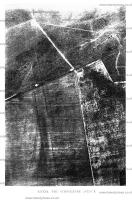
The Stonehenge Avenue [Map].
28th May 1928. Reference Nos. 15. and 17. County. Wilts. 54 SE. (122; D. 6). Parish. Amesbury. Latitude. 51° 10' 53" N. Longitude. 1° 48' 46" W. Height above Sea-level. About 300 ft. (91 metres). Geological Formation. Upper Chalk. Time and Date of Photograph. 10.9 a.m., 28th May. Height of Aeroplane. 2,500 ft. (762 metres). Speed of Shutter. 1/180th of a second.
The history of the rediscovery of the Stonehenge Avenue has already been published in the Observer and in Air Survey and Archaeology, together with a bibliography of the recent literature of Stonehenge. The present account assumes a knowledge of the main facts there related. The photographs here reproduced, however, are new, and bring out very clearly the course of the avenue where it runs nearly due east and west. Its double line is seen crossing Plate XXXIX; a glance reveals the continuity of the upper part, where it is on virgin down, with the lower, where it enters a large cornfield. The upper part can be traced continuously and without a single break right up to Stonehenge itself; in the top left-hand corner of Plate XXXIX it can just be seen as it begins to curve gently away to the left.
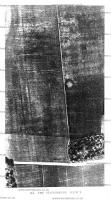
Across Plate XL its course can be followed as far as the fieldroad between the two King Barrow copses. Beyond this, owing to the nature of the crops growing there in 1924, it cannot be traced on this photograph; nor was it visible from the air beyond this point in 1924, though photographs taken in earlier years by the Royal Air Force (reproduced in Air Survey and Archaeology) show its course quite clearly both here and beyond, as far as the Amesbury Road.
In the field to the right will be seen a large white spot surrounded by a darker band. It is a round barrow [Amesbury Barrow 27 G41 [Map]], opened by Sir Richard Colt Hoare. It had, he states, been opened before. It contained the skeletons of two adults and two children. Round the arm of one of the adults was the broad bronze bracelet here illustrated, now in the Devizes Museum. (See Ancient Wiltshire, i. 160, Amesbury, Barrow 27; Stourhead Catalogue, no. 160, p. 42; Archaeologia, xliii. 469, fig. 172; Evans, Anc. Bronze Implements, fig. 480.) Goddard's reference number is 'Amesbury 41' (W.A.M. xxxviii. 168).
Above and to the right of the barrow are many circular rings and blobs, probably representing ploughed-out barrows. The sites might repay excavation, since the cists, dug below the surface level, might still be intact.
O.G.S. Crawford.