

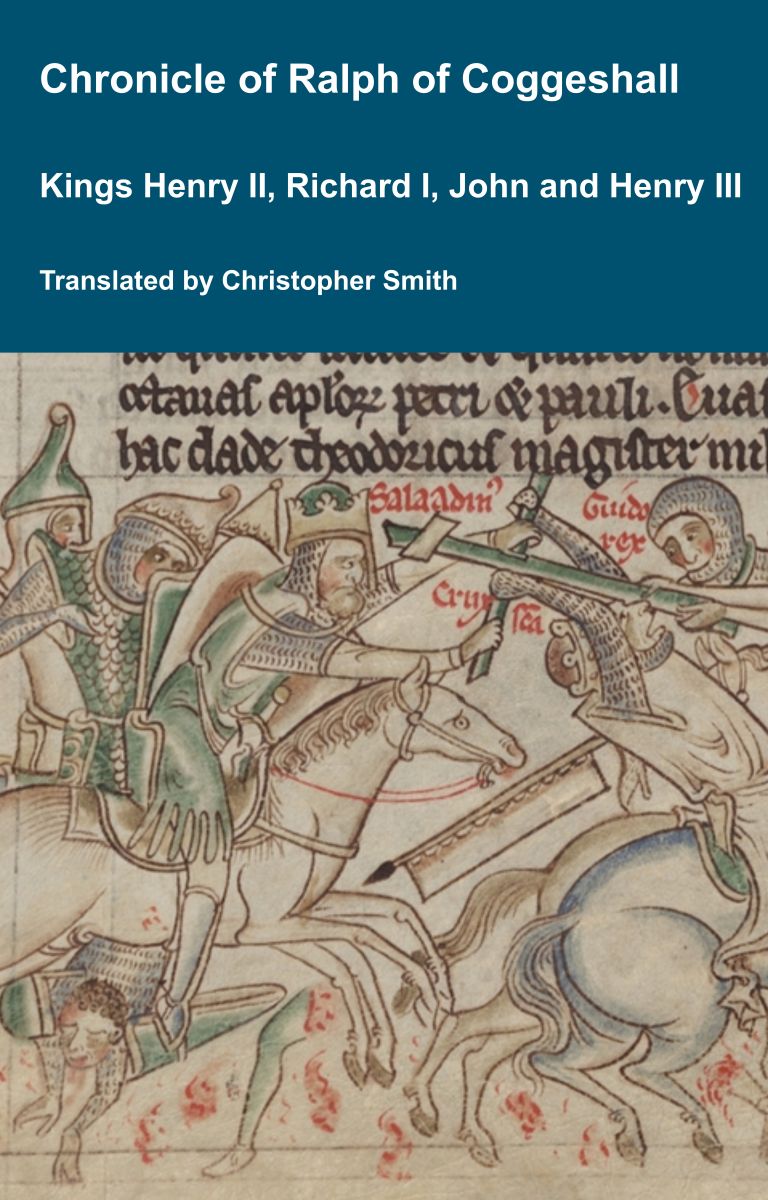
Chronicle of Abbot Ralph of Coggeshall
The Chronicle of Abbot Ralph of Coggeshall (Chronicon Anglicanum) is an indispensable medieval history that brings to life centuries of English and European affairs through the eyes of a learned Cistercian monk. Ralph of Coggeshall, abbot of the Abbey of Coggeshall in Essex in the early 13th century, continued and expanded his community’s chronicle, documenting events from the Norman Conquest of 1066 into the tumultuous reign of King Henry III. Blending eyewitness testimony, careful compilation, and the monastic commitment to record-keeping, this chronicle offers a rare narrative of political intrigue, royal power struggles, and social upheaval in England and beyond. Ralph’s work captures the reigns of pivotal figures such as Richard I and King John, providing invaluable insights into their characters, decisions, and the forces that shaped medieval rule. More than a simple annal, Chronicon Anglicanum conveys the texture of medieval life and governance, making it a rich source for scholars and readers fascinated by English history, monastic authorship, and the shaping of the medieval world.
Available at Amazon in eBook and Paperback format.
Wiltshire Archaeological Magazine 1894 V28 Pages 172-173 is in Wiltshire Archaeological Magazine 1894 V28.
Opening of Barrows, &c., near Haxon. By William Cunnington.
In June, 1851, I opened a long barrow east of Combe, about half-a-mile from Beach's Barn, and nearly south-west from Everleigh Church, which had been ploughed over for some years, and reduced in height to little more than 4ft. There was no central interment, but at the east end we found a very great heap of large flints, beneath which were many skeletons in complete disorder. A perfect lower jaw with sixteen teeth was brought away. With only two men it was impossible to examine the barrow in the day, so it was reluctantly left.
In September, 1894, 1 visited the neighbourhood again, hoping thoroughly to complete the examination. On this occasion Mr. B. H. Cunnington and Col. Dunn were present. We were wrongly directed to a large barrow under cultivation on Haxon Down. In this a considerable section was made without definite results, but on the floor of the barrow there was an abundance of wood ashes, and scattered throughout the earth were numerous flint-flakes, with some good examples of scrapers, also, just under the surface, a large four-sided conical weapon or bludgeon.1 The evidence was in favour of its being a cremated interment. On the following morning we were again disappointed. A barrow under cultivation, three-fourths of a mile east of Combe, was attempted, and this proved to be a round barrow which had been previously opened; near the centre were many portions of a skeleton, and a fragment of thick Ancient British urn.
On the afternoon of the same day we were directed by Mr. Burry to a field about two hundred yards south of Beach's Barn, and adjoining the old Salisbury and Devizes Road, where large flints were frequently ploughed up, and where, extending over several acres, there are indistinct traces of long angular banks, and much general irregularity of the surface, showing that there had been former occupation. In two excavations on this spot we soon had abundant evidence of a Romano-British station. Every shovelfuU of earth contained fragments of pottery, stone roofing-tiles, brick-tiles, flat-headed nails, &c., wilh occasional pieces of Samian ware, though genuine examples were rare. The pottery was mostly of a common kind, with much of the smother-kiln, black variety, also some imitation Samian. Oyster shells were abundant (none of the "real natives") and a few shells of Mytilas edulis, so common on our coasts. These arc of interest. Have they been before found in connection with Romano-British antiquities? There were teeth and bones in abundance of the ordinary domestic auimals, horse, ox, sheep, hog, &c. In one of the holes, at a depth of 2½ft., there was a level space paved with stone tiles, mostly of oolitic rock. This spot would doubtless yield abundant remains of the ancient inhabitants, if carefully and thoroughly examined.
Note 1. These implements are now in our Museum.
 Become a Member via our Buy Me a Coffee page to read more.