

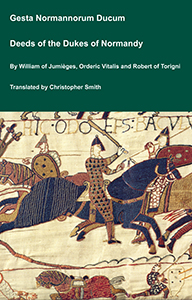
The Deeds of the Dukes of Normandy
The Gesta Normannorum Ducum [The Deeds of the Dukes of Normandy] is a landmark medieval chronicle tracing the rise and fall of the Norman dynasty from its early roots through the pivotal events surrounding the Norman Conquest of England. Originally penned in Latin by the monk William of Jumièges shortly before 1060 and later expanded at the behest of William the Conqueror, the work chronicles the deeds, politics, battles, and leadership of the Norman dukes, especially William’s own claim to the English throne. The narrative combines earlier historical sources with firsthand information and oral testimony to present an authoritative account of Normandy’s transformation from a Viking settlement into one of medieval Europe’s most powerful realms. William’s history emphasizes the legitimacy, military prowess, and governance of the Norman line, framing their expansion, including the conquest of England, as both divinely sanctioned and noble in purpose. Later chroniclers such as Orderic Vitalis and Robert of Torigni continued the history, extending the coverage into the 12th century, providing broader context on ducal rule and its impact. Today this classic work remains a foundational source for understanding Norman identity, medieval statesmanship, and the historical forces that reshaped England and Western Europe between 800AD and 1100AD.
Available at Amazon in eBook and Paperback format.
In 1497 Alderman Martin Bowes was born to [his father] Thomas Bowes.
Before 1526 Alderman Martin Bowes [aged 28] and Cecily Eliot were married.
Before 1538 Alderman Martin Bowes [aged 40] and Anne Barrett were married.
In 1540 Alderman Martin Bowes [aged 43] was appointed Sheriff of London.
In 1545 Alderman Martin Bowes [aged 48] was appointed Lord Mayor of London.
In 1553 [his wife] Anne Barrett died.
Henry Machyn's Diary. 22nd October 1553. The xxij day of October was bered the good [lady] [his former wife] Bowes, the wyff of ser Marten Bowesse [aged 56] late alderman and goldsmyth of London, with harolds, and with a C. men and women in gownes and cotes of .. and xxiiij gownes of mantyll frys, alff men and the [half] women, and ys howse and the strett and the chyrche hangyd with blake clothe, and with ther armes a-pon the blake .... hangyd with blake and armes, and ther wher iiij grett candyll stykes gyldyd, with iiij grett tapurs of ... and ij grett whytt branchys bornyng gyldyd, and the compeny of Clarkes, and prestes; and then cam the corpse with iiij penons of arms borne a-bowt her ... stayffes torchys bornyng a-bowt her with xij of ys servands beyryng of them; and then cam the cheyffe mornars; and then my lord mare and the swordbeyrer, and ser Hare Hubbellthorne and ser Rowland Hyll knyghtes, and mornars many, and ij knyght(s) more, and dyvers gentyllmen, and after the craft of Goldsmyth(s); and when all was done they whent, and the durge, so home to ys placsse; and the marow after a goodly masse song in Laten, and a sermon, and when all was done they whent to dener ther.
Note. P. 46. Funeral of lady Bowes. "The lady Anne Bowes, wyff to syr Martyn Bowes, departed this world the xixth of October in A. 1553, and was beryed the xxijth of the same moneth at St. Mary Wollars churche in Lombart strete." (MS. Harl. 897, f. 13b.) This was therefore the second of sir Martin's three wives, mentioned in the inscriptions on "A goodly marble close tombe under the communion table of St. Mary Wolnoth: Here lyeth buried the body of sir Martin Bowes knight, alderman and lord maior of London, and also free of the Goldsmiths' company: with Cecilia, dame Anne, and dame Elizabeth, his wives. The which sir Martin Bowes deceased the 4. day of August, An. Dom. 1566." His will was also kept in the same church "in a faire table," i. e. there was an inscription recording his having given lands to discharge the ward of Langbourne "of all Fifteenes to bee granted to the king by parliament." Sir Martin Bowes was sub-treasurer of the mint under Henry VIII. and Edward VI. and resigned that office in Jan. 1550–1: see three grants made him on that occasion in Strype, Memorials, vol. ii. pp. (271), 494. The portrait of sir Martin Bowes, still preserved at Goldsmiths' Hall, is described by Malcolm, Londinium Redivivum, ii. 411.
In 1554 Alderman Martin Bowes [aged 57] and Elizabeth Harlow were married.

Around 1561. Unknown Painter. Portrait of Alderman Martin Bowes [aged 64].
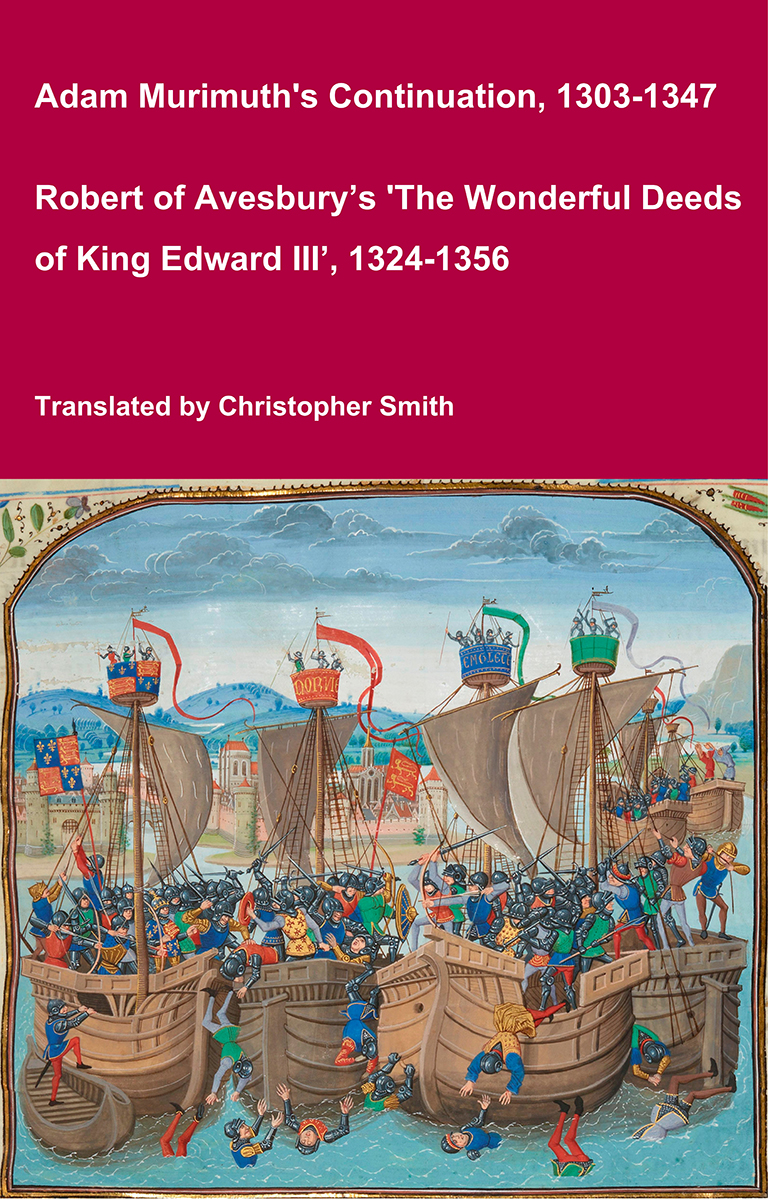
Adam Murimuth's Continuation and Robert of Avesbury’s 'The Wonderful Deeds of King Edward III'
This volume brings together two of the most important contemporary chronicles for the reign of Edward III and the opening phases of the Hundred Years’ War. Written in Latin by English clerical observers, these texts provide a vivid and authoritative window into the political, diplomatic, and military history of fourteenth-century England and its continental ambitions. Adam Murimuth Continuatio's Chronicarum continues an earlier chronicle into the mid-fourteenth century, offering concise but valuable notices on royal policy, foreign relations, and ecclesiastical affairs. Its annalistic structure makes it especially useful for establishing chronology and tracing the development of events year by year. Complementing it, Robert of Avesbury’s De gestis mirabilibus regis Edwardi tertii is a rich documentary chronicle preserving letters, treaties, and official records alongside narrative passages. It is an indispensable source for understanding Edward III’s claim to the French crown, the conduct of war, and the mechanisms of medieval diplomacy. Together, these works offer scholars, students, and enthusiasts a reliable and unembellished account of a transformative period in English and European history. Essential for anyone interested in medieval chronicles, the Hundred Years’ War, or the reign of Edward III.
Available at Amazon in eBook and Paperback format.
Henry Machyn's Diary. 30th June 1561. The xxx day of June [1561] was the Goldsmyth(s') fest, and ther was ser Mertens Bowsses [aged 64], knyght, and dyvers worshephull gentyllmen and gentyllwomen.
Henry Machyn's Diary. 5th November 1561. The v day of November was bered in sant Stephen's in Walbroke ser Rowland Hylle, latt mare and altherman and mercer and knyght, with a standard and v pennons of armes, and a cott armur and a helmet, a crest, sword, and mantyll, and xj dosen of skochyons of armes; and he gayff a c. gownes and cottes to men and women; and ther wher ij haroldes of armes, master Clarenshux [aged 51] and master Somersett, and my lord mayre [aged 65] morner, the cheyff morner; ser Recherd Lee, master Corbett, with dyvers odur morners, ser Wylliam Cordell, ser Thomas Offeley [aged 61], ser Martens Bowes [aged 64] and master Chamburlan althermen, and the ij shreyffes, and master Chambur .. and master Blakewell, with mony mo morners, and a 1. pore men in good blake gownes, besyd women; and the dene of Powlles [aged 44] mad the sermon; and after all done my lord mayre and mony and althermen whent to the Mercers' hall and the craft to dener, and the resedu to ys plase to dener, and grett mon mad [moan made] for ys deth, and he gayff myche to the pore.
Note. P. 271. Death and funeral of the good sir Rowland Hill. This reverend senator has the highest character given him in his epitaph, which was placed "on a faire stone in the south aile of St. Stephen's Walbrook:"
A friend to vertue, a lover of learning,
A foe to vice, and vehement corrector,
A prudent person, all truth supporting;
A citizen sage, and worthy counsellor;
A lover of wisdome, of justice a furtherer,
Loe, here his corps lyeth, sir Rowland Hill by name,
Of London late lord maier, and alderman of fame.
He was the son of Thomas Hill, of Hodnet in Shropshire; was sheriff 1541–2; lord mayor 1549–50. He founded a grammar school at Drayton in Shropshire, and performed other admirable acts of beneficence recorded by Stowe in his Survay, in his chapter "Honour of Citizens." "He dwelled in Walbrook, over against the said church of St. Stephen; and was buried at St. Stephen's in Walbrook 1561." Arms, Azure, two bars argent, on a canton sable a chevron between three pheons of the second, an eagle's head erased of the third, between two mullets gules. (List by Wm. Smith, Rouge-dragon.)
Henry Machyn's Diary. 15th June 1562. The sam day was the Goldsmyth(s') fest, and at sant Foster's ther prechyd master Gowth the parsune of sant Peter's in Cornhyll, and dynyd my lord mare [aged 66] and the ij shreyffes, ser Marten Bowse [aged 65], and master Gylbart, with dyvers odur althermen.
Henry Machyn's Diary. 1st July 1562. The furst day of July was the Marchand-tayllers' fest, and dynyd my lord mare [aged 66], the yerle of Sussex [aged 37], the yerle of Kyldare [aged 37], ser (blank) Stanley, and ser Thomas Whytt, ser Thomas Offeley [aged 62] and master Ro .., ser Wyllyam Huett, ser Marten Bowes [aged 65], master Cowper, master Allen, master Gyl[bert,] master Chamburlayn altherman, master Champyon, master Avenon, master Malere, and master Baskerfeld, and the master and the iiij wardens and the clarkes and the bedyll of the Skynnars, and mony worshephull men, and mony lades and gentyllwomen, and they had agaynst the dynner iijxx and (blank) bukes [bucks] and iiij stages; and master Wylliam Allen [aged 47] electyd shreyff for the quen, and master Whettelle the master, and master Raff Whytt hed warden and master Mar .. and master serjant Halle and master Browne wardens; and master Garter [aged 52] and master Clarenshux [aged 52] dynyd there.
Note. P. 287. The Skinners attend the Merchant-taylors' feast. In the 1st Rich. III. a dispute for precedency between the Skinners and Merchant-taylors was determined by agreement that either should take precedence in alternate years, and that the master and wardens of each should dine with the other company on their respective feasts of Corpus Christi and the Nativity of St. John the Baptist. See the ordinance effecting this arrangement in Herbert's Twelve City Companies, vol. ii. p. 319; and see remarks by the present writer in Archæologia, vol. xxx. p. 500.
Henry Machyn's Diary. 6th August 1562. The vj day of August was reynyd at Yeld-hall [Map] vij, vj for qwynnyng [coining]; iiij was cast for deth, Thomas Wylford, Thomas Borow, ... Maltby, Phelipe Furney gold-smyth, and ij fr[eely] qwytt; and ther satt a-pone them my lord [justice] Chamley, ser Recherd Sakefeld, the master of the rolles, sir Martin Bowes [aged 65], ser Wylliam Garett, ser William Huett, master re[corder], master Surcott, and master Chydley and master Eldertun.
In 1566 Alderman Martin Bowes [aged 69] died.