

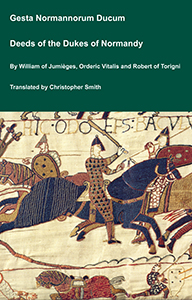
The Deeds of the Dukes of Normandy
The Gesta Normannorum Ducum [The Deeds of the Dukes of Normandy] is a landmark medieval chronicle tracing the rise and fall of the Norman dynasty from its early roots through the pivotal events surrounding the Norman Conquest of England. Originally penned in Latin by the monk William of Jumièges shortly before 1060 and later expanded at the behest of William the Conqueror, the work chronicles the deeds, politics, battles, and leadership of the Norman dukes, especially William’s own claim to the English throne. The narrative combines earlier historical sources with firsthand information and oral testimony to present an authoritative account of Normandy’s transformation from a Viking settlement into one of medieval Europe’s most powerful realms. William’s history emphasizes the legitimacy, military prowess, and governance of the Norman line, framing their expansion, including the conquest of England, as both divinely sanctioned and noble in purpose. Later chroniclers such as Orderic Vitalis and Robert of Torigni continued the history, extending the coverage into the 12th century, providing broader context on ducal rule and its impact. Today this classic work remains a foundational source for understanding Norman identity, medieval statesmanship, and the historical forces that reshaped England and Western Europe between 800AD and 1100AD.
Available at Amazon in eBook and Paperback format.
Paternal Family Tree: Burnaby
On 29th January 1864 [his father] Edwyn Sherard Burnaby (age 33) and [his mother] Louisa Julia Mary Dixie (age 21) were married at St George's Church, Hanover Square.
On 9th April 1868 Algernon Edwyn Burnaby was born to [his father] Edwyn Sherard Burnaby (age 37) and [his mother] Louisa Julia Mary Dixie (age 25).
In 1881 [his mother] Louisa Julia Mary Dixie (age 38) died.
On 31st May 1883 [his father] Edwyn Sherard Burnaby (age 53) died at Brighton. Algernon Edwyn Burnaby (age 15) inherited Baggrave Hall.
On 13th April 1896 Algernon Edwyn Burnaby (age 28) and Sybil Cholmondeley (age 24) were married.
In 1902 Algernon Edwyn Burnaby (age 33) and Sybil Cholmondeley (age 30) were divorced.
On 18th July 1908 Algernon Edwyn Burnaby (age 40) and Minna Field were married at York Harbour.
On 26th May 1911 [his former wife] Sybil Cholmondeley (age 39) died two weeks after falling out of a window at her home at 5 Wilton Place, Belgravia and suffering severe injuries. At an inquest, the coroner found that the fall was purely accidental.
The Advertiser (Adelaide, SA: 1889 - 1931). 12th July 1911
AN, AWFUL FALL.
A terrible fate befell the only sister of [his former brother-in-law] Lord Delamere (age 41), as disclosed at the inquest at Westminster, London. Mrs. Sybil Burnaby, according to the tragic story, had been kneeling at an open, window on a settle which ran upon castors and wishing to know the time, stood on the settle and reached forward to see the clock of St. Paul's Church. The leafage of the trees obstructed her view, and is she leaned further the settle ran from under her, and she fell. A nurse, who had been standing, a yard or two away, managed to seize her dress as she fell through the window, and Mrs. Burnaby turned and grasped the wooden window frame. The nurse, retaining a frenzied hold of the dress with both bands, screamed for aid. Mrs. Barnaby's maid rushed in; she also reached through the window and caught at the dress, her mistress imploring them, "Don't let me go!'' For a moment or two they held her so, when suddenly time silk material of the dress ripped and tore in their hands. Mrs. Burnaby's fingers were wrenched from the window-sill, and she fell from the bedroom window to the area beneath. Suffering from terrible fractures, she was still conscious when admitted to the hospital. Captain Edward Seymour stated that Mrs. Burnaby, who was his cousin, was 39 years of age. He was the executor of her will. She had been married to Colonel Algernon Edwyn Burnaby (age 43), formerly of the Royal Horse Guards, but she obtained a divorce from him in 1892 [Note. A mistake for 1902]. Since then she had lived chiefly in Wilton-place. She had no trouble in her affairs, and, to the best of his belief, she had got over the trouble of the divorce from her husband. She was a person of calm and quiet disposition. The nurse, Katherine Cleghorn, said the accident happened about 7 in the; morning, when Mrs. Burnaby came into the witness bedroom as usual. She was partly dressed I and looking quite bright and cheerful. The surgeon at St. George's Hospital said Mrs. Burnaby's injuries were a compound compressed comminuted fracture of the frontal bone and fracture of both thighs. She was not unconscious, but he did not ask her any questions. The Coroner said there was no doubt that Mrs. Barnaby's death was purely accidental. A verdict accordingly was returned.
On 13th November 1938 Algernon Edwyn Burnaby (age 70) died. [his son] Hugh Edwyn Burnaby inherited Baggrave Hall. He sold it in 1939.
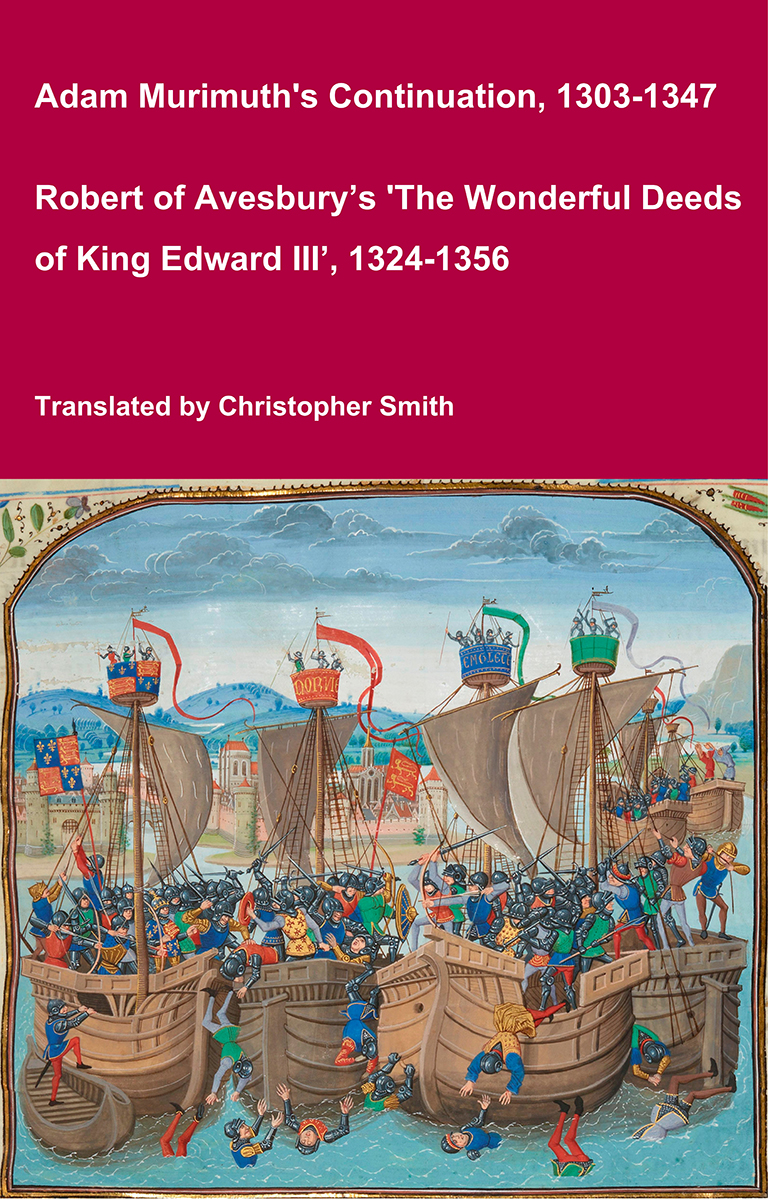
Adam Murimuth's Continuation and Robert of Avesbury’s 'The Wonderful Deeds of King Edward III'
This volume brings together two of the most important contemporary chronicles for the reign of Edward III and the opening phases of the Hundred Years’ War. Written in Latin by English clerical observers, these texts provide a vivid and authoritative window into the political, diplomatic, and military history of fourteenth-century England and its continental ambitions. Adam Murimuth Continuatio's Chronicarum continues an earlier chronicle into the mid-fourteenth century, offering concise but valuable notices on royal policy, foreign relations, and ecclesiastical affairs. Its annalistic structure makes it especially useful for establishing chronology and tracing the development of events year by year. Complementing it, Robert of Avesbury’s De gestis mirabilibus regis Edwardi tertii is a rich documentary chronicle preserving letters, treaties, and official records alongside narrative passages. It is an indispensable source for understanding Edward III’s claim to the French crown, the conduct of war, and the mechanisms of medieval diplomacy. Together, these works offer scholars, students, and enthusiasts a reliable and unembellished account of a transformative period in English and European history. Essential for anyone interested in medieval chronicles, the Hundred Years’ War, or the reign of Edward III.
Available at Amazon in eBook and Paperback format.
In May 1952 [his former wife] Minna Field died at Coconut Grove.
[his son] Hugh Edwyn Burnaby was born to Algernon Edwyn Burnaby and Sybil Cholmondeley.
Great x 3 Grandfather: Reverend Andrew Burnaby
Great x 2 Grandfather: Archdeacon Andrew Burnaby
Great x 1 Grandfather: Edwyn Andrew Burnaby
Great x 3 Grandfather: John Edwyn
Great x 2 Grandmother: Anna Edwyn
GrandFather: Edwyn Burnaby
Great x 2 Grandfather: Reverend William Browne 
Great x 1 Grandmother: Mary Browne
Great x 2 Grandmother: Mary Adcock
Father: Edwyn Sherard Burnaby
Great x 2 Grandfather: Thomas Salisbury
Great x 1 Grandfather: Thomas Salisbury of Marshfield House
Great x 2 Grandmother: Mary Lister 
GrandMother: Anne Caroline Salisbury
Great x 3 Grandfather: John Webb of Church Stanway in Gloucestershire
Great x 2 Grandfather: Francis Webb
Great x 1 Grandmother: Frances Webb
Great x 2 Grandmother: Mary Garritt
GrandFather: Willoughby Wolstan Dixie 8th Baronet
Mother: Louisa Julia Mary Dixie
Great x 1 Grandfather: Evan Lloyd of Ferney Hall
GrandMother: Louisa Anna Lloyd