

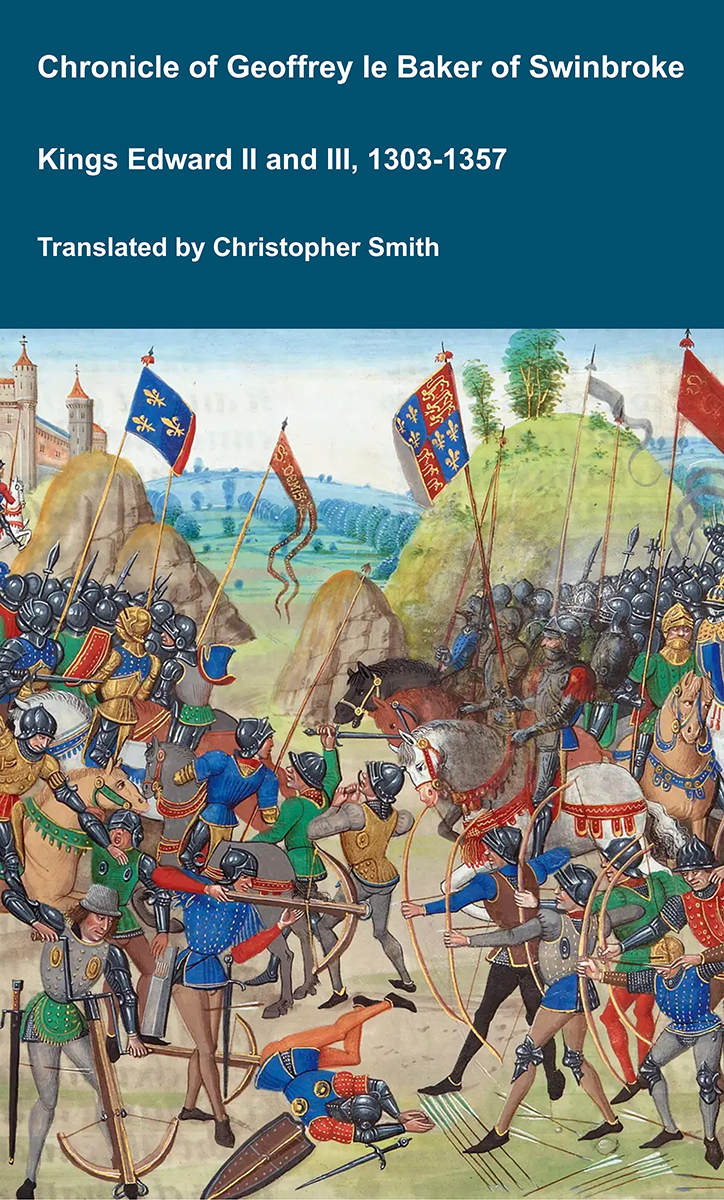
Chronicle of Geoffrey le Baker of Swinbroke
Baker was a secular clerk from Swinbroke, now Swinbrook, an Oxfordshire village two miles east of Burford. His Chronicle describes the events of the period 1303-1356: Gaveston, Bannockburn, Boroughbridge, the murder of King Edward II, the Scottish Wars, Sluys, Crécy, the Black Death, Winchelsea and Poitiers. To quote Herbert Bruce 'it possesses a vigorous and characteristic style, and its value for particular events between 1303 and 1356 has been recognised by its editor and by subsequent writers'. The book provides remarkable detail about the events it describes. Baker's text has been augmented with hundreds of notes, including extracts from other contemporary chronicles, such as the Annales Londonienses, Annales Paulini, Murimuth, Lanercost, Avesbury, Guisborough and Froissart to enrich the reader's understanding. The translation takes as its source the 'Chronicon Galfridi le Baker de Swynebroke' published in 1889, edited by Edward Maunde Thompson.
Available at Amazon in eBook and Paperback format.
Maternal Family Tree: Jane Coe
On 28th April 1583 [her father] Benedict Barnham [aged 24] and [her mother] Dorothy Smith were married at St Clements Church. They had seven girls and one boy. Three girls and a boy died in infancy.
In 1592 Alice Barnham Viscountess St Alban was born to [her father] Benedict Barnham [aged 33] and [her mother] Dorothy Smith.
In 1598 [her father] Benedict Barnham [aged 39] died. He left an estate of £20,000 of whom the chief beneficiaries were his wife [her mother] Dorothy Smith and her daughters [her sister] Elizabeth Barnham Countess Castlehaven [aged 6], Alice Barnham Viscountess St Alban [aged 6].
In November 1598 [her step-father] John "Lusty" Pakington [aged 49] and [her mother] Dorothy Smith were married. They had two daughters and a son.
On 10th May 1606 Francis Bacon 1st Viscount St Alban [aged 45] and Alice Barnham Viscountess St Alban [aged 14] were married. The difference in their ages was 30 years.


Before 1612 [her brother-in-law] Mervyn Tuchet 2nd Earl Castlehaven [aged 18] and [her sister] Elizabeth Barnham Countess Castlehaven [aged 19] were married. He the son of George Tuchet 1st Earl Castlehaven [aged 60] and Lucy Mervyn Baroness Audley and Tuchet.
On 29th June 1612 Robert Crichton 8th Lord Sanquhar was hanged in Westminster Palace Yard for having arranged the murder of his fencing Master John Painter Turner who had previously disfigured him during practice. At his trial [her husband] Francis Bacon 1st Viscount St Alban [aged 51] read the charges.
In 1617 George Tuchet 1st Earl Castlehaven [aged 66] died. His son [her brother-in-law] Mervyn [aged 24] succeeded 2nd Earl Castlehaven, 12th Baron Audley of Heighley in Staffordshire, 9th Baron Tuchet, 2nd Baron Audley of Orier in England. [her sister] Elizabeth Barnham Countess Castlehaven [aged 25] by marriage Countess Castlehaven.
In 1618 [her husband] Francis Bacon 1st Viscount St Alban [aged 56] was created 1st Baron Verulam. Alice Barnham Viscountess St Alban [aged 26] by marriage Baroness Verulam.
Letters of John Chamberlain Volume 2.310. [19th December 1618] Yt is growne altogether in fashion to burie now by night, as on Sonday last the Lady Haddington1 had a solemne convoy of almost an hundred coaches (and torches in aboundance), that accompanied her from Westminster to White-chappell on her way to New-hall in Essex where she is to be buried: in this troupe besides the countesses of Bedford [aged 38], Excester [aged 38], and Devonshire [aged 50] was the Lady Verulam [aged 26] with a world of other Ladies. The countesse of Salisburie [aged 28] the Friday before made a great feast and a play, though her husband [aged 27] were absent at court, and the rest of her house and frends in sorow about a lewde libell, that (excepting the highest) runs over all the court and countrie almost that followes not theyre faction, and though the author cannot be found out, yet notice is taken that the Lady of Wallingford [aged 35] was one of the first that sunge yt, and the King thinckes of her yt may be required. I heare of another crosse libell that shold pay her and all hers in the same coine, but for my part I protest I have neither seene nor seeke after any of them, but only heare the generall buzze abrode.
Note 1. Cf. Letters 309.


On 9th February 1619 [her brother-in-law] Humphrey Ferrers and [her half-sister] Anne Pakington [aged 20] were married at Kensington.
In 1622 [her sister] Elizabeth Barnham Countess Castlehaven [aged 30] died.
On 27th January 1626 [her husband] Francis Bacon 1st Viscount St Alban [aged 65] was created 1st Viscount St Alban. Alice Barnham Viscountess St Alban [aged 34] by marriage Viscountess St Alban.
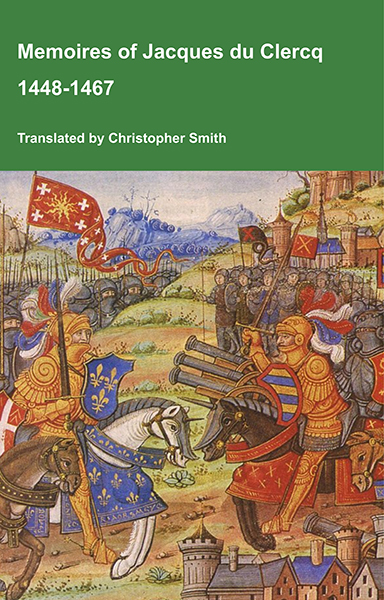
This is a translation of the 'Memoires of Jacques du Clercq', published in 1823 in two volumes, edited by Frederic, Baron de Reissenberg. In his introduction Reissenberg writes: 'Jacques du Clercq tells us that he was born in 1424, and that he was a licentiate in law and a counsellor to Philip the Good, Duke of Burgundy, in the castellany of Douai, Lille, and Orchies. It appears that he established his residence at Arras. In 1446, he married the daughter of Baldwin de la Lacherie, a gentleman who lived in Lille. We read in the fifth book of his Memoirs that his father, also named Jacques du Clercq, had married a lady of the Le Camelin family, from Compiègne. His ancestors, always attached to the counts of Flanders, had constantly served them, whether in their councils or in their armies.' The Memoires cover a period of nineteen years beginning in in 1448, ending in in 1467. It appears that the author had intended to extend the Memoirs beyond that date; no doubt illness or death prevented him from carrying out this plan. As Reissenberg writes the 'merit of this work lies in the simplicity of its narrative, in its tone of good faith, and in a certain air of frankness which naturally wins the reader’s confidence.' Du Clercq ranges from events of national and international importance, including events of the Wars of the Roses in England, to simple, everyday local events such as marriages, robberies, murders, trials and deaths, including that of his own father in Book 5; one of his last entries.
Available at Amazon in eBook and Paperback format.
On 9th April 1626 [her husband] Francis Bacon 1st Viscount St Alban [aged 65] died of pneumonia. He was buried at St Paul's Walden Bury, Hertfordshire. Viscount St Alban and Baron Verulam extinct.
After 1636 [her brother-in-law] Philip Stanhope 1st Earl Chesterfield [aged 52] and [her half-sister] Anne Pakington Countess Chesterfield [aged 37] were married. She by marriage Countess Chesterfield.
Around 1639 [her mother] Dorothy Smith died.
On 29th June 1650 Alice Barnham Viscountess St Alban [aged 58] died.
GrandFather: Francis Barnham
Father: Benedict Barnham
Great x 1 Grandfather: William Bradbridge
GrandMother: Alice Bradbridge
Alice Barnham Viscountess St Alban
Great x 1 Grandfather: John Smith of Withcote in Leicestershire
GrandFather: Ambrose Smith of Withcote in Leicestershire
Great x 2 Grandfather: Richard Cave of Stanford in Northamptonshire
Great x 1 Grandmother: Dorothy Cave
Great x 2 Grandmother: Elizabeth Mervin
Mother: Dorothy Smith
Great x 1 Grandfather: John Coe of Coggleshall in Essex
GrandMother: Jane Coe