

William of Worcester's Chronicle of England
William of Worcester, born around 1415, and died around 1482 was secretary to John Fastolf, the renowned soldier of the Hundred Years War, during which time he collected documents, letters, and wrote a record of events. Following their return to England in 1440 William was witness to major events. Twice in his chronicle he uses the first person: 1. when writing about the murder of Thomas, 7th Baron Scales, in 1460, he writes '… and I saw him lying naked in the cemetery near the porch of the church of St. Mary Overie in Southwark …' and 2. describing King Edward IV's entry into London in 1461 he writes '… proclaimed that all the people themselves were to recognize and acknowledge Edward as king. I was present and heard this, and immediately went down with them into the city'. William’s Chronicle is rich in detail. It is the source of much information about the Wars of the Roses, including the term 'Diabolical Marriage' to describe the marriage of Queen Elizabeth Woodville’s brother John’s marriage to Katherine, Dowager Duchess of Norfolk, he aged twenty, she sixty-five or more, and the story about a paper crown being placed in mockery on the severed head of Richard, 3rd Duke of York.
Available at Amazon in eBook and Paperback format.
Before 5th September 1492 [his father] John Judde and [his mother] Margaret Chichele were married.
On 5th September 1492 Andrew Judde was born to [his father] John Judde and [his mother] Margaret Chichele at Tonbridge, Kent [Map].
In 1493 [his father] John Judde died.
Before 1523 Andrew Judde (age 30) and Mary Murfyn were married.
In 1523 [his wife] Mary Murfyn died.
Around 1537 Thomas Langton (age 22) and [his future wife] Mary Mathews were married.
In 1542 Andrew Judde (age 49) and Agnes m Judde were married.
In 1544 Andrew Judde (age 51) was elected Sheriff of London.
In 1550 Andrew Judde (age 57) was elected Lord Mayor of London.
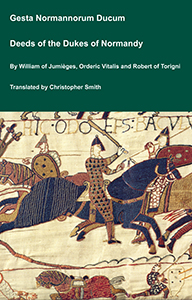
The Deeds of the Dukes of Normandy
The Gesta Normannorum Ducum [The Deeds of the Dukes of Normandy] is a landmark medieval chronicle tracing the rise and fall of the Norman dynasty from its early roots through the pivotal events surrounding the Norman Conquest of England. Originally penned in Latin by the monk William of Jumièges shortly before 1060 and later expanded at the behest of William the Conqueror, the work chronicles the deeds, politics, battles, and leadership of the Norman dukes, especially William’s own claim to the English throne. The narrative combines earlier historical sources with firsthand information and oral testimony to present an authoritative account of Normandy’s transformation from a Viking settlement into one of medieval Europe’s most powerful realms. William’s history emphasizes the legitimacy, military prowess, and governance of the Norman line, framing their expansion, including the conquest of England, as both divinely sanctioned and noble in purpose. Later chroniclers such as Orderic Vitalis and Robert of Torigni continued the history, extending the coverage into the 12th century, providing broader context on ducal rule and its impact. Today this classic work remains a foundational source for understanding Norman identity, medieval statesmanship, and the historical forces that reshaped England and Western Europe between 800AD and 1100AD.
Available at Amazon in eBook and Paperback format.
Before 19th November 1550 [his wife] Agnes m Judde died. She was buried at St Helen's Church, Bishopsgate.
Henry Machyn's Diary. 19th November 1550. The xix day of November was buried my [his wife] lade Jude, ma[yress] of London, and wyff of sir Androw Jude (age 58), mayr of London, and bered in the parryche of saynt Ellen in Bysshope-gatt stret, for he gayff mony, gownes, and to the powre men and women ij C. gownes of mantyll ... and the Clarkes of London had the beryng of my lade, and then came ... with ij harolds a-for with iiij baners a-bowt her borne, and after my [lord] mayre and ys bredurne, and alle the stret and the chyrche wher hangyd with blake and with schochyons of ther armes, and a gret dolle and a grett [dinner.]
On 15th February 1551 Andrew Judde (age 58) was knighted.
Diary of Edward VI. 8th March 1551. Sir Jhon Yorke hade great losse, about 2,000 pounde weight of silver, by treason of English men, wich he brought for provision of the mintes. Also Judd (age 58)1 1,500; also Tresham (Gresham2) 500: so the hole came to 4,000 pound.
Note 1. Sir Andrew Judde, an alderman of London, the founder of Tunbridge school.
Note 2. Sir John Gresham (age 56), another alderman, uncle of the celebrated sir Thomas (age 32).
Before 1552 Thomas Langton and [his future wife] Mary Mathews were married.
In 1552 Andrew Judde (age 59) and Mary Mathews were married.
Henry Machyn's Diary. 14th September 1558. [The xiv day of September was buried sir Andrew Jud (age 66), skinner, merchant of Muscovy, and late mayor of London; with a] .... pennon of armes, and a x dosen penselles ... skochyons, and a herse of wax of v prynse [pals, garnished with] angelles, and a (blank) pormen [poor men] in nuw gownes, and master Clarenshus kyng of armes, and master Somersett harold, [and the morrow] masse and a sermon, and after my lord mare and the althermen had (unfinished)
Note. P. 173. Funeral of sir Andrew Judd. A name still well known as the founder of Tunbridge school. He also founded the Skinners' almshouses near Saint Helen's, Bishopsgate: see Herbert's City Companies, ii. 350. He had been sheriff in 1544, and lord mayor in 1551. His monument still remains in St. Helen's, Bishopsgate, and has kneeling effigies of himself, the first of his three wives, four sons, and one daughter: it is engraved in Wilkinson's Londina Illustrata, 1825, where also is a full memoir of him. Maitland, p. 1107, has printed the poetical epitaph without his name: it bears out our diarist's designation of him as a "merchant of Muscovy,"—
To Russia and Muscovea,
To Spayne, Gynny, withoute fable
Travaild he by land and sea
Both mayor of London and staple, &c.
"His only daughter Alice was maried to Tho. Smith customer, mother to sir John, sir Thomas, and sir Richard, now living." (1605). Arms, quarterly, 1 and 4, Gules, a fess regulée between three boar's heads couped argent; 2 and 3, Azure, three lyons rampant argent. (List by Wm. Smith, Rouge-dragon.)
After 4th October 1558 Alderman James Altham (age 29) and [his wife] Mary Mathews were married.
Before 14th September 1588 Andrew Judde (age 96) died.
In 1602 [his former wife] Mary Mathews died.
Father: John Judde
Great x 1 Grandfather: Robert Chichele
GrandFather: Valentine Chichele
Mother: Margaret Chichele