

William of Worcester's Chronicle of England
William of Worcester, born around 1415, and died around 1482 was secretary to John Fastolf, the renowned soldier of the Hundred Years War, during which time he collected documents, letters, and wrote a record of events. Following their return to England in 1440 William was witness to major events. Twice in his chronicle he uses the first person: 1. when writing about the murder of Thomas, 7th Baron Scales, in 1460, he writes '… and I saw him lying naked in the cemetery near the porch of the church of St. Mary Overie in Southwark …' and 2. describing King Edward IV's entry into London in 1461 he writes '… proclaimed that all the people themselves were to recognize and acknowledge Edward as king. I was present and heard this, and immediately went down with them into the city'. William’s Chronicle is rich in detail. It is the source of much information about the Wars of the Roses, including the term 'Diabolical Marriage' to describe the marriage of Queen Elizabeth Woodville’s brother John’s marriage to Katherine, Dowager Duchess of Norfolk, he aged twenty, she sixty-five or more, and the story about a paper crown being placed in mockery on the severed head of Richard, 3rd Duke of York.
Available at Amazon in eBook and Paperback format.
Anna Alma-Tadema is in Painters.

1863. [her father] Lawrence Alma-Tadema (age 26). A portrait of the artist's daughters Laurense and Anna Alma-Tadema.
Life of Lawrence Alma-Tadema by Helen Zimmern. Four years after joining her son [[her father] Lawrence Alma-Tadema (age 28)], Madame Tadema died. It is sad to think that this good parent did not live to witness her son's world-wide fame, but pleasant to know that she still heard the praise aroused by some of his first exhibited pictures, and to see him the recipient of his first gold medal, that accorded to him at Amsterdam in 1862. In 1865 Tadema married a French lady, and removed to Brussels, where he remained until his wife's death. This occurred in 1869, when he was left alone with his sister and two little girls, the eldest, Laurence, who has developed into a gifted writer, and the second, Anna, the delicate, dainty artist who has inherited so much of her father's power for reproducing detail.
It was during the lifetime of his first wife that Alma Tadema paid his first visit to Italy and saw with his own eyes the homes of those Romans who were destined to become his most familiar friends.
Lawrence Alma-Tadema and [her mother] Marie-Pauline Gressin-Dumoulin were married at the City Hall in Antwerp.
On 16th May 1867 Anna Alma-Tadema was born to [her father] Lawrence Alma-Tadema (age 31) and [her mother] Marie-Pauline Gressin-Dumoulin.
Life of Lawrence Alma-Tadema by Helen Zimmern. An accident brought Tadema to London in 1870, and here he at once took root. A year later he remarried1, his wife this time being Miss [her step-mother] Laura Theresa Epps (age 19), a woman of rare beauty, and herself a painter of distinction.
Note 1. In July 1871 [her father] Lawrence Alma-Tadema (age 35) and Laura Theresa Epps were married.




1877. Robert Faulkner (age 54). Photograph of Anna Alma-Tadema (age 9).
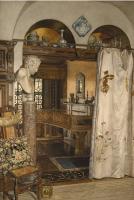
1884 Anna Alma-Tadema (age 16). "The Gold Room".

1885. [her father] Lawrence Alma-Tadema (age 48). Portrait of the artist's daughter Anna Alma-Tadema (age 17).
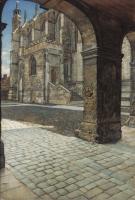
1885 Anna Alma-Tadema (age 17). "Eton College Chapel [Map]".
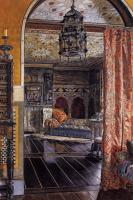
1885 Anna Alma-Tadema (age 17). "The Drawing Room, Townshend House".
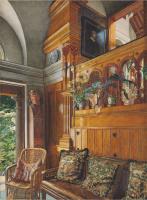
1886-7. Anna Alma-Tadema (age 18). "The Garden Studio".
Chronicle of Walter of Guisborough
A canon regular of the Augustinian Guisborough Priory, Yorkshire, formerly known as The Chronicle of Walter of Hemingburgh, describes the period from 1066 to 1346. Before 1274 the Chronicle is based on other works. Thereafter, the Chronicle is original, and a remarkable source for the events of the time. This book provides a translation of the Chronicle from that date. The Latin source for our translation is the 1849 work edited by Hans Claude Hamilton. Hamilton, in his preface, says: 'In the present work we behold perhaps one of the finest samples of our early chronicles, both as regards the value of the events recorded, and the correctness with which they are detailed; Nor will the pleasing style of composition be lightly passed over by those capable of seeing reflected from it the tokens of a vigorous and cultivated mind, and a favourable specimen of the learning and taste of the age in which it was framed.'
Available at Amazon in eBook and Paperback format.
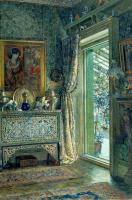
1887. Anna Alma-Tadema (age 19). "Drawing Room, 1a Holland Park".
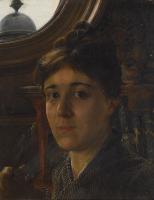
Around 1892 Anna Alma-Tadema (age 24). Self-portrait.
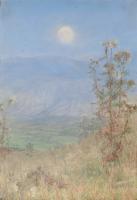
1900 Anna Alma-Tadema (age 32). "The idler's harvest".
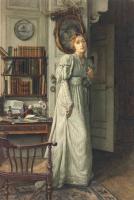
1900 Anna Alma-Tadema (age 32). "The Closing Door".
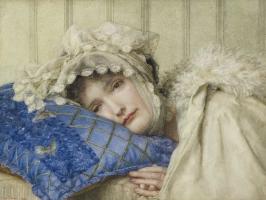
1902 Anna Alma-Tadema (age 34). "Girl in a Bonnet with her Head on a Blue Pillow".
On 25th June 1912 [her father] Lawrence Alma-Tadema (age 76) died at Kaiserhof Spa, Wiesbaden, Germany where he had travelled with his daughter Anne (age 45) for treatment of his stomach ulcers. He was buried in the crypt of St Paul's Cathedral [Map].
On 5th July 1943 Anna Alma-Tadema (age 76) died unmarried.
Father: Lawrence Alma-Tadema
GrandFather: Eugène Gressin-Dumoulin
Mother: Marie-Pauline Gressin-Dumoulin