


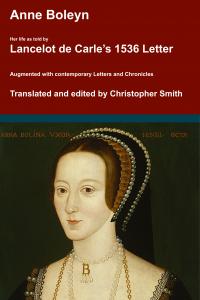
Anne Boleyn. Her Life as told by Lancelot de Carle's 1536 Letter.
In 1536, two weeks after the execution of Anne Boleyn, her brother George and four others, Lancelot du Carle, wrote an extraordinary letter that described Anne's life, and her trial and execution, to which he was a witness. This book presents a new translation of that letter, with additional material from other contemporary sources such as Letters, Hall's and Wriothesley's Chronicles, the pamphlets of Wynkyn the Worde, the Memorial of George Constantyne, the Portuguese Letter and the Baga de Secrets, all of which are provided in Appendices.
Available at Amazon in eBook and Paperback format.
In 1516 John Philpot was born at Compton, Hampshire. He was educated at Winchester College, Winchester and New College, Oxford University.
After February 1552 John Philpot (age 36) was appointed Archdeacon of Winchester following the death of the previous incumbent William Boleyn (deceased).
After 30th October 1553 Archdeacon John Philpot (age 37) was imprisoned at the King's Bench Prison [Map]. He had attended the Convocation at St Paul's Cathedral following the accession of Queen Mary following which he published his account of the Disputationis including his defence of the Protestant Catechism. He remained in prison for the remaining two years of his life.
Foxe's Book of Martyrs. Upon entering Smithfield, the ground was so muddy that two officers offered to carry him to the stake, but he replied: "Would you make me a pope? I am content to finish my journey on foot." Arriving at the stake, he said, "Shall I disdain to suffer at the stake, when my Redeemer did not refuse to suffer the most vile death upon the cross for me?" He then meekly recited the One hundred and" seventh and One hundred and eighth Psalms, and when he had finished his prayers, was bound to the post, and fire applied to the pile. On December 18, 1555, perished this illustrious martyr John Philpot (age 39), reverenced by man, and glorified in heaven!
On 18th December 1557 Archdeacon John Philpot (age 41) was burned at the stake for being a heretic i.e. being a Protestant.
Foxe's Book of Martyrs. Mr. John Philpot
This martyr was the son of a knight, born in Hampshire, and brought up at New College, Oxford, where for several years he studied the civil law, and became eminent in the Hebrew tongue. He was a scholar and a gentleman, zealous in religion, fearless in disposition, and a detester of flattery. After visiting Italy, he returned to England, affairs in King Edward's days wearing a more promising aspect. During this reign he continued to be archdeacon of Winchester under Dr. Poinet, who succeeded Gardiner. Upon the accession of Mary, a convocation was summoned, in which Mr. Philpot defended the Reformation against his ordinary, Gardiner, again made bishop of Winchester, and soon was conducted to Bonner and other commissioners for examination, October 2, 1555, after being eighteen months' imprisoned. Upon his demanding to see the commission, Dr. Story cruelly observed, "I will spend both my gown and my coat, but I will burn thee! Let him be in Lollard's tower, (a wretched prison,) for I will sweep the king's Bench and all other prisons of these heretics!'