

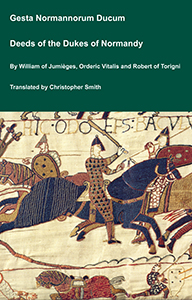
The Deeds of the Dukes of Normandy
The Gesta Normannorum Ducum [The Deeds of the Dukes of Normandy] is a landmark medieval chronicle tracing the rise and fall of the Norman dynasty from its early roots through the pivotal events surrounding the Norman Conquest of England. Originally penned in Latin by the monk William of Jumièges shortly before 1060 and later expanded at the behest of William the Conqueror, the work chronicles the deeds, politics, battles, and leadership of the Norman dukes, especially William’s own claim to the English throne. The narrative combines earlier historical sources with firsthand information and oral testimony to present an authoritative account of Normandy’s transformation from a Viking settlement into one of medieval Europe’s most powerful realms. William’s history emphasizes the legitimacy, military prowess, and governance of the Norman line, framing their expansion, including the conquest of England, as both divinely sanctioned and noble in purpose. Later chroniclers such as Orderic Vitalis and Robert of Torigni continued the history, extending the coverage into the 12th century, providing broader context on ducal rule and its impact. Today this classic work remains a foundational source for understanding Norman identity, medieval statesmanship, and the historical forces that reshaped England and Western Europe between 800AD and 1100AD.
Available at Amazon in eBook and Paperback format.
On 16th March 1828 Bishop George Ridding was born at Winchester College, Winchester where his father was vicar.
In 1884 1884 Bishop George Ridding (age 55) was appointed first Bishop Southwell.
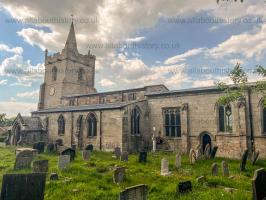
Saint Michael and All Angels Church, Church Broughton [Map] was restored by J. R. Naylor of Derby. It was re-opened by the Bishop of Southwell (age 58) on 22 June 1886.
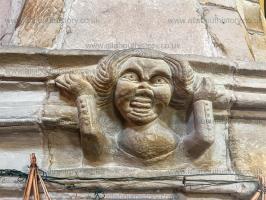
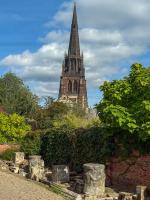
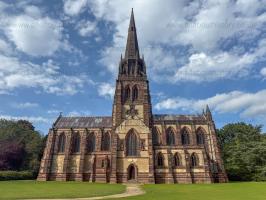
Clumber Chapel [Map] was commissioned by Henry Pelham-Clinton 7th Duke Newcastle-under-Lyne (age 25) and designed by George Frederick Bodley (age 62). Built in Runcorn Sandstone and white Steetley Stone, the building is 42m long. The spire is 55m high. The oak screen that separates the Crossing from the Chancel is also designed by Bodley. The Chapel was dedicated by Bishop George Ridding (age 61) on 23rd October 1889.
Henry Pelham-Clinton 7th Duke Newcastle-under-Lyne: On 28th September 1864 he was born to Henry Pelham Alexander Pelham-Clinton 6th Duke Newcastle-under-Lyne and Henrietta Adela Hope Duchess Newcastle under Lyne. On 22nd February 1879 Henry Pelham Alexander Pelham-Clinton 6th Duke Newcastle-under-Lyne died. His son Henry succeeded 7th Duke Newcastle under Lyme, 14th Earl Lincoln. On 30th May 1928 Henry Pelham-Clinton 7th Duke Newcastle-under-Lyne died. His brother Francis succeeded 8th Duke Newcastle under Lyme, 15th Earl Lincoln.
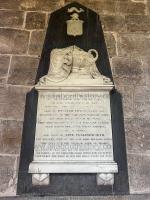
On 30th August 1904 Bishop George Ridding (age 76) died. He was buried in Southwell Minster [Map]. Monument by Frederick William Pomeroy (age 47) in 1907.


Life of William Morris. Notwithstanding its popularity and its increasing numbers, the internal condition of the college was far from satisfactory. " There was neither teaching nor discipline," is the sweeping verdict of a contemporary of Morris who afterwards rose to high academic distinction. The rector. Dr. Richards, was ill and non-resident. The only one of the fellows who was at all friendly or encouraging was Ridding, the present Bishop of Southwell, who had brought a more energetic tradition with him from Balliol. Morris's own tutor contented him- self with seeing that he attended lectures on the prescribed books for the schools, and noted him in his pupil-book as "a rather rough and unpolished youth, who exhibited no special literary tastes or capacity, but had no difficulty in mastering the usual subjects of examination." It is proper to add that this vague supervision was then regarded as sufficient fulfilment of a college tutor's duty, and that his college tutor is the last person in the world to whom an undergraduate thinks of communicating his inner thoughts or his literary enthusiasms.