

The History of William Marshal was commissioned by his son shortly after William’s death in 1219 to celebrate the Marshal’s remarkable life; it is an authentic, contemporary voice. The manuscript was discovered in 1861 by French historian Paul Meyer. Meyer published the manuscript in its original Anglo-French in 1891 in two books. This book is a line by line translation of the first of Meyer’s books; lines 1-10152. Book 1 of the History begins in 1139 and ends in 1194. It describes the events of the Anarchy, the role of William’s father John, John’s marriages, William’s childhood, his role as a hostage at the siege of Newbury, his injury and imprisonment in Poitou where he met Eleanor of Aquitaine and his life as a knight errant. It continues with the accusation against him of an improper relationship with Margaret, wife of Henry the Young King, his exile, and return, the death of Henry the Young King, the rebellion of Richard, the future King Richard I, war with France, the death of King Henry II, and the capture of King Richard, and the rebellion of John, the future King John. It ends with the release of King Richard and the death of John Marshal.
Available at Amazon in eBook and Paperback format.
Paternal Family Tree: Burghesh
Around 1282 [his father] Robert Burghesh 1st Baron Burghesh [aged 28] and [his mother] Maud Badlesmere Baroness Burghesh [aged 17] were married.
In 1292 Bishop Henry Burghesh was born to [his father] Robert Burghesh 1st Baron Burghesh [aged 38] and [his mother] Maud Badlesmere Baroness Burghesh [aged 27].
On 12th November 1303 [his father] Robert Burghesh 1st Baron Burghesh [aged 49] was created 1st Baron Burghesh by writ of summons. [his mother] Maud Badlesmere Baroness Burghesh [aged 38] by marriage Baroness Burghesh.
In 1306 [his mother] Maud Badlesmere Baroness Burghesh [aged 41] died.
In 1306 [his father] Robert Burghesh 1st Baron Burghesh [aged 52] died. He was buried in the St Catherine Chantry at Lincoln Cathedral [Map]. His son [his brother] Stephen [aged 23] succeeded 2nd Baron Burghesh.
In 1310 [his brother] Stephen Burghesh 2nd Baron Burghesh [aged 27] died. His daughter [his niece] Maud [aged 6] succeeded 3rd Baroness Burghesh.
Before 1314 [his brother] Bartholomew "The Elder" Burghesh 1st Baron Burghesh [aged 26] and [his sister-in-law] Elizabeth Verdun Baroness Burghesh [aged 13] were married.
On 27th May 1320 Bishop Henry Burghesh [aged 28] was appointed Bishop of Lincoln due to the influence of his uncle Bartholomew Badlesmere 1st Baron Badlesmere [aged 44] despite the chapter having already elected a new bishop.
On 20th July 1320 Bishop Henry Burghesh [aged 28] was consecrated Bishop of Lincoln.
On 14th April 1322 [his uncle] Bartholomew Badlesmere 1st Baron Badlesmere [aged 46] was tried by Henry Cobham 1st Baron Cobham [aged 62] at Canterbury, Kent [Map].
Sentenced to death Bartholomew Badlesmere 1st Baron Badlesmere was drawn for three miles behind a horse to Blean, Canterbury, where he held property, where he was beheaded. His head was displayed on the Burgh Gate, Canterbury and the rest of his body left hanging at Blean, Canterbury. He was buried at Whitefriars. His nephew Henry Burghesh's [aged 30] lands were also seized. These were restored around 1326.
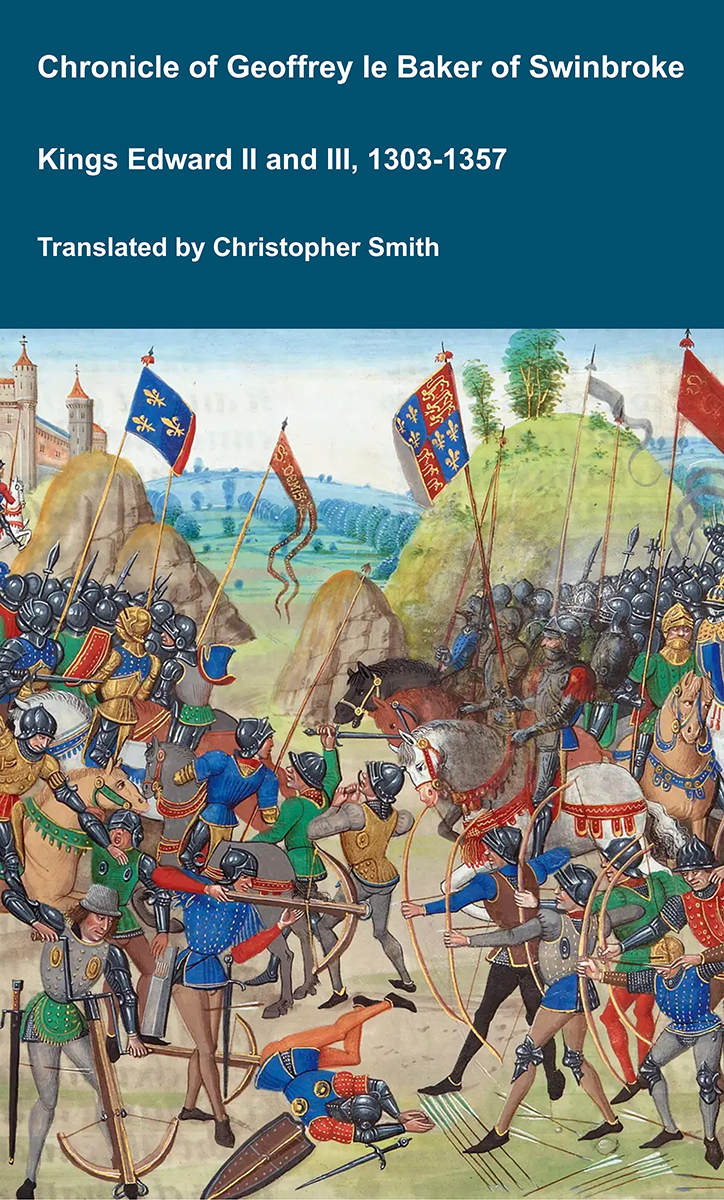 Chronicle of Geoffrey le Baker of Swinbroke. Those of Hereford he hated, having been deprived of his temporal possessions; those of Lincoln, Henry de Burghesh,1 although honoured with a bishop's mitre through royal promotion, nevertheless, due to the same guilt as the aforementioned Adam, knowing himself to be guilty, greatly feared and consequently hated them as well. On the other hand, all the knights and bishops who were friends of these men were burdened with sick hearts and prone to rage, held back only by reverence for the king's peace. To make matters worse, they provoked against themselves the furious wrath of the queen,2 a most violent and womanly wrath, because, due to the greedy counsel and arrangement of those men, the royal consort's household had been diminished, and fixed incomes had been assigned to her with strict limitation, forcing her to live on a more meagre allowance than she was accustomed to. Thus, the insatiable feminine greed, frustrated in its desires, or perhaps the extravagant nature of womanhood, which that sex is ever wont to indulge, being denied its usual outlet, flared up not only against the Dispensers, but even against her husband, whom she accused of following their counsel more than hers.
Illos Herefordensis suis temporalibus privatus odiebat; illos Lincolniensis Henricus de Borewasch, quamquam regis promocione decoratus infula, tamen consimili culpa qua supradictus Adam sciens se noxium, valde metuebat et per consequens odiebat. Contra universi militum et episcoporum istorum amici habuerunt animos egro dolore sarcinatos et in furiam proclivos, et sola reverencia regie pacis manus continentes. Ad hoc contra seipsos in universum nefas rapidissimam iram femineam regine concitabant, eo quod, illorum avaro consilio et ordinacione familia consortis regie minorata, sibi certi reditus cum precisione fuerant taxati, parciori annona quam solebat victure. Unde avaricia insaciabilis feminina concupitis frustrata, aut certe prodigalitas muliebris artata, quarum alteri solet semper ille sexus indulgere, non solum contra Dispensatores, set et contra maritum, plus illos quam illam consiliis imitatum, exarsit in iras.
Note 1. Henry Burghersh [aged 32], nephew of Bartholomew de Badlesmere, had been forced by Edward into the see of Lincoln when only in his twenty-ninth year and thus under the canonical age. The papal bull of appointment is dated 27th May 1320 (Rymer's Fœdera 2.425). Previously the king had asked the pope to promote him to Winchester, 2nd November 1319 (Rymer's Fœdera 2.425). In spite of these favours he had joined in the rebellion of 1322. See Stubbs Constitutional History of England 2.386. He was treasurer in 1327, and chancellor in 1328-1330. He died at Ghent in 1340.
Note 2. On the 18th of September 1324 the king took into his own hands the queen's estates, on the threat of a French invasion. Rymer's Fœdera 2.569.
In October 1326 Isabella of France Queen Consort England [aged 31] landed at Harwich, Suffolk with her son Edward [aged 13] and Roger Mortimer 1st Earl March [aged 39], John Maltravers 1st Baron Maltravers [aged 36] and Nicholas Abrichecourt [aged 36]. Bishop Henry Burghesh [aged 34] joined her shortly afterwards.
Adam Murimuth's Continuation and Robert of Avesbury’s 'The Wonderful Deeds of King Edward III'
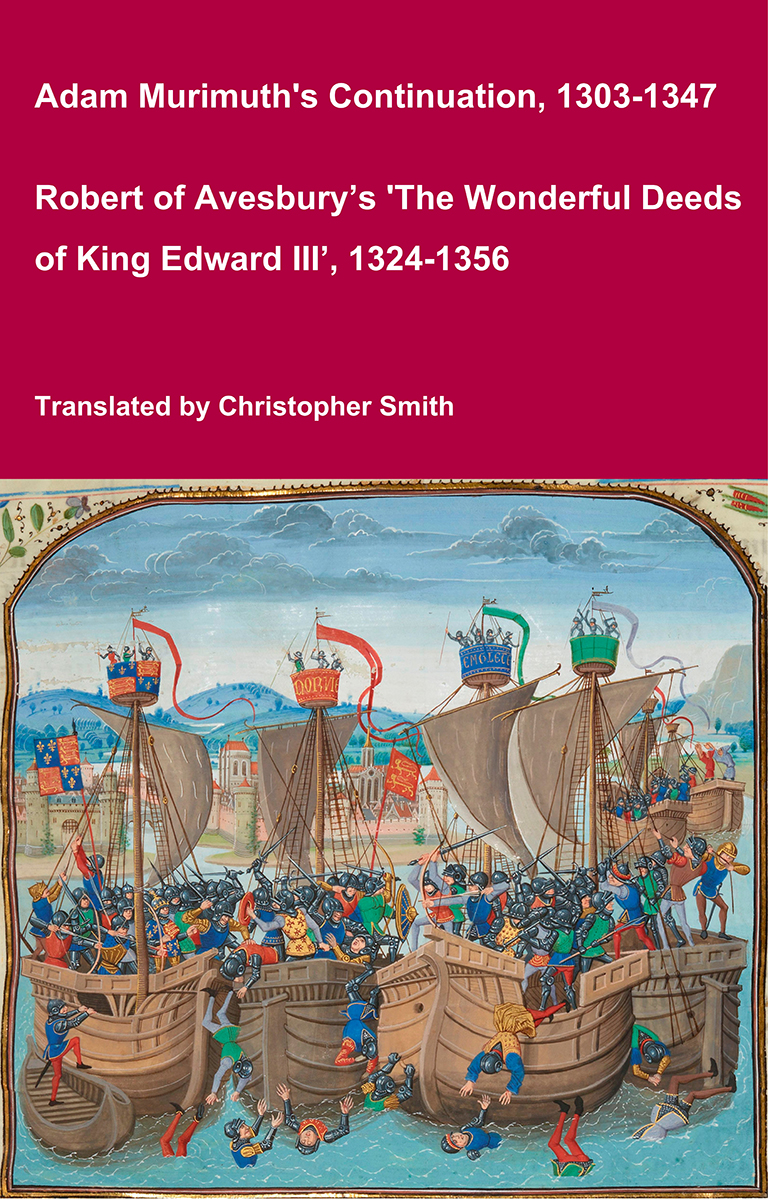
This volume brings together two of the most important contemporary chronicles for the reign of Edward III and the opening phases of the Hundred Years’ War. Written in Latin by English clerical observers, these texts provide a vivid and authoritative window into the political, diplomatic, and military history of fourteenth-century England and its continental ambitions. Adam Murimuth Continuatio's Chronicarum continues an earlier chronicle into the mid-fourteenth century, offering concise but valuable notices on royal policy, foreign relations, and ecclesiastical affairs. Its annalistic structure makes it especially useful for establishing chronology and tracing the development of events year by year. Complementing it, Robert of Avesbury’s De gestis mirabilibus regis Edwardi tertii is a rich documentary chronicle preserving letters, treaties, and official records alongside narrative passages. It is an indispensable source for understanding Edward III’s claim to the French crown, the conduct of war, and the mechanisms of medieval diplomacy. Together, these works offer scholars, students, and enthusiasts a reliable and unembellished account of a transformative period in English and European history. Essential for anyone interested in medieval chronicles, the Hundred Years’ War, or the reign of Edward III.
Available at Amazon in eBook and Paperback format.
In 1327 Bishop Henry Burghesh [aged 35] was appointed Lord Treasurer.
In 1328 Bishop Henry Burghesh [aged 36] was appointed Lord Chancellor.
On 25th January 1330 [his brother] Bartholomew "The Elder" Burghesh 1st Baron Burghesh [aged 43] was created 1st Baron Burghesh. [his sister-in-law] Elizabeth Verdun Baroness Burghesh [aged 30] by marriage Baroness Burghesh.
On 31st August 1330 John Mohun 1st Baron Dunster [aged 61] died. His grandson John [aged 10] succeeded 2nd Baron Mohun of Dunster. Given his young age he became a ward of the King who sold his wardship and marriage to Bishop Henry Burghesh [aged 38] who then married him to his niece Joan Burghesh Baroness Dunster [aged 11], daugher of his brother Bartholomew "The Elder" Burghesh 1st Baron Burghesh [aged 43].
In 1334 Bishop Henry Burghesh [aged 42] was appointed Lord Treasurer which office he held until 1337.
Calendar Inquitisitions Port Mortem Volume 7 Edward III 691. 691. Giles, Son And Heir of [his uncle] Bartholomew De Badelesmere.
Writ to the escheator to take the proof of age of the said Giles, whose lands and tenements are in the wardship of H(enry) bishop of Lincoln, and who was born at Markettesoverton, co. Rutland, and was baptized in the church there, 7 November, 9 Edward III.
RUTLAND
Proof of age, 14 November [1335], 9 Edward III.
Richard de Sancto Lico, knight, aged 50 years, says that the said Giles, who was born in the manor of Hameldone, co. Rutland, and was baptized in the parish church of St. Andrew [Map] there, was, on the feast of St. Luke last, 21 years of age; and this he knows, because he was present when John de Drokenesforde, then bishop of Bath and Wells, baptized him; and Sir Robert de Watevile, knight, and Giles le Faukener, esquire of the aforesaid Bartholomew, were godfathers of the said Giles, and Lady Margery de Harington, then lady of Glaston, was his godmother.
John de Witlesbury, knight, aged 50 years and more, says that the said Giles was 21 years of age on the above feast, and this he knows, because his own son John was born on the very day when the said Giles was born at Hameldon and baptized in the church there, and his said son was 21 years of age on the above feast (last).
John de Boyvile, knight, aged 40 years and more, says the like, and knows it because he has a charter made on the same day, and from that day 21 years have elapsed.
John de Weyvile, aged 50 years, says the like, and knows it because he was there with his lady, Lady Margery de Haringtone, who was godmother of the said Giles, and wrote the day of his birth in a memorandum, which he still has.
John Basset, aged 50 years and more, says the like, and knows it because he has a son, who was born on the same day as the said Giles, and he was 21 years of age on the said feast of St. Luke (last).
William de la Hide, of Egelton, aged 50 years, says the like, and knows it because he espoused Alice his wife on the day the said Giles was born, from which day 21 years had elapsed on the feast of St. Luke (last).
William de la Hide, of Egelton, aged 50 years, says the like, and knows it because he espoused Alice his wife on the day the said Giles was born, from which day 21 years had elapsed on the feast of St. Luke (last).
Thomas Flemmyng, of Egelton, aged 50 years and more, says the like, and knows it because he was present when the said Giles was baptized, and the parish chaplain wrote the day of birth in the missal.
William de Sancto Petro, of Okham, aged 60 years, says the like, and knows it because [he has] a quit-claim of William de Okham, made on the day on which the said Giles was born, and by its date he knows the age of the said Giles.
William de Sancto Petro, of Okham, aged 60 years, says the like, and knows it because [he has] a quit-claim of William de Okham, made on the day on which the said Giles was born, and by its date he knows the age of the said Giles.
William de Ryhale, of Okham, aged 50 years, says the like, and knows it because he was (stetit) then with Sir Bartholomew de Badelesmere, when the said Giles was born, and he has the day of his birth written in a calendar.
Robert de Nevile, of Berudon, aged 50 years and more, says the like, and knows it by the death of Walter his brother, who died on the day on which the said Giles was born.
Henry bishop of Lincoln [aged 46] being warned to be present did not appear in person or by any other.
Adam Murimuth Continuation. In this year, around the feast of the Nativity1 of Saint John the Baptist [24th June], there died at Ghent Lord Geoffrey Scrope, justice, and Lord Henry, bishop of Lincoln, principal councillors of the king; to whom Master Thomas de Beek succeeded, by provision of Pope Clement VI.
Hoc anno, circa festum Nativitatis sancti Johannis baptistæ, obiit in Gandavo dominus Galfridus Scrope, justiciarius, et dominus Henricus episcopus Lincolniensis, principales consiliarii regis, cui successit Henrico magister Thomas de Beek, per provisionem Clementis papæ sexti.
Note 1. Geoffrey Scrope [aged 55] died on 2nd December 1340. Bishop Henry Burghesh [aged 48] died on 4th December 1340. It appears the author is referring to the Feast of the Nativity rather than the Feast of the Nativity of Saint John the Baptist [24th June].
Chronicle of Geoffrey le Baker of Swinbroke. In this year, around the Feast of the Nativity of the Lord, Henry [aged 48],1 Bishop of Lincoln, and Sir Geoffrey Scrope [deceased], the king's chief justice and one of his principal counsellors, died in Ghent.
Hoc anno, circa Nativitatem Domini, Henricus episcopus Lin-colniensis et dominus Galfridus Scroup, iusticiarius, regis principales conciliarii, in Gandavo obierunt.
Note 1. On 4th December 1340 and 2nd December 1340 respectively.
On 4th December 1340 Bishop Henry Burghesh [aged 48] died at Ghent [Map]. He was buried in the St Catherine Chantry at Lincoln Cathedral [Map].
GrandFather: Gunselin Badlesmere 
Mother: Maud Badlesmere Baroness Burghesh
GrandMother: Joan Fitzbernard
