

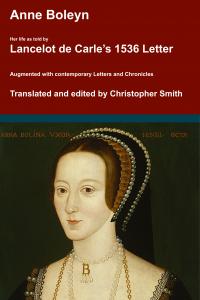
Anne Boleyn. Her Life as told by Lancelot de Carle's 1536 Letter.
In 1536, two weeks after the execution of Anne Boleyn, her brother George and four others, Lancelot du Carle, wrote an extraordinary letter that described Anne's life, and her trial and execution, to which he was a witness. This book presents a new translation of that letter, with additional material from other contemporary sources such as Letters, Hall's and Wriothesley's Chronicles, the pamphlets of Wynkyn the Worde, the Memorial of George Constantyne, the Portuguese Letter and the Baga de Secrets, all of which are provided in Appendices.
Available at Amazon in eBook and Paperback format.
Paternal Family Tree: Marshall
Around 1141 [his father] John Fitzgilbert [aged 36] and [his mother] Sybil of Salisbury were married.
In or after 1148 Bishop Henry Marshal was born to [his father] John Fitzgilbert [aged 43] and [his mother] Sybil of Salisbury.
In 1165 [his father] John Fitzgilbert [aged 60] died.
In 1185 Gilbert Clare 3rd Earl Pembroke [aged 8] died. Earl Pembroke extinct. It is possible his sister [his future sister-in-law] Isabel Clare Countess Pembroke [aged 13] inherited the title. Her husband [his brother] William Marshal 1st Earl Pembroke [aged 39] was created 1st Earl of Pembroke in 1199 which suggests she didn't inherit the title.
In August 1189 [his brother] William Marshal 1st Earl Pembroke [aged 43] and [his sister-in-law] Isabel Clare Countess Pembroke [aged 17] were married at Temple Church, London [Map]. The title Earl Pembroke (1C 1138) was not included in the settlement since it had been rescinded as a consequence of Isabel's father having supported King Stephen. The difference in their ages was 26 years. She the daughter of Richard "Strongbow" Clare 2nd Earl Pembroke and Aoife ni Diarmait Macmurrough Countess Pembroke and Buckingham.
Chronicle of Roger de Hoveden. 10th February 1194. On the same day, Hubert [aged 34], Archbishop of Canterbury, along with Hugh, Bishop of Lincoln, Richard [aged 64], Bishop of London, Gilbert, Bishop of Rochester, Godfrey, Bishop of Winchester, as well as the Bishops of Worcester and Hereford, Henry [aged 46], Bishop-elect of Exeter, and many abbots and clergy of the diocese of Canterbury, gathered in the chapel of the infirm monks at Westminster. There, they pronounced a sentence of excommunication upon Count John and upon all his supporters and advisors, who had disturbed or sought to disturb the peace and kingdom of the King of England, unless they abandoned their hostility and sought reconciliation. Furthermore, they appealed to the presence of the Lord Pope against William, Bishop of Ely, so that he might no longer exercise the office of legate in England. They confirmed their appeal with their seals and sent it first to the king, and then to the Supreme Pontiff for ratification. This appeal was made on the fourth Ides of February (February 10), on a Thursday.
Eodem die Hubertus Cantuariensis archiepiscopus, et Hugo Lincolniensis, et Ricardus Lundoniensis, et Gilbertus Rofensis, et Godefridus Wintoniensis, et Wigornensis et Herefordensis episcopi, et Henricus Exoniensis electus, et abbates et clerici multi Cantuariensis diocesis, convenerunt in capella monachorum infirmornm apud Westmonasterium, et sententiam anathematis tulerunt in comitem Johannem, et in omnes fautores ejus et consiliarios, qui pacem et regnum regis Anglize turbaverunt vel turbarent, nisi relicta hostilitate ad satisfactionem venirent. Deinde appellaverunt ad præsentiam domini papæ contra Willelmum Eliensem episcopum, ne ipse de cwtero fungeretur in Anglia legationis officio; et appellationem suam sigillis suis confirmaverunt, et miserunt illam domino regi, deinde summo pontifici confirmandam. Facta est autem hæc appellatio quarto idus Februarii, feria quinta.
On 10th February 1194 Bishop Henry Marshal [aged 46] was appointed Bishop of Exeter.
Chronicle of Roger de Hoveden. 30th March 1194. On the thirtieth day of March, a Wednesday, Richard, King of England, held the first day of his council at Nottingham. Present at this council were: Queen Eleanor [aged 72], his mother, Hubert [aged 34], Archbishop of Canterbury, who sat on the king's right, Geoffrey [aged 42], Archbishop of York, who sat on the king's left, Hugh [aged 69], Bishop of Durham, Hugh [aged 54], Bishop of Lincoln, William, Bishop of Ely, the king's chancellor, William, Bishop of Hereford, Henry, Bishop of Worcester, Henry [aged 46], Bishop of Exeter, John, Bishop of Whithorn (Candida Casa), Count David [aged 42], brother of the King of Scotland, Hamelin [aged 65], Earl of Warenne, Ranulf [aged 24], Earl of Chester, William [aged 26], Earl of Ferrers, William [aged 18], Earl of Salisbury, Roger Bigod [aged 50].
Tricesima die mensis Martii, feria quarta, Ricardus rex Angiiæ celebravit primum conciJii sui diem apud Notingliam; cui interfueiunt Alienor regina mater ejus, et Hubertus Cantuariensis arcbiepiscopus, qui in dextris regis sedebat in concilio illo, et Gaufridus Eboracensis arcbiepiscopus, qui a sinistris ejus sedebat, et Hugo Dunelmensis, et Hugo Lincolniensis, et Willelmus Eliensis regis cancellarius, et Willelmus Herefordensis, et Henriecus Wigornensis, et Henricus Exoniensis, et Johannes Candidæ Casæ episcopi; et comes David frater regis, Scotiæ, et Hamelinus comes de Warenna, et Ranulfus comes Cestriæ, et Willelmus comes de Ferreres, et Willelmus comes de Salesbiria, et Rogerus Bigot.
In 1199 [his brother] William Marshal 1st Earl Pembroke [aged 53] was created 1st Earl Pembroke.
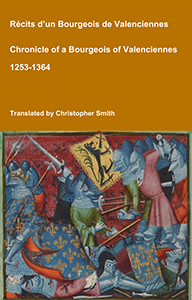
Chronicle of a Bourgeois of Valenciennes
Récits d’un bourgeois de Valenciennes aka The Chronicle of a Bourgeois of Valenciennes is a vivid 14th-century vernacular chronicle written by an anonymous urban chronicler from Valenciennes in the County of Hainaut. It survives in a manuscript that describes local and regional history from about 1253 to 1366, blending chronology, narrative episodes, and eyewitness-style accounts of political, military, and social events in medieval France, Flanders, and the Low Countries. The work begins with a chronological framework of events affecting Valenciennes and its region under rulers such as King Philip VI of France and the shifting allegiances of local nobility. It includes accounts of conflicts, sieges, diplomatic manoeuvres, and the impact of broader struggles like the Hundred Years’ War on urban life in Hainaut. Written from the perspective of a burgher (bourgeois) rather than a monastery or royal court, the chronicle offers a rare lay viewpoint on high politics and warfare, reflecting how merchants, townspeople, and civic institutions experienced the turbulence of the 13th and 14th centuries. Its narrative style combines straightforward reporting of events with moral and civic observations, making it a valuable source for readers interested in medieval urban society, regional politics, and the lived experience of war and governance in pre-modern Europe.
Available at Amazon in eBook and Paperback format.
On 24th or 27th October 1206 Bishop Henry Marshal [aged 58] died. He was buried at Exeter Cathedral [Map] where his tomb is extant.
On 16th September 1889 Bishop Henry Marshal was appointed Dean of York.
GrandFather: Gilbert Giffard 
Father: John Fitzgilbert
Great x 1 Grandfather: Edward of Salisbury 1st Baron Trowbridge 1st Baron Chitterne
GrandFather: Walter of Salisbury 2nd Baron Chitterne
Mother: Sybil of Salisbury
GrandMother: Sybilla Chaworth Baroness Chitterne 