

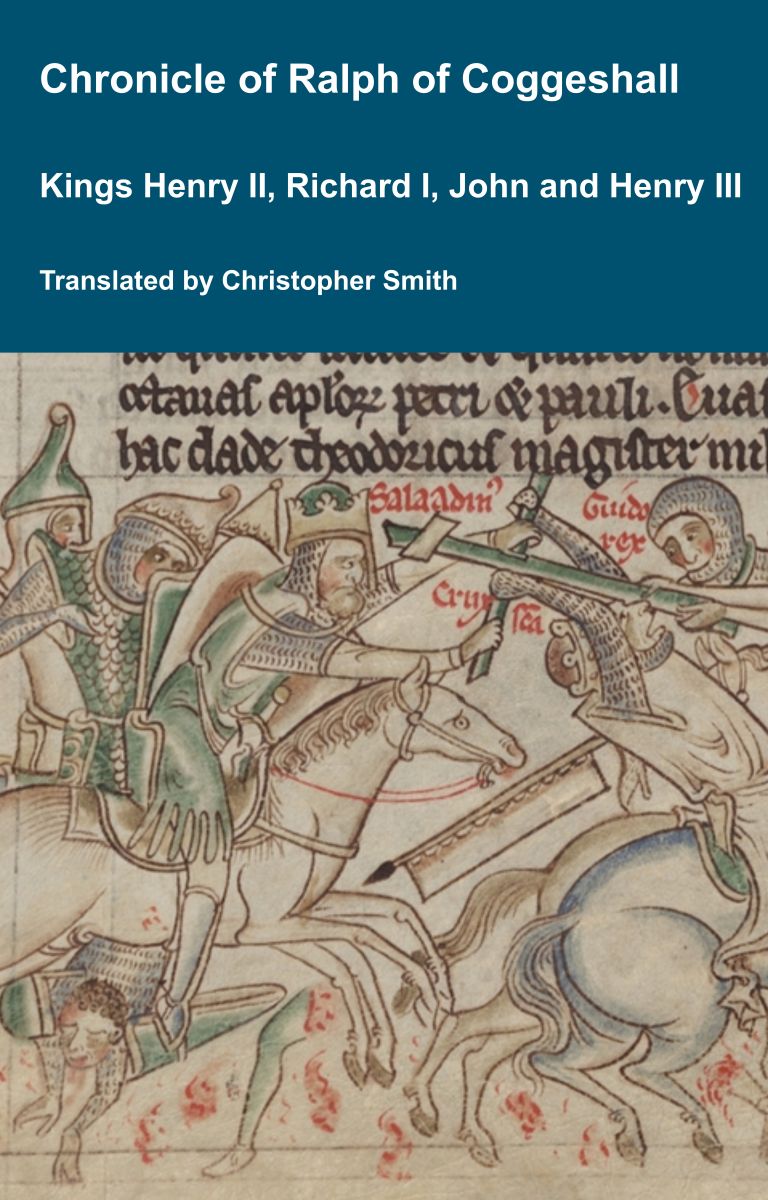
Chronicle of Abbot Ralph of Coggeshall
The Chronicle of Abbot Ralph of Coggeshall (Chronicon Anglicanum) is an indispensable medieval history that brings to life centuries of English and European affairs through the eyes of a learned Cistercian monk. Ralph of Coggeshall, abbot of the Abbey of Coggeshall in Essex in the early 13th century, continued and expanded his community’s chronicle, documenting events from the Norman Conquest of 1066 into the tumultuous reign of King Henry III. Blending eyewitness testimony, careful compilation, and the monastic commitment to record-keeping, this chronicle offers a rare narrative of political intrigue, royal power struggles, and social upheaval in England and beyond. Ralph’s work captures the reigns of pivotal figures such as Richard I and King John, providing invaluable insights into their characters, decisions, and the forces that shaped medieval rule. More than a simple annal, Chronicon Anglicanum conveys the texture of medieval life and governance, making it a rich source for scholars and readers fascinated by English history, monastic authorship, and the shaping of the medieval world.
Available at Amazon in eBook and Paperback format.
Paternal Family Tree: Crew
Maternal Family Tree: Amy Fermor 1509-1580

In or before 1624 [his father] John Crew 1st Baron Crew [aged 25] and [his mother] Jemima Waldegrave Baroness Crew [aged 21] were married.
On 31st January 1633 Bishop Nathaniel Crew 3rd Baron Crew was born to [his father] John Crew 1st Baron Crew [aged 35] and [his mother] Jemima Waldegrave Baroness Crew [aged 31].
On 7th November 1642 [his brother-in-law] Edward Montagu 1st Earl Sandwich [aged 17] and [his sister] Jemima Crew Countess Sandwich [aged 17] were married.


Around 1650 [his brother] Thomas Crew 2nd Baron Crew [aged 26] and [his sister-in-law] Mary Townshend were married. She the daughter of Roger Townshend 1st Baronet and Mary Vere Countess of Westmoreland [aged 42].
Samuel Pepys' Diary. 17th May 1662. So to Whitehall and there met Mr. Moore, and I walked long in Westminster Hall [Map], and thence with him to the Wardrobe to dinner, where dined Mrs. Sanderson, the mother of the maids, and after dinner my Lady and she and I on foot to Pater Noster Row [Map] to buy a petticoat against the Queen's [aged 23] coming for my Lady, of plain satin, and other things; and being come back again, we there met Mr. Nathaniel Crew [aged 29]1 at the Wardrobe with a young gentleman, a friend and fellow student of his, and of a good family, Mr. Knightly, and known to the Crews, of whom my Lady privately told me she hath some thoughts of a match for my Lady Jemimah. I like the person very well, and he hath £2000 per annum.
Note 1. Nathaniel Crew, born 1633, fifth son of John, first Lord Crew; he himself became third Lord Crew in 1697. Sub-Rector of Lincoln College, Oxford, 1659. Took orders in 1664, and was Rector of Lincoln College in 1668; Dean of Chichester, 1669; Bishop of Oxford, 1671; Bishop of Durham, 1674; sworn of the Privy Council in 1676. He was very subservient to James II, and at the Revolution was excepted from the general pardon of May, 1690, but he was allowed to keep possession of the bishopric of Durham.
Samuel Pepys' Diary. 26th June 1663. Up betimes, and Mr. Moore coming to see me, he and I discoursed of going to Oxford this Commencement, Mr. Nathaniel Crew [aged 30] being Proctor and Mr. Childe commencing Doctor of Musique this year, which I have a great mind to do, and, if I can, will order my matters so that I may do it.
Samuel Pepys' Diary. 5th November 1666. After dinner and this discourse I took coach, and at the same time find my [his nephew] Lord Hinchingbrooke [aged 18] and [his brother] Mr. John Crew [aged 38] and the Doctor [aged 33] going out to see the ruins of the City; so I took the Doctor into my Hackney coach (and he is a very fine sober gentleman), and so through the City. But, Lord! what pretty and sober observations he made of the City and its desolation; till anon we come to my house, and there I took them upon Tower Hill [Map] to shew them what houses were pulled down there since the fire; and then to my house, where I treated them with good wine of several sorts, and they took it mighty respectfully, and a fine company of gentlemen they are; but above all I was glad to see my Lord Hinchingbrooke drink no wine at all. Here I got them to appoint Wednesday come se'nnight to dine here at my house, and so we broke up and all took coach again, and I carried the Doctor to Chancery Lane [Map], and thence I to White Hall, where I staid walking up and down till night, and then got almost into the play house, having much mind to go and see the play at Court this night; but fearing how I should get home, because of the bonefires and the lateness of the night to get a coach, I did not stay; but having this evening seen my [his niece] Lady Jemimah, who is come to towne, and looks very well and fat, and heard how Mr. John Pickering [aged 55] is to be married this week, and to a fortune with £5000, and seen a rich necklace of pearle and two pendants of dyamonds, which Sir G. Carteret [aged 56] hath presented her with since her coming to towne, I home by coach, but met not one bonefire through the whole town in going round by the wall, which is strange, and speaks the melancholy disposition of the City at present, while never more was said of, and feared of, and done against the Papists than just at this time.
Samuel Pepys' Diary. 5th November 1666. Thence to my [his father] Lord Crew's [aged 68], and there dined, and mightily made of, having not, to my shame, been there in 8 months before. Here my Lord and Sir Thomas Crew [aged 42], Mr. John [aged 38], and Dr. Crew [aged 33], and two strangers. The best family in the world for goodness and sobriety. Here beyond my expectation I met my Lord Hinchingbrooke [aged 18], who is come to towne two days since from Hinchingbroke [Map], and brought his sister and brother Carteret [aged 25] with him, who are at Sir G. Carteret's [aged 56].
Samuel Pepys' Diary. 28th December 1666. Up, and Creed and I walked (a very fine walk in the frost) to my Lord Bellasses [aged 52], but missing him did find him at White Hall, and there spoke with him about some Tangier business. That done, we to Creed's lodgings, which are very pretty, but he is going from them. So we to Lincoln's Inne Fields, he to Ned Pickering's [aged 48], who it seems lives there, keeping a good house, and I to my [his father] Lord Crew's [aged 68], where I dined, and hear the newes how my Lord's brother, Mr. Nathaniel Crew [aged 33], hath an estate of 6 or £700 per annum, left him by the death of an old acquaintance of his, but not akin to him at all. And this man is dead without will, but had, above ten years since, made over his estate to this Mr. Crew, to him and his heirs for ever, and given Mr. Crew the keeping of the deeds in his own hand all this time; by which, if he would, he might have taken present possession of the estate, for he knew what they were. This is as great an act of confident friendship as this latter age, I believe, can shew.


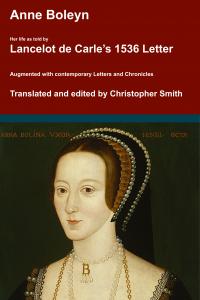
Anne Boleyn. Her Life as told by Lancelot de Carle's 1536 Letter.
In 1536, two weeks after the execution of Anne Boleyn, her brother George and four others, Lancelot du Carle, wrote an extraordinary letter that described Anne's life, and her trial and execution, to which he was a witness. This book presents a new translation of that letter, with additional material from other contemporary sources such as Letters, Hall's and Wriothesley's Chronicles, the pamphlets of Wynkyn the Worde, the Memorial of George Constantyne, the Portuguese Letter and the Baga de Secrets, all of which are provided in Appendices.
Available at Amazon in eBook and Paperback format.
Samuel Pepys' Diary. 3rd April 1667. By and by up to the Duke of York [aged 33], where our usual business, and among other things I read two most dismal letters of the straits we are in (from Collonell Middleton and Commissioner Taylor) that ever were writ in the world, so as the Duke of York would have them to shew the King [aged 36], and to every demand of money, whereof we proposed many and very pressing ones, Sir G. Carteret [aged 57] could make no answer but no money, which I confess made me almost ready to cry for sorrow and vexation, but that which was the most considerable was when Sir G. Carteret did say that he had no funds to raise money on; and being asked by Sir W. Coventry [aged 39] whether the eleven months' tax was not a fund, and he answered, "No, that the bankers would not lend money upon it". Then Sir W. Coventry burst out and said he did supplicate his Royal Highness, and would do the same to the King, that he would remember who they were that did persuade the King from parting with the Chimney-money to the Parliament, and taking that in lieu which they would certainly have given, and which would have raised infallibly ready money; meaning the bankers and the farmers of the Chimney-money, whereof Sir, G. Carteret, I think, is one; saying plainly, that whoever did advise the King to that, did, as much as in them lay, cut the King's throat, and did wholly betray him; to which the Duke of York did assent; and remembered that the King did say again and again at the time, that he was assured, and did fully believe, the money would be raised presently upon a land-tax. This put as all into a stound; and Sir W. Coventry went on to declare, that he was glad he was come to have so lately concern in the Navy as he hath, for he cannot now give any good account of the Navy business; and that all his work now was to be able to provide such orders as would justify his Royal Highness in the business, when it shall be called to account; and that he do do, not concerning himself whether they are or can be performed, or no; and that when it comes to be examined, and falls on my Lord Treasurer [aged 60], he cannot help it, whatever the issue of it shall be. Hereupon Sir W. Batten [aged 66] did pray him to keep also by him all our letters that come from the office that may justify us, which he says he do do, and, God knows, it is an ill sign when we are once to come to study how to excuse ourselves. It is a sad consideration, and therewith we broke up, all in a sad posture, the most that ever I saw in my life. One thing more Sir W. Coventry did say to the Duke of York, when I moved again, that of about £9000 debt to Lanyon, at Plymouth, Devon [Map], he might pay £3700 worth of prize-goods, that he bought lately at the candle, out of this debt due to him from the King; and the Duke of York, and Sir G: Carteret, and Lord Barkeley [aged 65], saying, all of them, that my Lord Ashly [aged 45] would not be got to yield to it, who is Treasurer of the Prizes, Sir W. Coventry did plainly desire that it might be declared whether the proceeds of the prizes were to go to the helping on of the war, or no; and, if it were, how then could this be denied? which put them all into another stound; and it is true, God forgive us! Thence to the chappell, and there, by chance, hear that Dr. Crew [aged 34] is to preach; and so into the organ-loft, where I met Mr. Carteret, and my [his niece] Lady Jemimah, and [his brother] Sir Thomas Crew's [aged 43] two daughters, and Dr. Childe [aged 61] played; and Dr. Crew did make a very pretty, neat, sober, honest sermon; and delivered it very readily, decently, and gravely, beyond his years: so as I was exceedingly taken with it, and I believe the whole chappell, he being but young; but his manner of his delivery I do like exceedingly. His text was, "But seeke ye first the Kingdom of God, and his righteousness, and all these things shall be added unto you". Thence with my Lady to Sir G. Carteret's lodgings, and so up into the house, and there do hear that the Dutch letters are come, and say that the Dutch have ordered a passe to be sent for our Commissioners, and that it is now upon the way, coming with a trumpeter blinded, as is usual. But I perceive every body begins to doubt the success of the treaty, all their hopes being only that if it can be had on any terms, the Chancellor [aged 58] will have it; for he dare not come before a Parliament, nor a great many more of the courtiers, and the King himself do declare he do not desire it, nor intend it but on a strait; which God defend him from! Here I hear how the King is not so well pleased of this marriage between the Duke of Richmond and Mrs. Stewart [aged 19], as is talked; and that he [the Duke] by a wile did fetch her to the Beare [Map], at the bridge foot, where a coach was ready, and they are stole away into Kent, without the King's leave; and that the King hath said he will never see her more; but people do think that it is only a trick. This day I saw Prince Rupert [aged 47] abroad in the Vane-room, pretty well as he used to be, and looks as well, only something appears to be under his periwigg on the crown of his head.

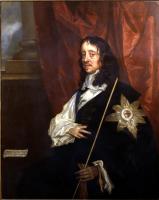


After 29th April 1669 Bishop Nathaniel Crew 3rd Baron Crew [aged 36] was appointed Clerk of the Closet to King Charles II of England Scotland and Ireland [aged 38].
In 1671 Bishop Nathaniel Crew 3rd Baron Crew [aged 37] was appointed Bishop of Oxford.
On 9th February 1671 Catherine Stewart was born to James Duke of York [aged 37] and Anne Hyde Duchess of York [aged 33]. She was baptised by Bishop Nathaniel Crew 3rd Baron Crew [aged 38]. She died aged less than one years old.
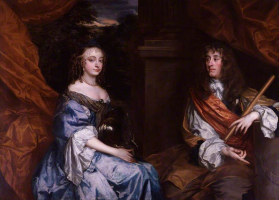


In 1674 [his brother] Thomas Crew 2nd Baron Crew [aged 50] and [his sister-in-law] Anne Armine [aged 22] were married. The difference in their ages was 28 years.
In 1674 [his sister] Jemima Crew Countess Sandwich [aged 49] died.
In 1674 Bishop Nathaniel Crew 3rd Baron Crew [aged 40] was appointed Bishop of Durham.

Around 1675 John Greenhill [aged 31] (attributed). Portrait of Bishop Nathaniel Crew 3rd Baron Crew [aged 41].
On 14th October 1675 [his mother] Jemima Waldegrave Baroness Crew [aged 73] died.
On 12th December 1679 [his father] John Crew 1st Baron Crew [aged 81] died. His son [his brother] Thomas [aged 55] succeeded 2nd Baron Crew of Stene in Northamptonshire.
In 1680 Bishop Nathaniel Crew 3rd Baron Crew [aged 46] lived at 16 17 Great Piazza Covent Garden.
From 1681 to 1688 Bishop Nathaniel Crew 3rd Baron Crew [aged 47] lived at 43 King Street.
John Evelyn's Diary. 30th March 1684. Easter day. The Bp. of Rochester [Dr. Turner] [aged 46] preach'd before, the King [aged 53] after which his Ma*, accompanied with three of his natural sonns, the Dukes of Northumberland [aged 18], Richmond [aged 11], and St. Alban's [aged 13] (sons of Cleaveland [aged 43], Portsmouth [aged 34] and Nelly [aged 34] respectively), went up to the Altar; ye three boyes entering before the King within the railes, at the right hand, and three Bishops on the left, viz. London [aged 52] (who officiated), Durham [aged 51], and Rochester, with the Sub-dean Dr. Holder. the King kneeling before the Altar, taking his offering, the Bishop first receiv'd, and then his Ma* after which he retir'd to a canopied seate on the right hand. Note, there was perfume burnt before the Office began. I had receiv'd ye Sacrament at Whitehall early with the Lords and Household, ye Bp. of London officiating. Then went to St. Martin's [Map], where Dr. Tenison [aged 47] preach'd (recover'd from ye small-pox); then went againe to Whitehall as above. In the afternoone went to St. Martin's againe.
John Evelyn's Diary. 6th February 1685. Prayers were solemnly made in all the Churches, especialy in both ye Court Chapells, where the Chaplaines reliev'd one another every halfe quarter of an houre from the time he began to be in danger till he expir'd, according to the forme prescrib'd in the Church Offices. Those who assisted his Majesty's [aged 54] devotions were, the Abp. of Canterbury [aged 68], the Bishops of London [aged 53], Durham [aged 52], and Ely [aged 47], but more especialy Dr. Ken, the Bp. of Bath and Wells [aged 47] receiving the Holy Sacrament, but his Ma* told them he would consider of it, which he did so long 'till it was too late. Others whisper'd that the Bishops and Lords, except the Earles of Bath [aged 56] and Feversham [aged 44], being order'd to withdraw the night before, Hurlston, the 'Priest, had presumed to administer the Popish Offices. He gave his breeches and keys to ye Duke [aged 51], who was almost continually kneeling by his bed-side, and in teares. He also recommended to him the care of his natural children, all except the Duke of Monmouth [aged 35], now in Holland, and in his displeasure. He intreated the Queene [aged 46] to pardon him (not without cause); who a little before had sent a Bishop to excuse her not more frequently visiting him, in reguard of her excessive griefe, and withall, that his Ma* would forgive it if at any time she had offended him. He spake to ye Duke to be kind to the Dutchesse of Cleaveland [aged 44], and especialy Portsmouth [aged 35], and that Nelly [aged 35] might not starve.
The History of William Marshal was commissioned by his son shortly after William’s death in 1219 to celebrate the Marshal’s remarkable life; it is an authentic, contemporary voice. The manuscript was discovered in 1861 by French historian Paul Meyer. Meyer published the manuscript in its original Anglo-French in 1891 in two books. This book is a line by line translation of the first of Meyer’s books; lines 1-10152. Book 1 of the History begins in 1139 and ends in 1194. It describes the events of the Anarchy, the role of William’s father John, John’s marriages, William’s childhood, his role as a hostage at the siege of Newbury, his injury and imprisonment in Poitou where he met Eleanor of Aquitaine and his life as a knight errant. It continues with the accusation against him of an improper relationship with Margaret, wife of Henry the Young King, his exile, and return, the death of Henry the Young King, the rebellion of Richard, the future King Richard I, war with France, the death of King Henry II, and the capture of King Richard, and the rebellion of John, the future King John. It ends with the release of King Richard and the death of John Marshal.
Available at Amazon in eBook and Paperback format.

John Evelyn's Diary. 1st January 1686. Imploring ye continuance of God's providential care for the yeare now entered, I went to the public devotions. The Deane of the Chapell and Cleark of the Closset put out, viz. Bp. of London [aged 54] and ..., and Rochester [aged 51] and Durham [aged 52] put in their places; the former had oppos'd the toleration intended, and shewn a worthy zeale for the Reform'd Religion as establish'd.
John Evelyn's Diary. 14th July 1686. Was sealed at our office the constitution of certain commissioners to take upon them full power of all Ecclesiastical affairs, in as unlimited a manner, or rather greater, than the late High Commission-Court, abrogated by Parliament; for it had not only faculty to inspect and visit all Bishops' dioceses, but to change what laws and statutes they should think fit to alter among the colleges, though founded by private men; to punish, suspend, fine, etc., give oaths and call witnesses. The main drift was to suppress zealous preachers. In sum, it was the whole power of a Vicar-General-note the consequence! Of the clergy the commissioners were the Archbishop of Canterbury [Sancroft] [aged 69], Bishop of Durham [Crewe] [aged 53], and Rochester [Sprat] [aged 51]; of the Temporals, the Lord Treasurer, the Lord Chancellor [Jefferies] [aged 41] (who alone was ever to be of the quorum), the Chief justice [Herbert] [aged 38], and Lord President [Earl of Sunderland] [aged 44].


John Evelyn's Diary. 8th September 1686. Dr. Compton, Bishop of London [aged 54], was on Monday suspended, on pretense of not silencing Dr. Sharp [aged 41] [NOTE. Assumed to be the subsequent Archbishop?] at St. Giles's [Map], for something of a sermon in which he zealously reproved the doctrine of the Roman Catholics. The Bishop having consulted the civilians, they told him he could not by any law proceed against Dr. Sharp without producing witnesses, and impleaded according to form; but it was overruled by my Lord Chancellor [aged 41], and the Bishop sentenced without so much as being heard to any purpose. This was thought a very extraordinary way of proceeding, and was universally resented, and so much the rather for that two Bishops, Durham [aged 53] and Rochester [aged 51], sitting in the commission and giving their suffrages the Archbishop of Canterbury [aged 69] refused to sit among them. He was only suspended ab officio, and that was soon after taken off. He was brother to the Earl of Northampton, had once been a soldier, had traveled in Italy, but became a sober, grave, and excellent prelate.


Before 1691. John Riley [aged 44]. Portrait of Bishop Nathaniel Crew 3rd Baron Crew [aged 57].
On 21st December 1691 Bishop Nathaniel Crew 3rd Baron Crew [aged 58] and Penelope Frowde Baroness Crewe were married.
On 30th November 1697 Thomas Crew 2nd Baron Crew [aged 73] died. His brother Nathaniel [aged 64] succeeded 3rd Baron Crew of Stene in Northamptonshire. Penelope Frowde Baroness Crewe by marriage Baroness Crew of Stene in Northamptonshire.

In 1698 Godfrey Kneller [aged 51]. Portrait of Bishop Nathaniel Crew 3rd Baron Crew [aged 64].
In 1699 [his wife] Penelope Frowde Baroness Crewe died.
On 23rd July 1700 Bishop Nathaniel Crew 3rd Baron Crew [aged 67] and Dorothy Forster Baroness Crewe [aged 29] were married. She by marriage Baroness Crew of Stene in Northamptonshire. The difference in their ages was 37 years.
In 1701, following the murder of [his brother-in-law] Ferdinando Forster [aged 30], he estate passed through to co-heirs: his sister [his wife] Dorothy [aged 30] who had married Nathaniel Crew, 3rd Baron Crew [aged 67], Bishop of Durham, and Thomas Forster of Adderstone [aged 17], the son of their deceased sister Frances.
In 1715 [his wife] Dorothy Forster Baroness Crewe [aged 44] died.
Chronicle of Abbot Ralph of Coggeshall
The Chronicle of Abbot Ralph of Coggeshall (Chronicon Anglicanum) is an indispensable medieval history that brings to life centuries of English and European affairs through the eyes of a learned Cistercian monk. Ralph of Coggeshall, abbot of the Abbey of Coggeshall in Essex in the early 13th century, continued and expanded his community’s chronicle, documenting events from the Norman Conquest of 1066 into the tumultuous reign of King Henry III. Blending eyewitness testimony, careful compilation, and the monastic commitment to record-keeping, this chronicle offers a rare narrative of political intrigue, royal power struggles, and social upheaval in England and beyond. Ralph’s work captures the reigns of pivotal figures such as Richard I and King John, providing invaluable insights into their characters, decisions, and the forces that shaped medieval rule. More than a simple annal, Chronicon Anglicanum conveys the texture of medieval life and governance, making it a rich source for scholars and readers fascinated by English history, monastic authorship, and the shaping of the medieval world.
Available at Amazon in eBook and Paperback format.
On 18th September 1721 Bishop Nathaniel Crew 3rd Baron Crew [aged 88] died. Baron Crew of Stene in Northamptonshire extinct.
Kings Wessex: Great x 19 Grand Son of King Edmund "Ironside" I of England
Kings Gwynedd: Great x 16 Grand Son of Owain "Great" King Gwynedd
Kings Seisyllwg: Great x 22 Grand Son of Hywel "Dda aka Good" King Seisyllwg King Deheubarth
Kings Powys: Great x 17 Grand Son of Maredudd ap Bleddyn King Powys
Kings England: Great x 12 Grand Son of King Edward I of England
Kings Scotland: Great x 18 Grand Son of King Duncan I of Scotland
Kings Franks: Great x 26 Grand Son of Charles "Charlemagne aka Great" King of the Franks King Lombardy Holy Roman Emperor
Kings France: Great x 20 Grand Son of Hugh I King of the Franks
Kings Duke Aquitaine: Great x 24 Grand Son of Ranulf I Duke Aquitaine
Great x 4 Grandfather: Thomas Crewe of Nantwich 
Great x 3 Grandfather: John Crewe of Nantwich
Great x 2 Grandfather: Randulph Crewe
Great x 1 Grandfather: John Crew
GrandFather: Thomas Crew
Father: John Crew 1st Baron Crew
Great x 3 Grandfather: John Bray of Eaton Bray 
Great x 2 Grandfather: Reginald Bray
Great x 1 Grandfather: Reginald Bray of Stene and Hinton
GrandMother: Temperance Bray
Bishop Nathaniel Crew 3rd Baron Crew 12 x Great Grand Son of King Edward I of England
Great x 4 Grandfather: Thomas Waldegrave 
Great x 3 Grandfather: William Waldegrave
Great x 2 Grandfather: George Waldegrave
Great x 1 Grandfather: Edward Waldegrave 9 x Great Grand Son of King Edward I of England
Great x 4 Grandfather: Roger Drury of Hawstead in Suffolk
Great x 3 Grandfather: Robert Drury
Great x 2 Grandmother: Anne Drury 8 x Great Grand Daughter of King Edward I of England
Great x 4 Grandfather: William Calthorpe  9 x Great Grand Son of King John of England
Great x 3 Grandmother: Anne Calthorpe 7 x Great Grand Daughter of King Edward I of England
Great x 4 Grandmother: Elizabeth Stapleton  6 x Great Grand Daughter of King Edward I of England
GrandFather: Edward Waldegrave 10 x Great Grand Son of King Edward I of England
Mother: Jemima Waldegrave Baroness Crew 11 x Great Grand Daughter of King Edward I of England
Great x 1 Grandfather: John Higham
GrandMother: Sarah Higham
Great x 4 Grandfather: William Yelverton
Great x 3 Grandfather: William Yelverton
Great x 2 Grandfather: William Yelverton
Great x 1 Grandmother: Martha Yelverton
Great x 4 Grandfather: Laurence Fermor 
Great x 3 Grandfather: Henry Fermor
Great x 2 Grandmother: Amy Fermor