

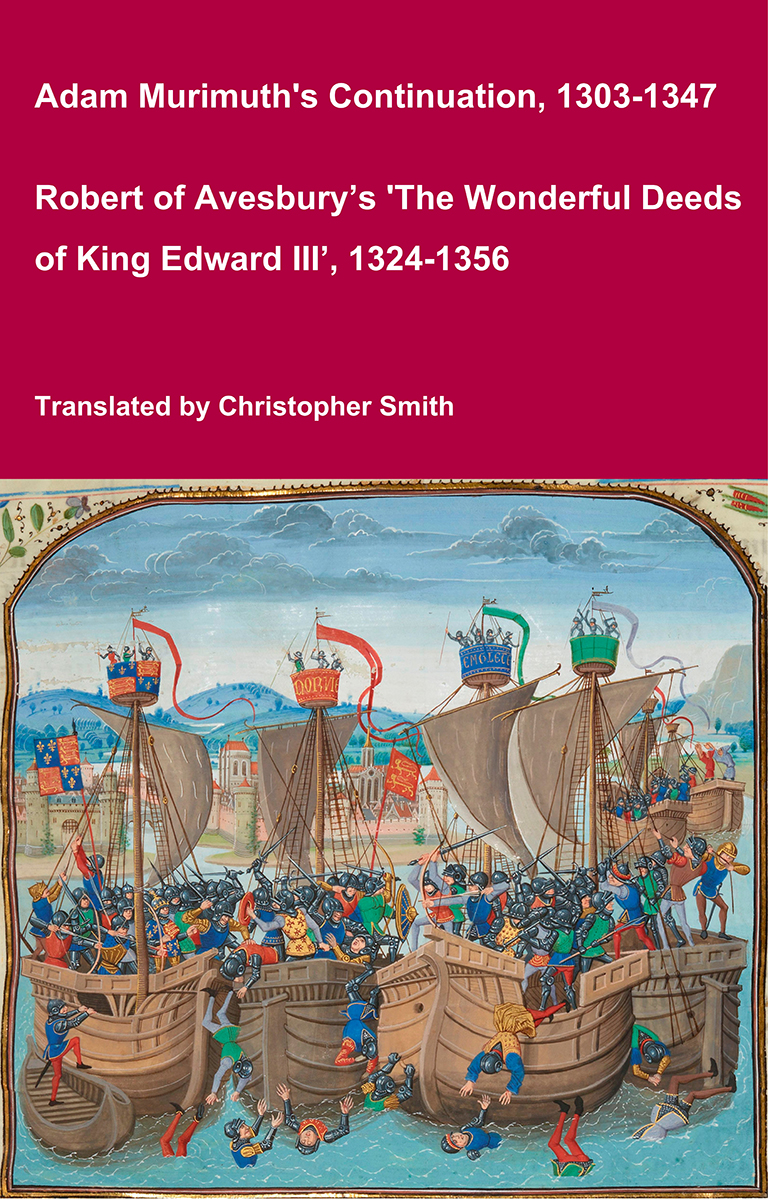
Adam Murimuth's Continuation and Robert of Avesbury’s 'The Wonderful Deeds of King Edward III'
This volume brings together two of the most important contemporary chronicles for the reign of Edward III and the opening phases of the Hundred Years’ War. Written in Latin by English clerical observers, these texts provide a vivid and authoritative window into the political, diplomatic, and military history of fourteenth-century England and its continental ambitions. Adam Murimuth Continuatio's Chronicarum continues an earlier chronicle into the mid-fourteenth century, offering concise but valuable notices on royal policy, foreign relations, and ecclesiastical affairs. Its annalistic structure makes it especially useful for establishing chronology and tracing the development of events year by year. Complementing it, Robert of Avesbury’s De gestis mirabilibus regis Edwardi tertii is a rich documentary chronicle preserving letters, treaties, and official records alongside narrative passages. It is an indispensable source for understanding Edward III’s claim to the French crown, the conduct of war, and the mechanisms of medieval diplomacy. Together, these works offer scholars, students, and enthusiasts a reliable and unembellished account of a transformative period in English and European history. Essential for anyone interested in medieval chronicles, the Hundred Years’ War, or the reign of Edward III.
Available at Amazon in eBook and Paperback format.
From 1265 to 1269 Bishop Robert of Holy Island, a Benedictine monk, served as sacrist at Durham.
On 24th September 1274 Bishop Robert of Holy Island was elected Bishop of Durham.
On 9th December 1274 Bishop Robert of Holy Island was consecrated Bishop of Durham.
 Chronicle of Walter of Guisborough. In the year of our Lord 1279, Walter Giffard [aged 54],1 Archbishop of York, died on the 22nd of April. He was succeeded by William de Wickwane2. In the second year of his archiepiscopate, wishing to visit his suffragan Robert of Holy Island, Bishop of Durham, and the chapter of Durham, he was repelled for they shut the city gates against him. Nevertheless, taking up his pontifical insignia, he preached in the city square, choosing as his sermon theme: "I have come down to see Judah and Jerusalem." After delivering his sermon, he pronounced a dreadful sentence of excommunication upon those who opposed him and placed the city under ecclesiastical interdict. But they treated all of this lightly, relying on a constitution of Pope Innocent IV concerning censuses and Roman exactions, and they appealed, claiming that he should not be admitted unless he had first visited his own chapter and diocese, which he had not done. For that constitution states: "We decree that any archbishop who wishes to visit his province must first take care to visit the chapter, city, and diocese of his own church." A year later, with the Bishop of Durham now dead, the archbishop returned again at the same time of year, around the [24th June 1280], intending another visitation. There, he suffered even greater injury than before, and after renewing the same dreadful sentence, he departed. From that time on, a lawsuit ensued in the Roman Curia at enormous expense.
Anno Domini MCCLXXIX obiit Walterus Giffard Eborum archiepiscopus X kalendas Maii. Cui successit Willelmus Wychewang. Hic in anno archiepiscopatus sui secundo suffraganeum suum Robertum de Insula Dunolmensem episcopum et capitulum Dunolmense visitare volens, passus est ibidem repulsam, clauserunt enim portas civitatis contra eum; ipse vero pontificali accepto prædicavit ibidem in platea civitatis, et assumpto themate, Descendi ut viderem Judæam et Jerusalem, et facto sermone in contradictores The bishopric sibi sententiam excommunicationis terribilem laid under fulminavit et locum eundem ecclesiastico supposuit interdicto. Ipsi vero parvipendebant omnia; fundaverant enim se super constitutionem Innocentii quarti de censibus et exactione Romana, et appellaverant, dicentes eum admitti non debere nisi proprium capitulum et dioecesim prius visitasset, quod non fecit. Dicit enim constitutio illa sic: Statuimus ut quilibet archiepiscopus, suam volens visitare provinciam, prius ecclesiæ suæ capitulum et civitatem ac dioecesim visitare procuret. Anno autem revoluto, et mortuo Dunolmensi episcopo, iterato et eodem tempore anni, scilicet circa festum Sancti Johannis Baptistæ, ibidem causa visitationis adveniens, majorem quam prius passus est injuriam, et renovata terribili sententia recessit et abiit: et extunc in Romana curia immensis sumptibus litigabant.
Note 1. The date of this archbishops death is assigned by Godwin to the 25th of April.
Note 2. MSS. Coll. Arm, and Cott. Tib. William Wickwane, Chancellor of York, was elected June 22, 1279, and consecrated at Rome on the 19th of September following.
On 7th June 1283 Bishop Robert of Holy Island died at Bishop Middleham,County Durham. He was buried in the CHapter House of Durham Cathedral [Map] on the 10th June 1283.
Annals of Dunstable. Likewise, the bishop of the church of Durham [Bishop Robert of Holy Island], who was a monk, died [7th June 1283]; and Anthony Bek [aged 38], who was then the most renowned clerk of the lord king, succeeded him.
Item episcopus Dunelmensis ecclesiæ obiit, qui fuit monachus; et successit ei Antonius Bech, qui fuit clericus domini regis tunc nominatissimus.