

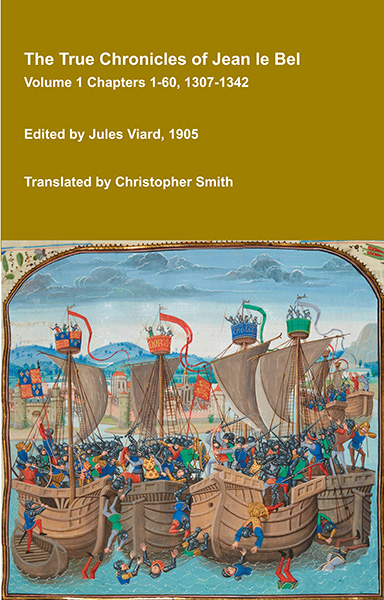
The True Chronicles of Jean le Bel Volume 1 Chapters 1-60 1307-1342
The True Chronicles of Jean le Bel offer one of the most vivid and immediate accounts of 14th-century Europe, written by a knight who lived through the events he describes, and experienced some of them first hand. Covering the early decades of the Hundred Years’ War, this remarkable chronicle follows the campaigns of Edward III of England, the politics of France and the Low Countries, and the shifting alliances that shaped medieval warfare. Unlike later historians, Jean le Bel writes with a strong sense of eyewitness authenticity, drawing on personal experience and the testimony of fellow soldiers. His narrative captures not only battles and sieges, but also the realities of military life, diplomacy, and the ideals of chivalry that governed noble society. A key source for Jean Froissart, Le Bel’s chronicle stands on its own as a compelling and insightful work, at once historical record and literary achievement. This translation builds on the 1905 edition published in French by Jules Viard, adding extensive translations from other sources Rymer's Fœdera, the Chronicles of Adam Murimuth, William Nangis, Walter of Guisborough, a Bourgeois of Valenciennes, Geoffrey le Baker of Swinbroke and Richard Lescot to enrich the original text and Viard's notes.
Available at Amazon in eBook and Paperback format.
Paternal Family Tree: Shute aka Barrington
St John the Baptist's Church, Mongewell [Map]Church Conservation Trusr Guidebook.
HISTORY
In Domesday Book of 1086 Mongewell ('Munda's stream or well') was held by Roger de Lacy. In the |5th century the Rede family had considerable possessions here and in the |9th century the village was owned by The Hon. Shute Barrington, Bishop successively of Llandaff, Salisbury and Durham, who lived at Mongewell House. Barrington is said to have greatly improved the lot of the poor of the parish and 'raised them to a state of comparative independence'. It is claimed that he started the co-operative movement here and opened a shop in the parish. The bishop was buried under the font, then located at the west end of the nave by the south door. A later owner was Uvedale Price, notable apostle of the 'Picturesque'. His other seat was at Foxley, near Hereford, where he built the remarkable church of St Mary the Virgin at Yazor in 1843, also now in the care of The Churches Conservation Trust.
The landscaped garden, in which the church became a feature, still partly survives. Barrington's house was rebuilt in 1890-91 and in 1953 Carmel College, founded by Rabbi Dr Kopul Rosen in 1948, moved here. Carmel College closed in 1997 and the estate was subsequently sold. Mongewell House, together with the former school buildings, is likely to revert to residential use.
Having become derelict and disused with no congregation to support it, Mongewell church was vested in The Churches Conservation Trust in 1985. A short walk northwards along the River Thames leads to Newnham Murren church, whilst across the river lies St Peter's Church, Wallingford, both also in the care of the Trust.
DESCRIPTION
The church is of 12th century date. When first built it consisted of a nave and chancel constructed in flint and stone: Norman features survive in the chancel walls, the reset corbels on either side of the chancel arch and the windows on the north and south sides. The reconstructed wooden roof dates from the 14th century.
In 1791 Shute Barrington partly rebuilt the church in the Gothick style, adding a western apse, an unusual polygonal turret in brick (which was originally rendered) and a gallery for the use of his family: the architect may have been James Wyatt. The tower was formerly surmounted by a lead-covered cupola and its door, protected by a porch. In 1880 Joseph Morris and Spencer Slingsby Stallwood restored the chancel in neo-Norman style, adding the zigzag decoration. Most of the fittings, including the font and the fine wrought iron chandelier, belong to this restoration. In 1888 the now roofless vestry was added to the north side of the nave.
In the early years of the 20th century the church gradually became derelict and assumed the appearance of a romantic ruin. Some repairs were undertaken in 1915 and 1954. In the late 1940s the nave roof collapsed, so in 1954 the architect Hugh Vaux had the chancel arch blocked, with a door inserted in it to provide access to the chancel, which continued to be used for occasional services. The font and several of the monuments, formerly in the nave, were moved into the chancel at this time.
The north wall of the chancel has monuments to Edmund Madock (1692) and his wife and to a reclining John Sanders, wearing a turban and holding a book. On the south wall is the monument to Bishop Shute Barrington and another to Jane Barrington, his mother. Other monuments are to the Durrell family — Thomas Durrell, who died in 1879, was a rector of Mongewell — and to John and Gertrude Fraser (1887). The Frasers gave the stained glass in the little east window with the figure of Christ which has, unfortunately, suffered some damage over the years.
There was formerly a clock on the tower and a single bell, 16 inches (0.43m) in diameter and hung in an oak frame. The bell was cast at the Gloucester foundry and bore the inscription "COME AWAY MAKE NO DELAY 1760".
Unfortunately this bell and the clock seem to have disappeared shortly after the Second World War. An inventory of the church made in 1553 lists two bells.
The stone base of the pulpit, dating to the 1880 restoration, survives at the east end of the nave.
Repairs to the church were carried out in 1915, 1954 and since 1985 by The Churches Conservation Trust under the supervision of Penelope Adamson and, latterly, by lan Stewart.
On 23rd June 1713 [his father] John Shute aka Barrington 1st Viscount Barrington [aged 35] and [his mother] Anne Daines Viscountess Barrington [aged 23] were married.
On 26th May 1734 Bishop Shute Barrington was born to John Shute aka Barrington 1st Viscount Barrington [aged 56] and Anne Daines Viscountess Barrington [aged 44].
On 14th December 1734 [his father] John Shute aka Barrington 1st Viscount Barrington [aged 56] died. His son [his brother] William [aged 17] succeeded 2nd Viscount Barrington of Ardglass in County Down, 2nd Viscount Barrington of Ardglass in County Down.
On 2nd February 1761 Bishop Shute Barrington [aged 26] and Diana Beauclerk [aged 15] were married. She the daughter of Charles Beauclerk 2nd Duke St Albans and Lucy Werden Duchess St Albans.
On 28th March 1766 [his wife] Diana Beauclerk [aged 20] died in childbirth. The child was stillborn.

On 1st October 1769 Bishop Shute Barrington [aged 35] was consecrated as Bishop of Llandaff at Lambeth Palace [Map] by Archbishop Frederick Cornwallis [aged 56].
On 14th August 1782 Bishop Shute Barrington [aged 48] was elected Bishop of Salisbury.
On 27th August 1782 Bishop Shute Barrington [aged 48] was translated to Bishop of Salisbury upon the confirmation of the election at St Mary-le-Bow Church, Cheapside [Map].
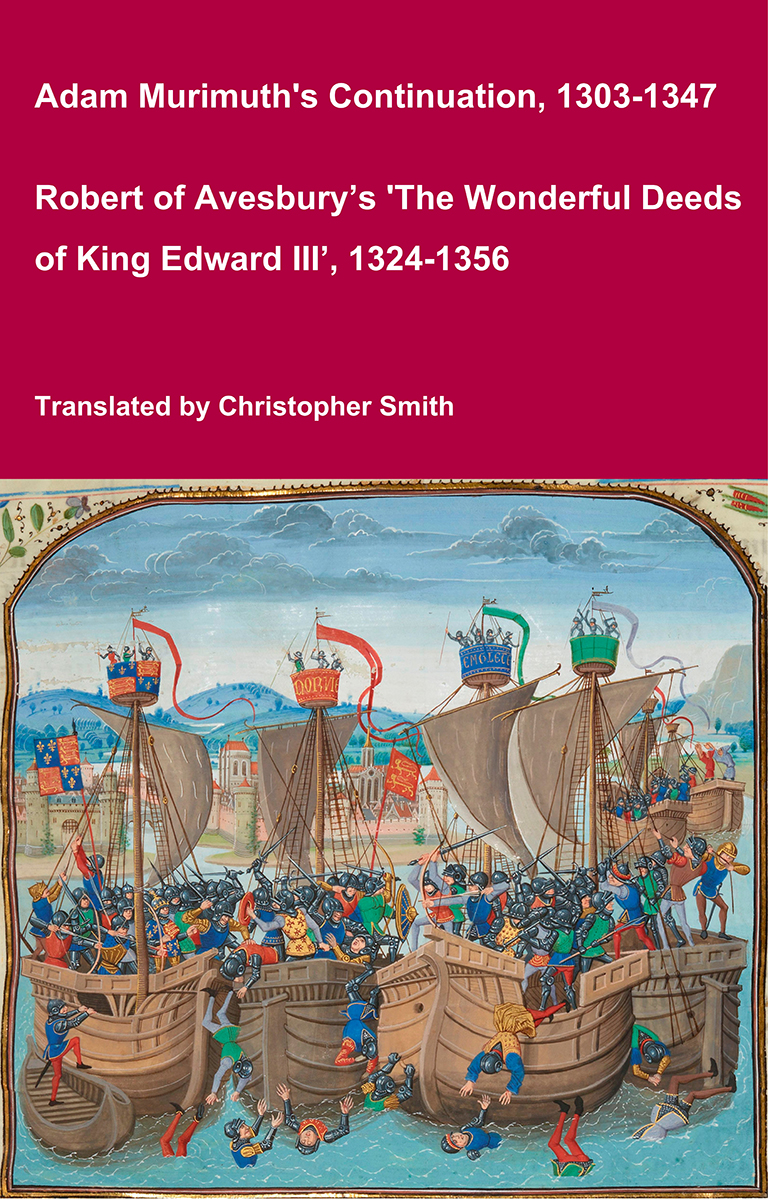
Adam Murimuth's Continuation and Robert of Avesbury’s 'The Wonderful Deeds of King Edward III'
This volume brings together two of the most important contemporary chronicles for the reign of Edward III and the opening phases of the Hundred Years’ War. Written in Latin by English clerical observers, these texts provide a vivid and authoritative window into the political, diplomatic, and military history of fourteenth-century England and its continental ambitions. Adam Murimuth Continuatio's Chronicarum continues an earlier chronicle into the mid-fourteenth century, offering concise but valuable notices on royal policy, foreign relations, and ecclesiastical affairs. Its annalistic structure makes it especially useful for establishing chronology and tracing the development of events year by year. Complementing it, Robert of Avesbury’s De gestis mirabilibus regis Edwardi tertii is a rich documentary chronicle preserving letters, treaties, and official records alongside narrative passages. It is an indispensable source for understanding Edward III’s claim to the French crown, the conduct of war, and the mechanisms of medieval diplomacy. Together, these works offer scholars, students, and enthusiasts a reliable and unembellished account of a transformative period in English and European history. Essential for anyone interested in medieval chronicles, the Hundred Years’ War, or the reign of Edward III.
Available at Amazon in eBook and Paperback format.
On 8th February 1783 [his mother] Anne Daines Viscountess Barrington [aged 93] died.

Around 1787 George Romney [aged 52]. Portrait of Bishop Shute Barrington [aged 52].
On 25th June 1791 Bishop Shute Barrington [aged 57] was elected Bishop of Durham.
On 1st September 1793 [his brother] William Wildman Barrington 2nd Viscount Barrington [aged 76] died. His nephew William [aged 32] succeeded 3rd Viscount Barrington of Ardglass in County Down, 3rd Viscount Barrington of Ardglass in County Down.
On 14th March 1800 [his brother] Daines Barrington [aged 73] died.

1805. John Opie [aged 43]. Portrait of Bishop Shute Barrington [aged 70].

1810 to 1811. William Owen [aged 41]. Portrait of Bishop Shute Barrington [aged 75].

In 1817. Thomas Lawrence [aged 47]. Portrait of Bishop Shute Barrington [aged 82].
On 25th March 1826 Bishop Shute Barrington [aged 91] died in Soho. He was buried in St John the Baptist's Church, Mongewell Park, Wallingford.
1833. Durham Cathedral [Map]. Monument to Bishop Shute Barrington sculpted by Francis Leggatt Chantrey [aged 51].


Great x 1 Grandfather: Francis Shute
GrandFather: Benjamin Shute
GrandFather: William Daines
Mother: Anne Daines Viscountess Barrington