

Abbot John Whethamstede’s Chronicle of the Abbey of St Albans
Abbot John Whethamstede's Register aka Chronicle of his second term at the Abbey of St Albans, 1451-1461, is a remarkable text that describes his first-hand experience of the beginning of the Wars of the Roses including the First and Second Battles of St Albans, 1455 and 1461, respectively, their cause, and their consequences, not least on the Abbey itself. His text also includes Loveday, Blore Heath, Northampton, the Act of Accord, Wakefield, and Towton, and ends with the Coronation of King Edward IV. In addition to the events of the Wars of the Roses, Abbot John, or his scribes who wrote the Chronicle, include details in the life of the Abbey such as charters, letters, land exchanges, visits by legates, and disputes, which provide a rich insight into the day-to-day life of the Abbey, and the challenges faced by its Abbot.
Available at Amazon in eBook and Paperback format.
Paternal Family Tree: Cobham
Around 1268 Bishop Thomas Cobham was born to [his father] John Cobham [aged 27] and [his mother] Joan Septvans.
Before July 1285 [his brother] Henry Cobham 1st Baron Cobham [aged 25] and [his sister-in-law] Maud Moreville [aged 21] were married.
In 1298 [his mother] Joan Septvans died.
In March 1300 [his father] John Cobham [aged 59] died at Cobham, Kent.
On 8th January 1313 [his brother] Henry Cobham 1st Baron Cobham [aged 53] was created 1st Baron Cobham.
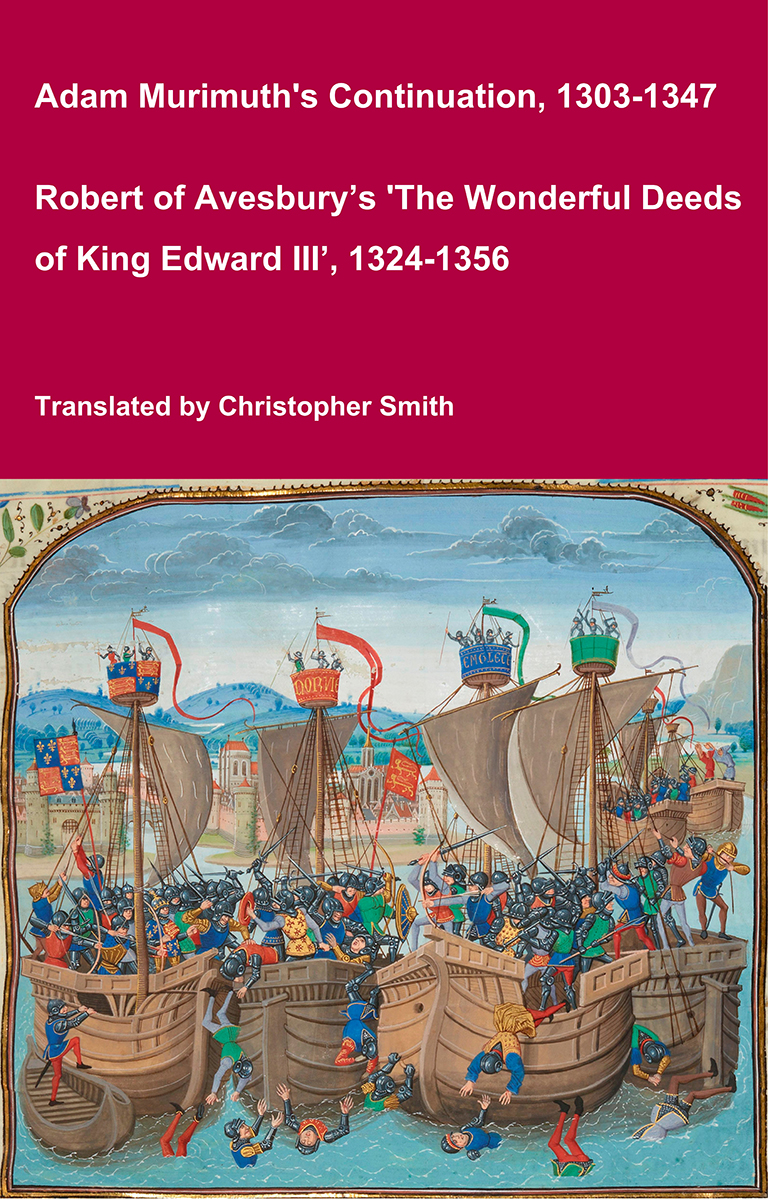 Adam Murimuth Continuation. In this year, on the twelfth day of the month of May, in the year of our Lord 1313, Archbishop Robert of Winchelsea [deceased] died, and Master Thomas de Cobham [aged 45], who was then in France on affairs of the kingdom, was unanimously elected in his place. Nevertheless, the king asked Pope Clement that Lord Walter Reynolds, bishop of Worcester, should be transferred to the church of Canterbury. This was done on the first day of October in the following year, namely in the year of our Lord 1313. Immediately afterwards he gave the bishopric of Worcester to Lord Walter de Maidstone, a man indeed widely spoken against in England for dishonourable conduct and life, and secretly familiar with the pope in an unseemly way. He remained in that bishopric only a short time. Later Pope John gave the bishopric of Worcester to the said Master Thomas de Cobham, who, because of the shame of his voluntary rejection from the church of Canterbury, remained for a long time at the Roman Curia, as will appear below.
Hoc anno, XIJ die mensis Maii, anno Domini MCCCXIII, obiit archiepiscopus Robertus de Wynchelse et fuit concorditer electus magister Thomas de Cobham, exsistens in Francia pro regni negotiis. Et tamen rex rogavit papam Clementem pro domino Waltero Reginaldi, episcopo W ygorniensi, ut ipsum transferret ad ecclesiam Cantuariensem; quod et factum fuit primo die Octobris in anno sequenti, scilicet anno Domini MCCCXIII, et statim dedit episcopatum Wygorniensem domino Waltero de Manestone, viro utique diffamato in Anglia de inhonesta conversatione et vita, et papæ ex inhonesta familiaritate secreto, qui modico tempore postmodum in episcopatu duravit Et postes papa Johannes dedit ipsum episcopatum Wygorniensem dicto magistro Thome de Cobham, qui propter verecundiam voluntariæ repulsionis suæ ab ecclesia Cantuariensi diu in Romana curia morabatur, sicut inferius apparebit.
On 31st March 1317 Bishop Thomas Cobham [aged 49] was appointed Bishop of Worcester.
On 22nd May 1317 Bishop Thomas Cobham [aged 49] was consecrated Bishop of Worcester.
On 14th April 1322 Bartholomew Badlesmere 1st Baron Badlesmere [aged 46] was tried by [his brother] Henry Cobham 1st Baron Cobham [aged 62] at Canterbury, Kent [Map].
Sentenced to death Bartholomew Badlesmere 1st Baron Badlesmere was drawn for three miles behind a horse to Blean, Canterbury, where he held property, where he was beheaded. His head was displayed on the Burgh Gate, Canterbury and the rest of his body left hanging at Blean, Canterbury. He was buried at Whitefriars. His nephew Henry Burghesh's [aged 30] lands were also seized. These were restored around 1326.
On 27th August 1327 Bishop Thomas Cobham [aged 59] died.
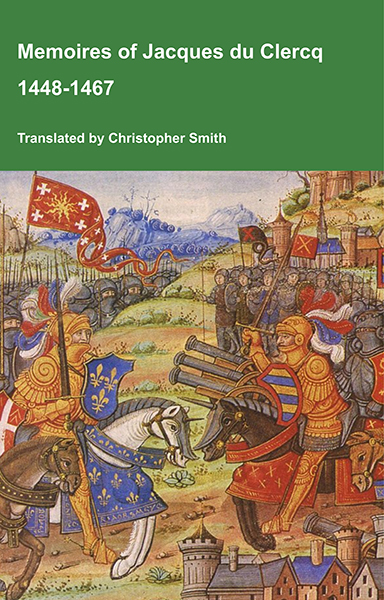
This is a translation of the 'Memoires of Jacques du Clercq', published in 1823 in two volumes, edited by Frederic, Baron de Reissenberg. In his introduction Reissenberg writes: 'Jacques du Clercq tells us that he was born in 1424, and that he was a licentiate in law and a counsellor to Philip the Good, Duke of Burgundy, in the castellany of Douai, Lille, and Orchies. It appears that he established his residence at Arras. In 1446, he married the daughter of Baldwin de la Lacherie, a gentleman who lived in Lille. We read in the fifth book of his Memoirs that his father, also named Jacques du Clercq, had married a lady of the Le Camelin family, from Compiègne. His ancestors, always attached to the counts of Flanders, had constantly served them, whether in their councils or in their armies.' The Memoires cover a period of nineteen years beginning in in 1448, ending in in 1467. It appears that the author had intended to extend the Memoirs beyond that date; no doubt illness or death prevented him from carrying out this plan. As Reissenberg writes the 'merit of this work lies in the simplicity of its narrative, in its tone of good faith, and in a certain air of frankness which naturally wins the reader’s confidence.' Du Clercq ranges from events of national and international importance, including events of the Wars of the Roses in England, to simple, everyday local events such as marriages, robberies, murders, trials and deaths, including that of his own father in Book 5; one of his last entries.
Available at Amazon in eBook and Paperback format.
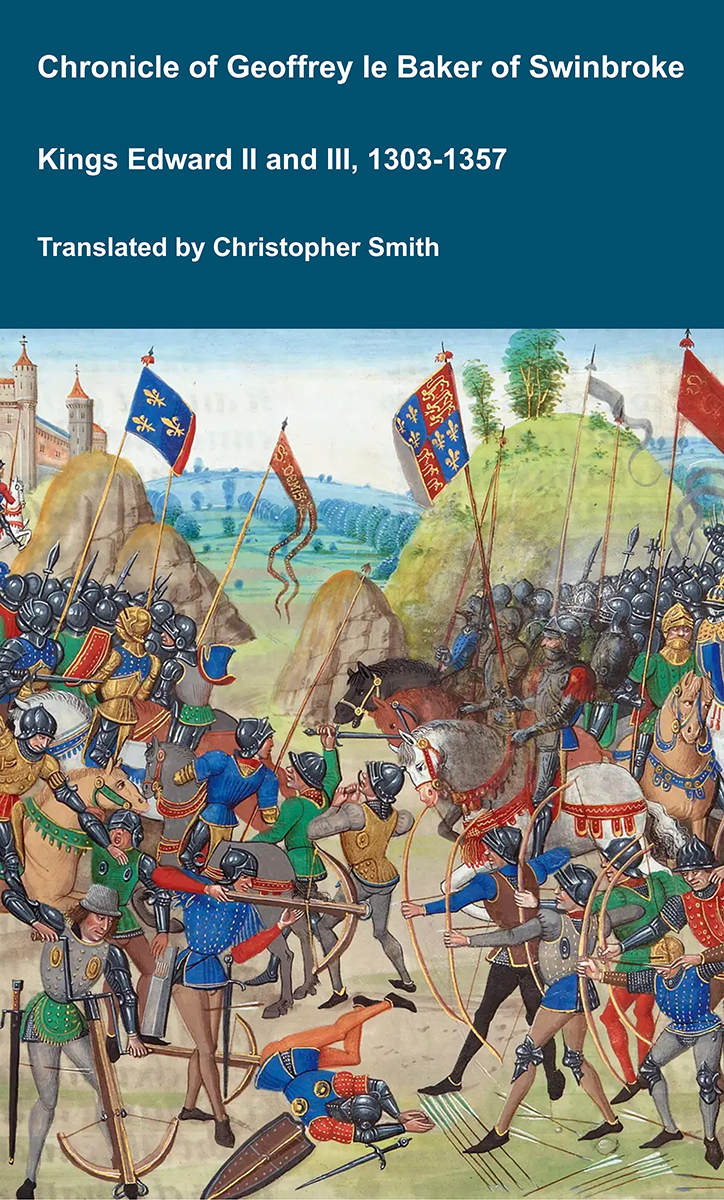 Chronicle of Geoffrey le Baker of Swinbroke. In this year, in the month of November, Walter,1 Archbishop of Canterbury, died, and he was succeeded by Master Simon de Mepham, a doctor of theology, through a canonical election. In this same year, Master Thomas de Cobham2, Bishop of Worcester, also died; and he was succeeded by papal provision by Adam Orleton, formerly Bishop of Hereford, who had gone to the papal court on behalf of his own affairs and those of the king's mother. Likewise, the pope provided the Church of Hereford with Master Thomas de Charlton, who was then present at the court.
Hoc anno, mense Novembris, obiit Walterus Cantuariensis archiepiscopus, cui successit per eleccionem canonicam magister Symon de Mepham, doctor in theologia. Hoc anno moriebatur magister Thomas de Cobham episcopus Wigorniensis; cui successit per provisionem pape Adam Torltoine, prius episcopus Herefordensis, ad curiam pro negociis propriis et matris regis profectus. Item papa providit ecclesie Herefordensi de magistro Thoma de Charletone, tunc in curia presente.
Note 1. Archbishop Walter Reynolds died on 16th November 1327.
Note 2. Thomas de Cobham, Bishop of Worcester, died on 27th August 1327.
[his father] John Cobham and [his mother] Joan Septvans were married.
GrandFather: Robert Septvans
Mother: Joan Septvans
